"It is all down to attention to detail and everything we do is based around that."
Gary Billingham is demonstrating how the 28 pieces which make up an Ettinger wallet are cut from leather using a hydraulic press by the small team at one of Walsall's last remaining leather goods factories. The edges of the pieces are thinned down so they are ready to be turned, glued and stitched together by hand.
Billingham has been at the factory near Birmingham since the 1980s, when "there were three pages in the Yellow Pages" business directory listing leather factories in the West Midlands town. "They were everywhere. It has gone from that to about five factories. It is more like a cottage industry."
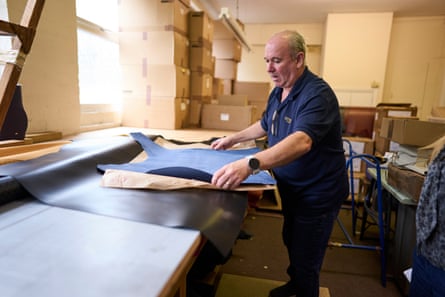
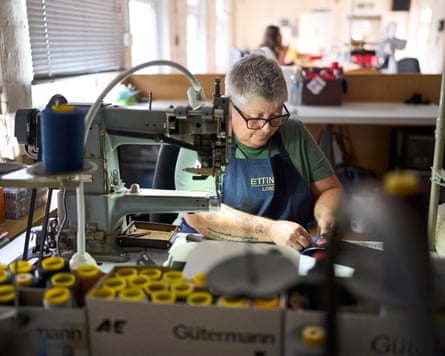
About 20 people, mostly women, work carefully and precisely in Ettinger's factory – a site of leather goods production since the 1890s – with a handful more doing work from home.
Robert Ettinger, the company's chief executive, says the vast majority of its manufacturing process has to be done by hand. "You can't bring in robots."
He still owns the British brand founded in 1934 by his father, who turned to selling and manufacturing leather goods in the UK after fleeing Nazi Germany via Paris and a stint in the film industry.
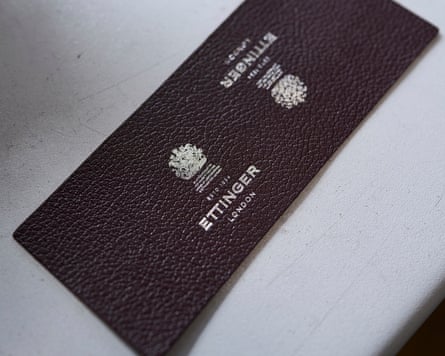
Ettinger began making wallets and sourcing leather items, and today the company supplies a range of luxury goods to wealthy customers, including King Charles and Queen Camilla whose royal warrants they hold.
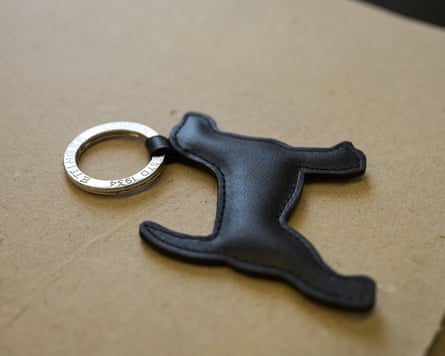
The company's bestseller is still a wallet, but they also sell leather pill containers, cigar cases, picture frames and various accoutrements for dog owners, from treat cases to dog-waste bag holders, all of which can be personalised with initials.
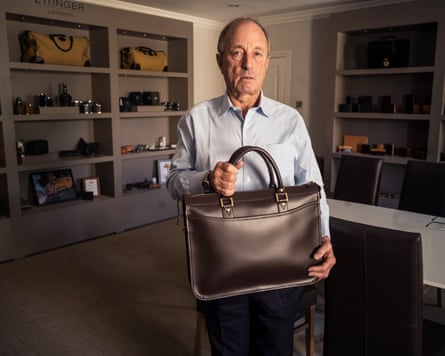
The brand sits in a niche between the big label luxury and high street with a British hand-crafted leather tote bag for just under £800 compared with more than £2,000 charged by a big swinger such as Louis Vuitton.
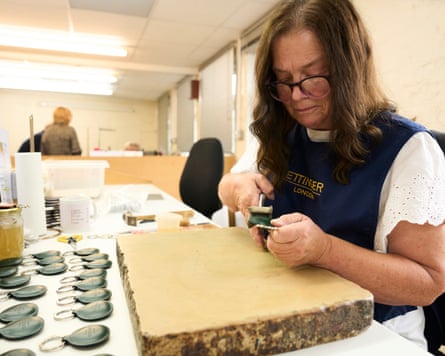
An array of machines resembling pastry-cutters are used to punch out leather shapes that are then glued by hand with a brush to build up each item with trims and linings.
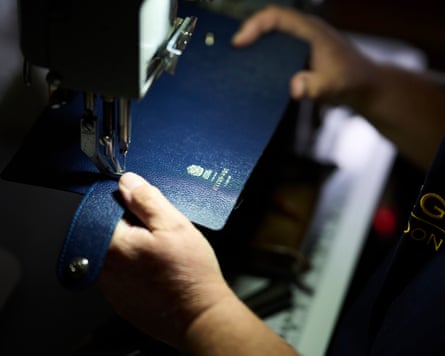
The tiny seams around the leather edges are thinned down with a shaving machine, known as a skiver, and turned inward before being stitched with a sewing machine. Each piece is then carefully checked and trimmed using a scalpel and sharp scissors before being polished and wrapped in tissue paper.
Gerry Ettinger, the founder, began by using an array of manufacturers before buying his original factory at the heart of London's leather-working trade in Clerkenwell near the Smithfield meat market in the 1950s.
Robert Ettinger says: "When I was a kid, there were dozens and dozens of small factories, making leather goods, and they all specialised. One made suitcases, and one made handbags, and one made wallets."
As the area gentrified in the 1990s, the Ettingers decided to move and bought out one of their suppliers, James Homer in Walsall, established in 1890. It was then mostly making corporate promotional leather goods. Staff were trained up and new machinery brought in to make the high standard of goods expected by Ettinger's new international clientele led by the Japanese.
Walsall has been a centre of leather-working from the middle ages. It was focused on saddle-making with more than 100 firms operating in the town by the end of the 19th century.
As the use of horses in everyday life declined, the factories began expanding into making other leather goods, ranging from bicycle saddles, car upholstery and furnishings to bags, gloves and purses.
The industry thrived during the first world war when there was high demand for military saddle wear but began to suffer in the 1950s as it faced competition from abroad and from human-made alternatives to leather.
Still, by 1970 there were about 50 leather goods manufacturers in Walsall, and the town produced around half of the British-made fancy leather goods, according to the Wolverhampton Heritage and History Society.
Tracy, expertly glueing and building Ettinger's elaborate cigar cases before they are sewn, has been at the company for 15 years and working in the leather industry since she left school 40 years ago.
"When we were that age it was all leather work. You could walk out of one job and into another on the same day," she says.
That history is recognised in street names and the local Saddlers Centre shopping mall and there is a leather skills training centre which offers courses in bridle making.
Launer, whose customers included the late Queen Elizabeth II, J&E Sedgwick, the bridle maker, and small leather goods firm E Hulme, founded in the 1920s, continue to make leather goods near Ettinger's factory. However, all employ only small numbers of people and the local industry is a shadow of its former self.
Even Walsall's leather museum, housed in a former factory that dates back to the 1880s, is now closed amid disputed plans to move it to a modern city centre site.
That reflects a rapid decline in the leather goods manufacturing industry across the UK with just 7,000 people employed in it today compared with 37,000 30 years ago.
Ettinger itself had to cut its staff numbers by about seven after the Covid pandemic hit trade.
Robert Ettinger says he never really considered shifting production overseas, despite most of his customers coming from outside the UK.
"We might have made more profit, but then we would also have much more competition because when you've got 50 companies bringing in a purse from the far east, then it's all about price."
He says the gambit is now paying off as a younger generation increasingly appreciates British craft, with online sales up 30% on last year and UK sales up by a fifth, with shoppers aged from their early 20s.
"A lot of younger people are now thinking that they want something that will last, that won't go out of fashion in three months' time. Yes, it costs more, but it lasts for 15 or 20 years, and can be repaired. I've just repaired my wallet which is 17 years old.
"Our products are affordable luxury. A purse or wallet for £200 or £300, it's the price of some trainers and they're not made in the UK. So it's not out of reach of most people."
Still, expanding production in the UK might be tricky. Billingham says it is hard to find and train new staff. Even those who attend Walsall's Leather Skills Centre are more likely to go into making car upholstery or saddles.
"We are all getting old now, that's a problem, we are from 40s to 60s. If you find someone working for somebody else you take them," says Billingham.
"To take five to 10 people on would be great but the reality is they are not there."
Robert Ettinger says the UK should look at how young people are trained into the trade in mainland Europe, where he was sent by his father to serve an apprenticeship.
"They spend a few years really learning a trade, everything from making leather goods, to being a chimney sweep, or a butcher, or baker. When you pass all the apprenticeship exams, you then go on to do more and become a master, a Meister. We don't have that here. So, it's harder for us to take on younger people."
He is optimistic things could change. "People might go into jobs which they don't really enjoy or get bored of doing, and then they join us, and, you know, it's like a family in our factory."