
The pedestrianisation of Oxford Street felt like the dream that could never come true, but this morning the first phase of the mayor’s transformation project began. Anna Moloney rushed to Selfridges to soak up the first day atmosphere
It’s only day one of Oxford Street’s pedestrianisation, but its place as a pivotal moment in the history of the street is already being memorialised. In the middle of the newly cordoned-off stretch, I stop to read a series of museum exhibit-style boards, narrating the history of the road from the Romans to today: “Long before Oxford Street became London’s busiest shopping street, and ahead of its transformation into a traffic-free space,” the chronicle begins – harking back, then, to all of yesterday.
It’s a confident launch for the long-mooted and highly contested project (possibly rushed through to give Sadiq Khan his legacy project), but if the mood of shoppers on the street is anything to go by, it’s already going down as a success.
A celebratory atmosphere
Indeed, as I proceed past the first batch of neon-green bollards signalling the start of the traffic-free zone, the mood is decisively celebratory. “You can walk in the road!” one balding Brit exclaims, springing from the pavement to the tarmac. Elsewhere, despite the drizzle, almost everyone is snapping pictures, while a number even stop to pose in front of the bollards. Two women, wanting to document the moment together, interrupt a security worker to take their photograph, while further up I spot a row of six men, hands soberly clasped in front of them, poised for their picture of this momentous day.
Pepe Velo, a wine importer for Spain who I interrupt taking a picture of the bollards on his way to a meeting, says he thinks it’s a great initiative. “It’s extremely difficult with the amount of people to go shopping with just two pavements, my wife and I always end up travelling up the middle,” he tells me, referring to the islands that stand between some of the traffic on the street. He compares it favourably to Las Ramblas, though adds that the weather is a crucial differentiator.
Stay in the know
Three daily briefings with the key market moves and top business and political stories.
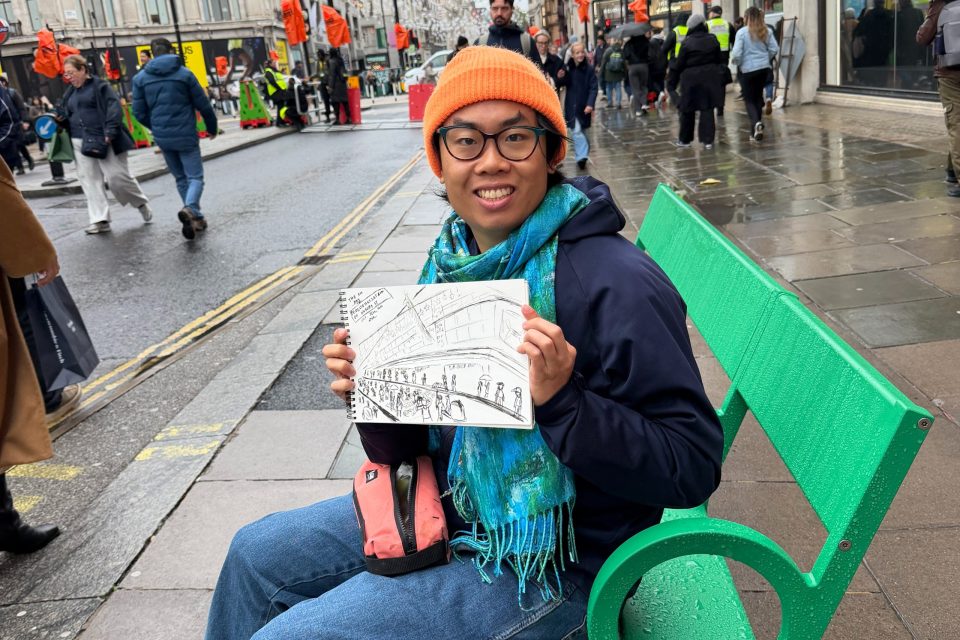
SUBSCRIBE HEREFurther up the street I come by Daniel Te, a young artist perched on one of the street’s shiny new green benches, sketching the car-free scene ahead of him. “I love a good pedestrianised street, it’s so crazy to see no cars here,” he says, adding that he would definitely be more likely to come shopping on Oxford Street now. “I do find myself intuitively staying on the pavements though,” he laughs, and indeed it is notable as I stroll along that the crowding is still concentrated at the edges, presumably out of habit as everyone gets used to the novelty of walking slap bang down the middle.
Aside from the biggie – no traffic – the transformation of the street design-wise is still in its early stages, and no doubt some will be determined to scoff at the opening as a damp squib compared with the sunny, tree-lined scenes promised by the shiny renderings pumped out by the mayor’s office. Indeed, other than the bollards and one central street mural, the street is unchanged in look, with pedestrians currently just welcomed to walk down the still road-marked tarmac. Currently, it’s just the Orchard Street to Great Portland Street stretch marked off (the Selfridges end), though further extensions are in the works, and the current trial period will seek to identify and mitigate potential issues.
The Oxford Street naysayers
Naturally, removing traffic from one of London’s busiest thoroughfares does not come without downsides. When I approach one security woman stationed by the bollards to ask about her role in this pedestrianised utopia, she barks the reply: “We’re doing HMVs”. When I ask what HVMs are, she looks at me like I’m an idiot before a three-word explanation: hostile vehicle mitigation.
Another key job of the security personnel is scolding cyclists. I watch one flag down a Deliveroo driver, who proceeds to dismount his bike, walk a few steps, and promptly get back on again.
Cabbies, too, are not happy about the change. One taxi driver tells me through his window that today, a half-term Monday, should have been the easiest day for the change, yet it was “already carnage” down the side roads. He says he’s keeping his fingers crossed the initiative will be reversed.
A key driver of the project has been to give London’s retailers a shot in the arm by rejuvenating the city’s flagship high street. A worker at the big Boots tells me it’s been a little bit busier today already, though the rain was partially driving more people to shelter inside anyway. A worker at a nearby shoe shop tells me she thinks the surge will come next week, when more people realise the change has happened, but says she’s not excited about it – she doesn’t want it busier before Christmas.
She may then wish to consider a job at one of the many vape or tackier souvenir shops that populate the street, and that Sadiq Khan has expressed a particular distaste for. When I go into one such establishment to ask if they are excited about the change, the manager says not. He says business has been completely dead today, which he attributes to the lack of buses. For the mayor, who has said he wishes to see the loss of Oxford Street’s “dross” shops as a result of the change, that may well be a victory.