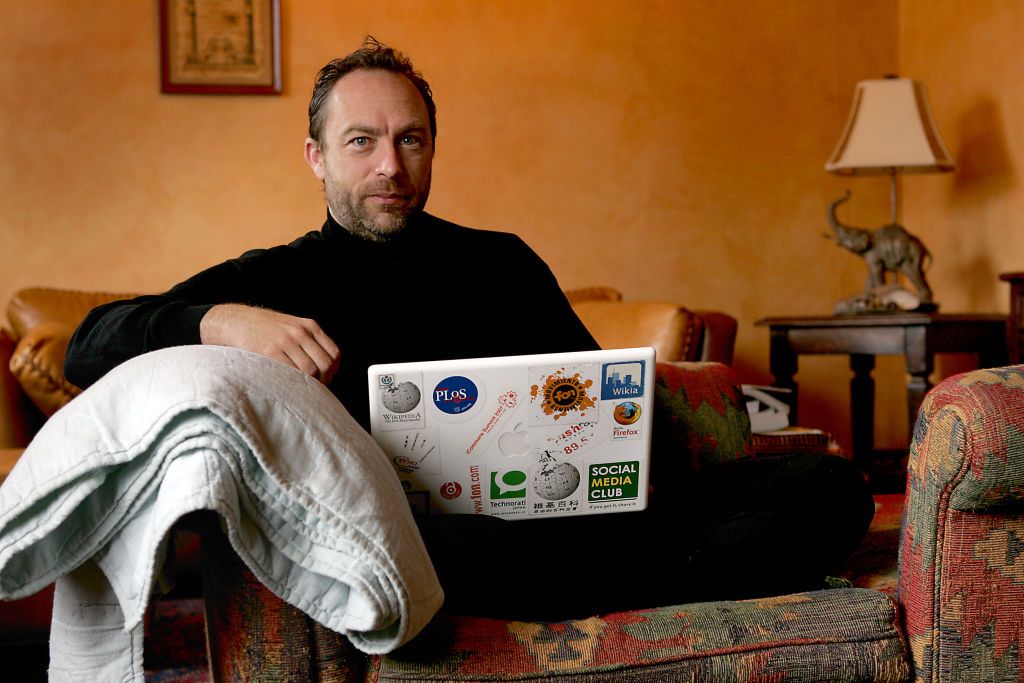
This has been a big year for Jimmy Wales. He turned 60 and his creation, Wikipedia, is celebrating its 25th anniversary. Wales marked the occasion with The Seven Rules of Trust, which his publisher described as “a sweeping reflection on the global crisis of credibility and knowledge”. But amid all the bouquets – recently hailed him as “the last decent tech baron” – there is plenty of barbed wire.
Wikipedia faces big problems, says . It is shedding both readers and volunteer editors and is at the centre of an escalating culture war. Moreover, “AI poses an existential threat”. Wikipedia played a crucial role in training large language models (LLMs), with its vast, free, multilingual dataset. “Now AI's use of that material threatens to suffocate the very source that helped bring it to life.”
Jimmy Wales no longer has an active role at the not-for-profit encyclopaedia. But he sits on the board and remains “the bearded face of Wikipedia”, says . As such, he has borne the full brunt of attacks by critics such as Elon Musk (once a fan) and former White House AI and cryptocurrency tsar David Sacks, who claimed that “Wokepedia” is run by “an army of left-wing activists”.
Start your trial of MoneyWeek today
Get unparalleled financial insight, analysis and expert opinion you can profit from.
Start your trial
Sign up for MoneyWeek’s free twice-daily newsletter.
Join more than 165,000 subscribers and keep yourself informed with latest financial news, insights and expert analysis to help you understand what really matters when it comes to your finances.
Join more than 165,000 subscribers and keep yourself informed with latest financial news, insights and expert analysis to help you understand what really matters when it comes to your finances.
Although describing himself as a “centrist dad” who's “actually quite in favour of business and capitalism and all that”, Jimmy Wales's reputation as a leftie goes back to his decision in 2003 to make Wikipedia a non-profit, which, given its commercial potential, was “either the smartest or the dumbest thing I ever did”.
Certainly, the decision cost Jimmy Wales a fortune. Wikipedia, which he co-founded in 2001, led the “Web 2.0” wave of companies that sprang up after the dotcom bust, says Bloomberg. Wales's direct contemporaries include Peter Thiel, Jeff Bezos, Elon Musk and Larry Page and Sergey Brin. “All of them have had profound influence on our lives,” says . “But only one… has failed to become a billionaire.” Apparently by choice. No wonder Wales gets up the noses of the new tech right. “He's ordinary, approachable, with none of the bombast of some of his… peers.”
Jimmy Donal Wales, as his own Wikipedia entry states, was born in Huntsville, Alabama, in 1966, where he was educated at home by his mother. After majoring in finance, Wales became an options trader in Chicago, becoming quietly “addicted” to the internet in his spare time. He lasted a year before, inspired by Netscape's 1995 IPO, he left to become an entrepreneur. He moved to London in 2012 when he married Kate Garvey, a former aide to Tony Blair.
Wales' first internet venture, Bomis – a “guy-oriented search engine” – provided the funds for his greater passion: an online encyclopaedia. The prototype Nupedia had such an elaborate editing and fact-checking process that after five months it had approved just one article. To speed things up, they launched a crowd-sourced version. The timing – during an explosion of search engines desperate for content – was sweet, and Wikipedia boomed, despite many early controversies about bias and accuracy. The site has since “become part of the plumbing of the internet”, says .
End of an era for Jimmy Wales and Wikipedia
Since stepping back from daily operations, Wales has launched several new ventures, including Fandom, an advertising-funded entertainment site, and WikiTribune, a short-lived, experimental news site. But Wikipedia is his great contribution to the world, as Richard Cooke makes clear in The Last Best Place on the Internet, which paints “an affectionate portrait of the many oddballs and misfits who have made the site what it is”, says The Economist. “Wikipedia is the largest encyclopaedia ever written by humans – and it is likely to hold that title for ever.” Any future rival is sure to be made with the help of AI.
This article was first published in MoneyWeek's magazine. Enjoy exclusive early access to news, opinion and analysis from our team of financial experts with a MoneyWeek subscription.