"It's the kind of heat that makes you feel like you're being dehydrated, like your skin is drying out," said Lucas Benitez, after harvesting watermelons with his sons and wife this summer. "The heat that we had 30 years ago is not nearly the heat that we have today."
This summer was the hottest on record in the US, and most workers in fields, greenhouses and unconditioned indoor facilities still do not have heat protections on the job, putting their health at risk as the climate crisis is expected to make extreme heat more frequent and intense.
Benitez began working in tomato fields in Immokalee, Florida when he was just 16, and in the early 1990s went on to help found the Coalition of Immokalee Workers (CIW), named after the major tomato growing region in south-west Florida. Today, CIW's fair food program has some of the strongest heat protections for workers in the country, and its approach is being emulated by other groups – in the US and beyond – as federal, state and local efforts to protect people from extreme heat stall.
The program's protections were hard won after years of boycotts, hunger strikes and protests against food corporations. The model, described as "market-based enforcement" by academics, works by targeting the reputation of the known brand-name of a company – say a fast-food retailer – to improve conditions rather than smaller entities in the supply chain.
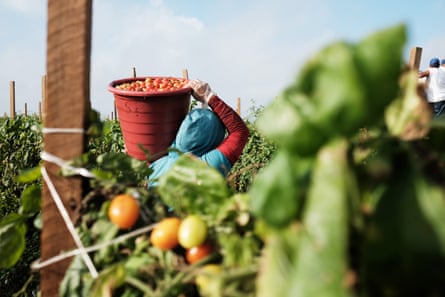
Retailers agree to pay a small premium to buy from farms that comply with a worker-protection code of conduct. Farms that violate the code can lose their preferred status, giving workers a powerful way to enforce protections without relying on government regulators.
Miami-based WeCount is among the labor groups that are now adopting the fair food program model for other hot, low-wage jobs. Worker organizations in dairy production in Vermont, construction in Minnesota, sugarcane production in India, and banana production in Ecuador have created similar human rights initiatives.
Florida produces about 70% of all indoor plants sold in the US. The workers who grow these plants were exposed to temperatures over 100F (37.8C) this summer and reported heat-related symptoms and dehydration, said Oscar Londoño, the co-executive director of WeCount, a human rights organization led by immigrant workers and families in south Florida.
"Workers feel like they're on the verge of fainting," Londoño said. "We have, unfortunately, far too many stories of heatstroke."
Extreme heat put other workers in danger this summer too. In September, 24-year-old Obed Azahel Hernandez Perez died from extreme heat exposure while harvesting sweet potatoes in Chickasaw county, Mississippi. And, last year, 47-year-old Marco Antonio Hernandez Guevera died after collapsing from the heat on his first day in the field at a tomato farm in Immokalee.
In Texas, hospitals are seeing an increasing number of cases of kidney disease among outdoor workers, which research suggests could be linked to prolonged exposure to extreme heat.
The state-level protection route
For years, WeCount advocated for heat protections for workers at the state level. Despite largely being symbolic (it did not include enforcement or penalty measures), the legislation died in committee every year, Londoño said. In 2021, the organization, along with labor partners across the state, launched the "que calor" campaign, meaning "how hot", with the goal of securing heat protections for workers. Two years later, WeCount set its sights on passing a local ordinance.
Unlike the drafted state legislation, the county bill had strong enforcement in the form of monetary penalties to make sure there was industry-wide compliance, Londoño said. The 19-page local ordinance included provisions when the heat index hit 90F (32.2C) for paid rest breaks, access to clean drinking water, and first aid procedures. In 2023, a five-member committee of Miami-Dade county commissioners voted 4-1 in favor of the ordinance and the full county commission passed the bill unanimously through first reading.
But before the county commission's final vote on the bill, the Florida state legislature blocked the local worker heat protection ordinance with a pre-emptive law banning local efforts to require heat protections for outdoor workers throughout the state. "It was devastating to see the legislature pre-empt commonsense protections," Londoño said. "We believe every worker deserves these protections."
WeCount has also advocated for federal heat protections for workers through proposed Occupational Safety and Health Administration (Osha) standards written under the Biden administration. "Unfortunately it looks like that heat standard is stalled. Workers can't depend on that," Londoño said. Proposed legislation introduced last November by Indiana representative Mark Messmer would block Osha from implementing the heat protections.
Without federal heat standards, many people remain unprotected, said Roy McAllister, director of occupational safety and health at the United Food and Commercial Workers International Union (UFCW), which represents 1.2 million workers. Few slaughterhouses at meatpacking and poultry plants are air-conditioned, and workers are exposed to heat from lack of ventilation, hot steam, meat carcasses, salt tanks, steriliser tanks, and ovens, he said. In warehouses and in grocery store receiving areas, some people work their shifts in areas that are hot, stuffy, and lack adequate air circulation.
"As we just saw, this is the hottest summer on record that we've ever had." McAllister said. "It continues to get hotter every year. We're starting to see more and more people exposed to high temperatures and there's no federal protective measures to keep employers accountable."
A long fight for better conditions
With today's extreme heat, the Coalition of Immokalee Workers decided it was necessary for the tens of thousands of people in their program to have access to electrolytes on participating farms year-round. This summer, the CIW's fair food program added the new requirement to its heat protection standards in a matter of weeks, which already required participating growers to provide shade, cool drinking water, paid rest breaks, heat illness training for workers and supervisors, and the ability for workers to seek medical attention without fear of retaliation.
But to get to this point – with 14 major participating food retailers, including Walmart, McDonald's, Whole Foods and Trader Joe's – workers in the fair food program put pressure on retailers through protests and hunger strikes around the country. Benitez was among a group of Coalition of Immokalee Workers who held a hunger strike outside of Taco Bell's headquarters in Irvine, California, in 2003 in an effort to get the chain to agree to only buy tomatoes from farms that pay their pickers a living wage.
"Taco Bell has a policy that it will not buy food from contractors that mistreat animals," Benitez told the Guardian during his hunger strike in 2003. "All we are asking is that they have the same policy for humans."
At the same time, student-led organizations boycotted Taco Bell over the working conditions of tomato pickers, getting some of their universities to cut ties with the franchise. After three years of boycotts, Taco Bell agreed to the coalition's demands in 2005. Later, the coalition took on McDonald's, which agreed to pay more for tomatoes to increase the wages of pickers in 2007.
WeCount is now in this phase of the strategy with its planting justice program and has set its sights on Costa Farms, one of the world's largest indoor plant growers. The day after Labor Day, WeCount coordinated actions at Costa locations in Florida, South Carolina, and Virginia.
Costa Farms told the Guardian that the company has received requests to join WeCount's planting justice program. "We take the underlying issues seriously, but the WeCount program's core workplace protections are already part of Costa Farms' existing systems and practices, including paid heat-prevention training, a comprehensive heat illness prevention plan, audited payroll and employee-controlled timekeeping systems, complaint-resolution processes and onsite medical support," the company said in a written statement.
"For more than six decades, Costa Farms has invested in the safety, training and development of our team members, and that commitment continues to shape how we care for and support our workforce today."
"We believe if Costa Farms becomes part of a new gold standard it will set a precedent for others to do the same while signaling to the major retailers that growers are ready to adopt this program," Londoño said. "If we can transform Florida we can transform the entire industry."