Good morning, and welcome to our rolling coverage of business, the financial markets and the world economy.
The fiscal pressures on the US government have risen after it paid the highest borrowing costs to sell long-term bonds in a quarter of a century.
An auction of 30-year US Treasury bonds last night showed that investors are demanding a heavy premium to take on long-duration US debt, amid concerns over the risk from inflation and the country's rising national debt.
The sale of $25bn of 30-year bonds on Thursday incurred a yield, or interest rate, of 5.216%, the most since 2001.
Bond yields rise when prices fall, so last night's auction suggests investors are worried that inflation will remain high for some time, prompting policymakers to keep interest rates high for some time.
That will concern the Treasury Department, as they need to fund a growing deficit due to Donald Trump's spending plans and tax cuts (plus the refunds on the president's tariffs).
, portfolio manager for the global fixed income team at , says ():
"Investors are being asked to absorb a growing supply of government debt globally at a time when deficits remain large, inflation uncertainty persists."
"If investors continue demanding greater compensation for inflation and fiscal risks, long-term yields could move higher and away from 5% even if Treasury auctions remain well covered."
The agenda
-
10am BST: Eurozone flash GDP report for Q2
-
1.30pm BST: US retail sales for July
-
3pm BST: University of Michigan's US consumer confidence index
The Energy & Climate Intelligence Unit (ECIU) are also unimpressed that the UK is considering watering down its electric vehicle sales targets again.
Head of Transport at the, says:
"Proposing to water down the UK's biggest climate policy the day after temperatures hit 38C, and a summer of heat and drought that risks the UK having its worst ever harvest, may seem strange to the increasing number of people concerned by images of homes on fire, and the security and affordability of the food we eat.
"At a time when the PM is on a cost of living tour, with pump prices up due to another war-driven oil and gas crisis, incentivising the industry to slow the sale of EVs will lead to higher costs of living for families across the UK, given electric cars can save hundreds, even thousands, of pounds a year in running costs, and are now no more expensive to buy then a petrol car. "Government watered down the policy last year, which has already added to the cost of living crisis. Parts of the industry called for flexibilities to meet sales targets, but then haven't acknowledged how those flexibilities have done exactly what was asked in helping put the industry on track to hit its targets for the third year running. "The first EVs sold under those targets are now turning up on the second hand market, and any slowdown risks choking that off, adding to the cost of living for regular families at a time when there is a surge in demand for used EVs."
The UK government's threat to slash its target for electric car sales (see earlier post) has been criticised by Transport & Environment, a group which campaigns for clean transport & energy.
UK director, has warned that such a move would leave Britain behind in the global race to adopt electric cars, and accused the Burnham government of caving into lobbying by the auto industry.
says:
"The Government is reopening this consultation at the worst point in the climate crisis seen across the UK and the wider world. Record temperatures, wildfires and worsening air pollution make it harder than ever to justify weakening the policy set to deliver the biggest single cut in emissions across the economy.
Ed Miliband has rightly described climate change as a national security issue, yet the Government is caving in to car industry lobbying and gambling with the future of British car manufacturing to cover up its failure to deliver a credible automotive industrial strategy. Slashing the 2030 electric vehicle target would leave Britain behind in the global electric race, put investment and jobs at risk, and mean up to three million fewer electric cars on our roads, locking drivers into years of expensive and volatile petrol and diesel prices.''
The UK government's proposal to cut Britain's electric vehicle sales targets is quickly attracting criticism.
, CEO of , argues that it will send the wrong signal to the market, saying:
"The ZEV mandate is working – giving manufacturers confidence to invest and drivers confidence to switch. Weakening it now would send exactly the wrong signal, just as EVs are becoming some of the best-value cars on the road.
"Carbon Brief estimates weaker targets could cost consumers £3bn a year in expensive petrol by 2030. We should be accelerating the transition, not creating another policy wobble that leaves drivers, businesses and the UK economy paying the price."
Newsflash: Andy Burnham's government has said it will look at cutting electric vehicle sales targets.
The government launched a consultation on Friday on cutting the target for new EVs to as little as 50% of all new cars in 2030, down from 80% under existing rules. The consultation will include several options, including leaving the headline target unchanged, or cutting it to 70%, 60% or 50%.
The proposals that could add millions of tonnes a year to the UK's future carbon dioxide emissions, after a summer in which wildfires have raged across Europe.
Electric car sales have soared by 29% in the UK this year, but the automotive industry has argued that the sales targets, known as the zero emission vehicle (ZEV) mandate, are putting too much pressure on manufacturers. They say the mandate forces them to sell electric cars at discounts, and have threatened job losses or even UK factory closures if the rules do not change.
Heidi Alexander, the transport secretary, said:
"It's right we keep targets under review to ensure they're practical and back British industry. The end goal hasn't changed – but we need to take business with us on the journey, and that's exactly what we're doing today, by making sure industry has the chance to shape how we get there."
The drop in US retail sales last month suggests consumers are looking "a little less healthy", suggests consultancy .
They believe it further reduces the chance of the Fed hiking at its next meeting in September, adding:
Nonetheless, the miss in July was mainly due to a sharp fall in non-store sales which likely reflects the different timing of Amazon Prime Day this year, rather than a fundamental downshift in consumer spending growth.
Just in: US retail spending fell last month, suggesting consumers are feeling the squeeze from inflation.
Spending at US retailers, and at bars and restaurants, fell by 0.6% month-on-month in July, new data from the US Census Bureau shows, following a 0.2% rise in June.
That incudes a 2.2% drop in spending at non-store retailers (ie, online), and a 1.8% drop at motor vehicle & parts dealers. Spending at gasoline stations fell by 0.9%, which may show motorists were deterred by higher fuel prices.
The data isn't adjusted for inflation.
The markets have been digesting last night's jump in US borrowing costs, at the auction of 30-year bonds.
, global strategist at says investors are demanding "hazard pay" in return for lending to the US for three decades.
explains:
That tells you the market is separating two trades that were previously being lumped together. Inflation pressure may be cooling, but fiscal pressure is not. Heavy Treasury issuance, persistent deficits, and a growing wave of corporate borrowing tied to the AI buildout mean the long end is carrying a different backpack than the front end.
There are worrying signs that demand for credit may be drying up in China.
China's new yuan loans contracted by a record amount in July, new data shows, probably due to a combination of seasonal factors and weak demand from households.
New yuan loans were down by 340 billion yuan (£37bn) in July - the largest decline on record and the second contraction this year, after April - calculations based on data released on Friday showed.
The fall comes despite a drop in borrowing costs, as explain:
"This weakness in loan demand comes despite the fact that nominal bank lending rates have continued to edge down.
The recent uptick in inflation means that, in real terms, bank lending rates have fallen sharply this year."
Insurer Aviva said it is helping customers affected by the wildfires near Stourbridge in the West Midlands, but said the fires were "not material" for the company, my colleague Joanna Partridge reports.
Aviva's chief executive, , told reporters the company had been in contact with its customers "to make sure they're in alternative accommodation", adding: "It must be absolutely horrendous for those customers that have had their homes destroyed by fire."

However, despite the string of heatwaves and numerous wildfires that have impacted the UK this summer, the insurer has not seen high numbers of related claims and Blanc said they had not seen was "not a material event in the UK for Aviva".
Blanc told reporters the insurer was looking at its reserves for subsidence and how to help customers to mitigate some weather events. She added:
"In the longer term, we're always obviously looking at the pricing models around exposure management, about what more we could do, about how we can actually help customers to prevent some of these events. Are there things that you can build into properties that will actually mitigate some of these events, I'm thinking particularly of flooding. That is an area where we are working on resilience, so we can help our customers be better prepared for when these events happen."
It came as Aviva reported a jump of operating profit of almost a quarter (24%) to in the first half of the year to £1.33bn as it heralded the "very good progress" it made integrated rival insurer Direct Line.
It is just over a year since Aviva completed its £3.7bn acquisition of Direct Line, in a deal that created one of the biggest car insurers in the country and Blanc said the company had already started to turn around performance at Direct Line.
Blanc refused to answer questions about her role as senior independent director at oil company BP, where she has been tasked with leading the search for a new chair, following the ousting of Albert Manifold.
Some BP shareholders have voiced concerns about Blanc running the search for a new chair for the second time, following Manifold's short stint.
Some Aviva investors have also queried how much of Blanc's time is spent dealing with developments at BP, rather than running the insurer.
Some European stock markets are becalmed today, as yesterday's Wall Street rally fails to resonate on the other side of the Atlantic.
In London, the 100 is down 21 points, or -0.2%, at 10,750 points, on track for its fifth daily fall in a row.
France's index is flat, as is Spain's , while Germany's is bucking the trend with a 0.5% rise.
"While European markets were in a holding pattern at the end of the week, their performance has generally been good so far this year, with investors having little reason to grumble," says head of markets at , adding:
"The FTSE 100 pulled back slightly on Friday as weakness in miners, pharma, tobacco and banks acted as a headwind.
Oil prices are showing no sign of easing back after the recent Middle East conflict-driven spike, which gives investors reason to take stock of events and recalibrate portfolios based on their views of what could happen next."
Employment growth lagged behind economic expansion in the eurozone in the last quarter, new data shows.
Eurozone GDP expanded by 0.4% in April-June, a new 'flash' estimate from statistics body Eurostat shows, confirming the first estimate last month. That also matches growth in the UK and the US in Q2 2026.
But the number of employed people increased by just 0.1% in the euro area, suggesting growth is not feeding through to the jobs market, as companies struggle with inflationary pressure.
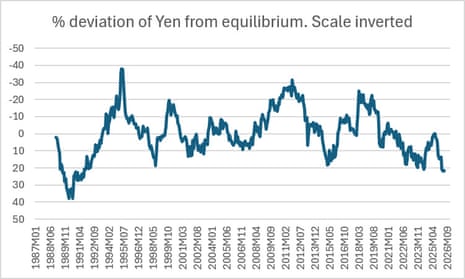
Looking back at the yen…Professor Costas Milas of the University of Liverpool Management School has calculated that Japan's currency is undervalued by over 20%.
Given that, would a September interest rate rise (see earlier post) stabilise the yen, following the recent US-Japan intervention?
It all depends on economic fundamentals, explains:
The critical question to ask here is how the Japanese yen is. My own estimates (Chart below) suggest that the yen is currently around 21 per cent undervalued relative to its (). What are the economic fundamentals?
1) The 10-year yield in Japan relative to the 10-year yield in the US.
2) Economic policy uncertainty in Japan relative to economic policy uncertainty in the US.
3) Trade policy uncertainty (as a proxy for tariffs).
To stabilise the yen, we should be looking for a big rise in the 10-year Japanese yield (part of it works through a hike in the Japanese policy interest rate), a drop in Japanese economic uncertainty and tariffs on Japanese exports to the US (which Trump is probably unwilling to implement).
Shares in software firms are rallying this morning, following a report that human-resources and financial management software company could be taken over.
(+4.5%), (+4.4%) and (+3.1%) are all among the top risers on the FTSE 100 share index this morning.
This comes after Reuters reported that private equity firm had been in talks with over a potential takeover. That pushed shares up by 18% yesterday.
(like many software companies) had been under pressure in recent months on concerns that AI models might eat into its business.
As the UK's summer of heatwaves continues, interest in air conditioning is rising almost as fast as the temperatures.
Rightmove reports this morning that searches for homes for sale in the UK with air conditioning have more than doubled this summer, as potential house buyers worry about keeping cool in the climate crisis.
More here:
The oil price is moving higher this morning, which will add to those inflation fears.
Brent crude has risen by almost 1% to $87.88 a barrel, having fallen yesterday for the first time in over a week.
Crude prices are rising after the Abu Dhabi National Oil Company reported that two of its vessels were attacked while transiting the Strait of Hormuz last night, and as the US threatened an indefinite naval blockade of Iran.
Concern abour rising US borrowing costs was one reason Washington worked with Tokyo to prop up the Japanese yen earlier this month.
The US was concerned that Japan's government might sell some of its holding of Treasury bonds in an attempt to stabilize its currency, so took part in a joint intervention to strenthen the yen instead.
That operation only had a temporary success (the yen recovered, but then began to weaken).
And now, The Bank of Japan is reportedly set to raise interest rates next month and could hike rates more aggressively afterwards, to provide support for the yen.
According to Reuters, three sources have said the BoJ is set to raise rates as soon as September, due to inflation worries and the weak yen.
, head of US rates strategy at , agrees that the rise in US borrowing costs is "problematic" for the Trump Treasury, adding (via the FT):
"They have to fund the government at more expensive levels."
Good morning, and welcome to our rolling coverage of business, the financial markets and the world economy.
The fiscal pressures on the US government have risen after it paid the highest borrowing costs to sell long-term bonds in a quarter of a century.
An auction of 30-year US Treasury bonds last night showed that investors are demanding a heavy premium to take on long-duration US debt, amid concerns over the risk from inflation and the country's rising national debt.
The sale of $25bn of 30-year bonds on Thursday incurred a yield, or interest rate, of 5.216%, the most since 2001.
Bond yields rise when prices fall, so last night's auction suggests investors are worried that inflation will remain high for some time, prompting policymakers to keep interest rates high for some time.
That will concern the Treasury Department, as they need to fund a growing deficit due to Donald Trump's spending plans and tax cuts (plus the refunds on the president's tariffs).
, portfolio manager for the global fixed income team at , says ():
"Investors are being asked to absorb a growing supply of government debt globally at a time when deficits remain large, inflation uncertainty persists."
"If investors continue demanding greater compensation for inflation and fiscal risks, long-term yields could move higher and away from 5% even if Treasury auctions remain well covered."
The agenda
-
10am BST: Eurozone flash GDP report for Q2
-
1.30pm BST: US retail sales for July
-
3pm BST: University of Michigan's US consumer confidence index