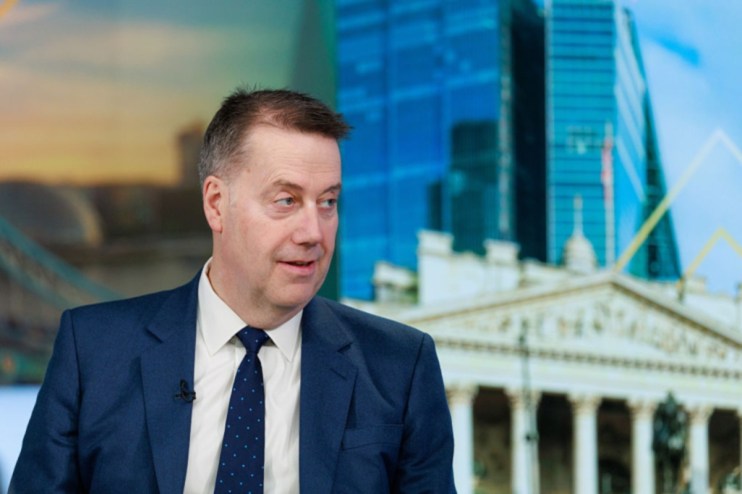
The government must unleash growth in the forthcoming Budget or ministers will be forced to hike taxes even higher at future fiscal events, the boss of the largest player in the UK pensions market has warned.
Andy Briggs, the chief executive of Standard Life, told the UK’s ageing population leaves the Chancellor John Healey with one of two options to either “drive economic growth” or face the prospect of a “rising tax bill” in order to meet his spending commitments.
In just over a month, Healey will deliver his first Budget as Chancellor against a stiff backdrop of rising borrowing costs and an increasing debt pile.
Briggs said “a series of measures to really support driving strong economic growth” would be “important” when Healey takes to the despatch box on 28 October.
“The most important thing is driving economic growth… if you drive economic growth and you create more roles, and you scale more businesses, that’s what will make the biggest difference across the tax and welfare system as a whole,” he added.
On Monday, Healey refused to rule out further tax hikes at the Budget, as he framed growth as the UK’s “pathway out of debt”.
Speculation has continued to mount that the UK is in for another punishing tax raid in October, which will follow on from ousted Chancellor Rachel Reeves’ two Budgets that raised £40bn and £26bn respectively.
Stop the pensions speculation, Briggs urges
Financial services leaders have been left fretting over numerous potential revenue-raising levies and urged the government to commit to the 25 per cent tax-free pension lump sum, currently capped at £268,275.
Last year, Labour-associated think tank the Fabian Society urged the Treasury to cut the lump sum to £100,000. Pensions minister Torsten Bell has previously advocated cutting the sum limit to just £40,000.
“When it comes to the topic of pensions, we want to avoid lots of speculation in every budget cycle,” Briggs said.
“That speculation undermines consumer confidence that if they’re saving for the long term, the goalposts won’t move along the way.”
He urged the government to make pensions a “long-term game with rules and approaches set over multiple decades, not speculated on in each annual Budget cycle”.
Briggs said the wider policy should be shaped by targeted support and allocating more to private assets.
The pensions chief has previously warned nearly 15m Brits were set to suffer in retirement as a result of workers using their automatic eight per cent auto-enrolment pension contribution as a ceiling rather than a foundation on which to build.
He called for “radical change and meaningful action” in the forthcoming Pension Commission, which is set to publish its legislative roadmap for decades to come in the sector.
Briggs’ comments followed Standard Life’s half-year updates where it swung to a loss after the market moved against positions the firm had taken to shield itself against volatility.
The FTSE 100 pensions giant posted an overall loss of £179m for the first six months of the year, driven by £473m in paper losses on financial protection contracts bought to safeguard the business against market falls.
Because stock markets rose, the value of those protective policies fell, and strict accounting rules forced the group to record the drop on its books. The strategy, known as hedging, is used by businesses to protect their balance sheets against sudden market drops and ensure steady cash flow.
“The group accepts the hedge-related volatility,” Standard Life said in its half-year update, adding it was a “known consequence of our hedging strategy that is designed to protect our cash, capital and dividend.”
Despite the headline drop, the FTSE 100 group recorded a 25 per cent increase in adjusted profit to £563m. This came as operating cash generation – the total amount it brings in from day-to-day core operations – jumped six per cent to £745m. The firm said it put them on track for mid-single-digit annual growth.