The pound is steady and gilt yields dipped, a day after delivered a cautious set of tax and spending plans in his maiden budget to help households hit by "global economic storms," as he put it, which had little impact on markets.
The stock market has risen, with the FTSE 100 index 42 points ahead at 10,736, a 0.4% gain. is the top riser, up 3.2%, after profits in the latest quarter doubled.
– the best performing major currency against the dollar this month with a 0.5% gain – dipped 0.1% against the greenback to $1.3310. It has gained a similar amount against the euro in October.
Government borrowing costs also eased. The yield on the 10-year benchmark gilt dipped 3.7 basis points to 5.308% this morning while two-year, five-year and 30-year yields are also down.
, chief markets economist at Capital Economics, said the "No harm" budget has kept gilts out of the firing line.
The UK budget announcement has proven the non-event that newly-minted chancellor Healey had signalled in advance. While his first budget is hardly inspiring, it contrasts favourably with the initial efforts of some of his recent predecessors. By sticking to a gradual fiscal tightening path, and to the expectations set over the past couple of months for a muddle-through budget, Healey has probably done enough to keep the gilt market on side for now.
We think that gilt yields will fall over the coming year as the UK's fiscal risk premium remains contained and the Bank of England policy takes a less hawkish path than money markets discount.
The chancellor said he will raise taxes on banks, gambling, savers and landlords, while also tightening VAT rules for online marketplaces. Its £4.4bn cost of living support package has been criticised as "badly targeted" by the Resolution Foundation this morning, though.
Speaking on BBC radio 4's Today programme this morning, Healey vowed to cut the welfare bill before the next election, with a "tough" approach to young people who do not accept support to get a job or training.
The European Central Bank has left its three key interest rates unchanged, as expected, after raising them twice since June.
It is expected to hike rates further in the coming months as policymakers seek to put a lid on rising inflation after an oil-price shock linked to the Iran war, in an effort to stop it feeding into other prices and wages.
The governing council explained in a statement:
Energy prices have continued to rise, posing upside risks to the inflation outlook and downside risks to the growth outlook. While the full effects of the energy shock are still unfolding, underlying inflation has remained broadly stable so far and wages do not show a material response at this stage. The increased magnitude and duration of the energy shock, as well as the implications for indirect and second-round effects, are likely to drive up inflation and lower growth. Financing conditions have tightened since the Governing Council's last meeting, which is likely to weigh on inflation and growth. The Governing Council is committed to setting monetary policy to ensure that inflation stabilises at its 2% target in the medium term.
The governing council remains well positioned to navigate the current elevated uncertainty. It will follow a data-dependent and meeting-by-meeting approach to determining the appropriate monetary policy stance. In particular, the governing council's interest rate decisions will be based on its assessment of the inflation outlook and the risks surrounding it, in light of the incoming economic and financial data, as well as the dynamics of underlying inflation and the strength of monetary policy transmission. The governing council is not pre-committing to a particular rate path.
Outgoing president will give a press conference in about 25 minutes.
The US economy grew by 3.4% in the third quarter, more than expected, while a closely watched inflation measure slowed.
Growth picked up from an annualised growth rate of 2.2% in the previous quarter, according to an advance estimate from the US Bureau of Economic Analysis.
Economists had expected 3.2% growth.
Increases in investment, consumer spending, and government spending were partly offset by a decline in exports.
The personal consumption expenditures (PCE) price index – an inflation measure that is closely watched by the US Federal Reserve increased 2.1%, down from an increase of 5% in the prior quarter. The PCE price index excluding food and energy increased 2.5%, versus an increase of 3.3% previously.
European Central Bank president Christine Lagarde quit (effective from February) because she could no longer remain neutral about French politics and wanted greater freedom to express her views, Reuters reports, quoting an unnamed source.
France is gearing up for a presidential election next year, where far-right candidate is the favourite to win.
An ECB spokesperson declined to comment.
We heard from owner this morning, which welcomed 's budget measures on business rates – they will be frozen for two years.
We have spoken to other, small business owners about what the budget means for them. My colleagues Sarah Butler and Joanna Partridge report:
"It is like letting the tyres down and then handing you a pump," says , assessing the relief handed to businesses in Healey's first budget as chancellor.
The managing director of Norfolk's argues that the budget made a "couple of steps towards helping" but added more labour costs for already burdened companies.
Nye, who employs 500 people at the height of the season at its 10 venues across Norfolk and Hertfordshire, was among those business owners watching Healey carefully on Wednesday, after two previous Labour budgets under had loaded extra costs on to businesses.
Healey aimed to help high street operators by removing the business rates burden from more small businesses and limiting the rise in the minimum wage for younger workers.
The chancellor put a lid on increases to business rates, so they will only rise in line with inflation for two years, and clamped down on VAT dodging by online sellers, among other measures intended to help high streets. However, some businesses argued 's chancellor could have gone further.
, the owner of the chain, says the chancellor has not fixed the "fundamental problem" that its costs are rising faster than it can increase sales.
Ireland's economy grew rapidly for a second quarter, adding to hopes for continued expansion across the eurozone despite surging energy costs.
It expanded at a quarterly rate of 5.5% between July and September, down from 10.2% in the previous quarter, according to preliminary estimates.
Ireland's statistics office said growth was driven in part by information and communications, which includes AI-related activity.
The government has long cautioned against using GDP to accurately measure economic growth as it is routinely distorted by multinational activity. Its preferred measure, modified domestic demand (MDD), is not included in the early estimates.
GDP is still used to calculate Ireland's share of activity across the eurozone and can be subject to large revisions. GDP was 3.9% higher on a year-on-year basis in the third quarter.
Christine Lagarde, who will step down as European Central Bank president next February, nine months before her term ends, announced the decision in a short video on X – and also explained why she has plasters on her face.
I have just informed my colleagues that I will step down as @ECB President on 7 February 2027. It has been a source of great pride to serve this institution. I thank all of those who have supported me on this journey over the past seven years.

In a separate post, she added:
Just to avoid any social media chatter: the plasters on my face are due to a small surgery earlier in the week. Follow doctor's orders and get your skin checked regularly!
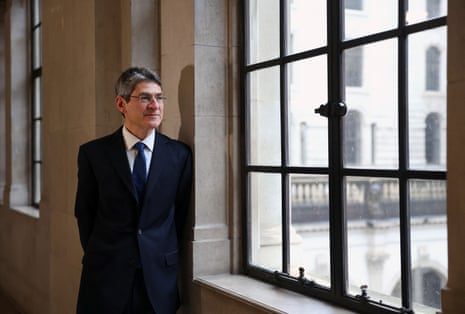
Jonathan Haskel, professor of economics at Imperial Business School who bcame head of the Office for Budget Responsibility (OBR) in the summer, has explained the OBR's verdict on the budget, speaking on BBC radio 4's Today programme this morning.
In its response to the budget on Wednesday, the government's independent forecaster said British households face a "grim picture" for living standards as the war in the Middle East drags down growth and triggers a fresh cost of living crisis.
As announced his first budget, the OBR issued its report showing a sharp downgrade for growth in 2027, household disposable incomes and the public finances, despite the measures taken by the chancellor.
told BBC radio 4:
Whilst the meteorological weather has been kind to us over the last summer period, the economic weather has been much less benign. And one way to think about that is that the borrowing rates which the chancellor faced have gone up very severely since we did our last forecast in March.
Now there are lots of numbers flying around, so forgive me for one more number, which is £14bn. That's the increase in the borrowing bill just from the increase in interest rates alone that the chancellor had to find before he even stood up and did any of the types of policies which you talked about.
To give people some sense of the scale of that, that's about a third or so of the entire Department for Transport budget. So that's a lot in comparison to the other services.
Real household disposable income per person, the amount of money that people have got after inflation and tax bills was growing at about 2% a year before the financial crisis of 2007-8.
We're forecasting that because of all the shocks and so forth we've had, that growth rate has gone right down. If you take the 10-year span from the beginning of the pandemic, that measure of income will have grown by 1% over that entire 10 years, not per year, but over that entire 10 years, and that's a very very difficult outcome obviously for people. A reflection of the severe adverse shocks that the economy has been subject to over the last decade.
The government's welfare bill is going up from around 10.5% of GDP to around 11.5% of GDP, Haskel said.
So that's a big increase. What's interesting about that increase is that I guess if we were having this conversation 20-30 years ago, we would think of welfare as primarily being payments to unemployed people, whereas it's much more now payments on disability and payments for pensioners.
Asked about upcoming cuts to government spending, he said:
What we've worked out in our report is that over the last three years of our forecast, so from 2029 onwards, that's an area where the government hasn't yet done all the various detailed spending plans for all its individual departments. So we've done the following calculation: we've asked the question: Suppose the government carried on with its commitments to defence, which the chancellor has talked about very eloquently, with its commitments to teaching and education, with its commitments to health. What would other departments have to withstand? What would be the deal for them over the last three years? And the answer to that is a cut by around 2.6% in real terms in all of those other departments, in order to meet those commitments.
The head of the Office for Budget Responsibility, , wanted to put the budget in the context of a British economy that has been growing slowly for a long time.
The OBR report says economic growth will slow to just 1% next year under the weight of inflation and high interest rates.
, the former BBC economics editor who now resides at Bloomberg as head of economics, said it should be the working assumption that the Iran war goes on for the rest of 's presidency, just as the Pentagon assumes. And even if it doesn't, there is likely to be another geopolitical tragedy to raise prices and fuel inflation just around the corner.
, the Resolution Foundation's interim chief economist, said there was a high degree of wishful thinking about the public finances and the government's ability to balance the books next year and in 2028 and 2029.
He said 's plan to freeze fuel duty until the middle of next year and then increase the levy significantly in subsequent years was unrealistic. The same outlook applies to Whitehall budgets, which are on course to shrink in real terms (adjusted for inflation) from next year but provide the same level of services.
It's like when my friends say they are going to diet next week and when that doesn't happen say they will diet twice as hard in the following week. And that is how I feel about the budget more generally.
It's another way of saying, maybe this time things will be different, but they weren't this time yesterday, so why would they be in the future?
Thwaites added that the country needed to have an honest conversation about how much poorer it was after the energy shock and what level of welfare and services it could afford to provide with a smaller bag of money to do it.
The Institute for Fiscal Studies said Wednesday's budget was "broadly the budget that many people were expecting".
IFS director told journalists at a press briefing:
A relatively small cost of living package and a handful of tax rises. Borrowing higher across the rest of the decade. Nods that there are bigger things to come, including in the 10-year plan.
One surprise was the length of the scorecard. There were a whopping 98 measures. Some of this seemed to be in the spirit of the prime minister's 'everyday fixes' – small measures that make things better. Sadly, there was also a lot of small, unhelpful fiddling with the tax system.
Sticking with the big picture for now, I am left thinking what I thought before the budget. Public service spending plans look extremely tight. They don't look to me like plans that this government would want to deliver. Whether or not they are delivered matters because the spending plans underpin the plan to bring down borrowing.
, chief economist at Berenberg Bank, said:
That she [] leaves early is no surprise and does not change the outlook for ECB policies and for the way the ECB deals with French risks, in our view. Only the timing of her announcement has come as a modest surprise.
EU leaders will try to fill the three vacancies on the ECB's executive board that will open up in 2027 no later than the EU summit of 17-18 December, and possibly beforehand, he said. According to various media reports, Germany will soon nominate a candidate to replace as the board member in charge of market operations, but not claim the presidency and probably not the chief economist position (currently held by ).
For now, Klaas Knot from the Netherlands and Spain's Pablo Hernandez de Cos remain the favourites to succeed Largarde. In addition to the usual issues of monetary policy competence and regional balance on the board, the question who may be best placed to deal with potential financial turbulences will likely play a key role in the choice of new ECB leaders. As a former chair of the G20's Financial Stability Board (FSB), Knot may have an edge in this respect.
Schmieding has an interesting line on the French election influencing the timing of the ECB's decision.
The European Union is trying to guard itself at least somewhat against the risk that right-wing Marine Le Pen may win the French presidential election in April/May 2027. Lagarde's successor will still be appointed while the staunchly pro-European centrist still resides in the Elysee Palace. He is a long-term political adversary of Le Pen.
Despite mounting problems, France is not (yet) close to a full-blown crisis. In case of a dramatically worsening crisis, the ECB could use its tools such as liquidity injections into short-term funding markets to prevent them from seizing up and/or deploy its "Transmission Protection Instrument (TPI)" to shield other countries such as Italy from contagion risks.
However, the ECB has no mandate and no appetite to fund French fiscal follies. In our view, the ECB would only support France if Paris returns to more sustainable policies. Recent market moves seem to mostly reflect France's worsening fundamentals. Of course, if the French yield spread were to blow out in a disorderly fashion and by far more than the fundamentals may warrant, the ECB may try to constrain that with a cautiously worded verbal intervention. In our view, we are not close to such a situation.
, the eurozone's top central banker, is stepping down nine months early.
The European Central Bank announced this morning that Lagarde would step down as its president on 7 February 2027; her term was scheduled to run until the end of October next year.
The ECB's governing council thanked Lagarde warmly and gave her a long standing ovation, as it met to set interest rates across the eurozone.
Lagarde has been seen as a candidate to take over the running of the World Economic Forum, which holds its annual meeting in Davos each January. WEF founder stepped down last year after being accused of financial and ethical misconduct – which he denies.
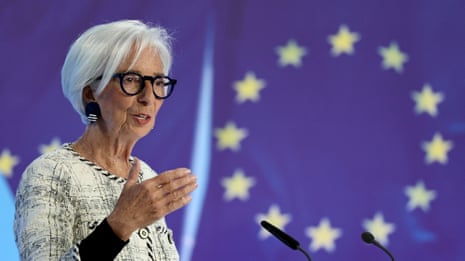
Lagarde's early departure fires the starting gun on the race to replace her as ECB chief, at a time when the eurozone is strugging with weak growth and above-target inflation. Potential candidates include Dutch central bank governor , of Spain, German central bank chief , and , the President of the European Investment Bank.
Lagarde joined the ECB in late 2019, shortly before the Covid pandemic. During her tenure the ECB also faced the economic consequences of the Ukraine and Iran war, and Donald Trump's trade war.
The ECB is widely expected to keep interest rate on hold at lunchtime.
Mortgage approvals across the UK sank to a near three-year low last month, while consumer lending grew at the fastest rate in eight years.
British lenders approved 53,443 mortgages for house purchase in September, the lowest number since December 2023, according to the latest Bank of England money and credit data.
UK mortgage approvals for house purchase fell to 53,443 in September 2026, down 2.5% month-on-month and down a rather more troubling 19.4% year-on-year.
Economists polled by Reuters had expected mortgage approvals to dip to 54,000.
, who heads up equity research on UK housebuilders and global building materials at RBC Capital Markets, said:
This marks the third consecutive monthly decline, an unwelcome hat-trick, making Halloween for housebuilders more trick than treat, and takes approvals to their lowest level since December 2023. The current run-rate sits 10.8% below the five-year average and 16.9% below the ten-year average, pointing to demand that remains stubbornly subdued. The value of approvals fell even faster, down 4.9% month-on-month and 17.7% year-on-year to £13.7bn. The UK housing market is not a market with positive momentum, happy Halloween.
Mortgage lending fell to £3.9bn in September, from £4.2bn in August, below the previous six-month average of £4.9bn.
Consumer lending grew at an annual rate of 9.8%, the fastest rate since April 2018. However, consumer credit fell on a monthly basis, to £1.9bn in September from £2.7bn in August. Credit card lending slowed to £700m from £1.3bn while other borrowing such as car dealership finance and personal loans declined to £1.2bn from £1.4bn.
has slumped to its biggest loss in more than a decade in the latest quarter, as Germany's largest carmaker suffered from falling sales in China.
The Wolfsburg-based carmaker lost €4.2bn (£3.5bn) before tax between July and September, the highest since the end of 2015, it said on Thursday. Its operating loss was €5.8bn, driven by a previously announced impairment of €6.4bn on its stake in the Porsche sportscar subsidiary, and another €1bn on its Chinese operations.
Sales in the first nine months of 2026 fell 11% to 5.9m, with a "shrinking" market in China to blame, according to , Volkswagen's chief financial officer.
Antlitz said the company's earnings were "too low to continue investing strongly in our future".

Volkswagen, which used to vie with to be the world's largest carmaker, is cutting as many as 100,000 jobs, many of them in Germany, as it tries to turn itself around and fight back against the wave of Chinese manufacturers that dominate the electric vehicle industry.
Volkswagen blamed its decline in profitability on a long-running price war in China that is spilling into other markets around the world, as well as the increased share of lower-margin electric vehicles.
However, , senior autos analyst at Bloomberg Intelligence, said the carmaker's guidance suggested a "sharp rebound" was likely in the last three months of 2026 after a "messy" third quarter. He said:
An 11% higher European order book and Audi recovery underpin the 4Q improvement and bode well for 2027 as restructuring savings build, helping offset China weakness, BEV [battery electric vehicle] mix margin dilution, rising costs and negative pricing.
Britain's hospitality sector has breathed a sigh of relief after the budget.
owner said this morning that the budget will significantly ease its cost burden, and now expects its business rates bill to be as much as £60m lower over the next couple of years.
froze the level of business rates paid by hospitality, leisure and retail businesses for two years, until 2028, so that no property faces an above inflation increase.
Whitbread, one of the hospitality sector's most vocal critics of last year's budget, was facing a hefty increase in costs due to the sharp rise in business rates announced by Healey's predecessor .
Here are some more details:
Whitbread expects its total business rate payments to rise by just £7.5m to £12.5m over the coming year, against its previous estimate of £35m, with a similar benefit the following year.
It expects business rates payments to be between £45m and £60m lower than previously expected by fiscal 2029.
, the chief executive, expressed relief:
The business rate measures announced in the UK budget will do much to mitigate the damaging impact of the past two budgets on the hospitality sector, and we are grateful that the government has listened to our concerns.
Limiting the increase in business rates over the next two years to inflation, together with a more reasonable increase in the national living wage and national minimum wage, will make a significant difference to our business. This provides further momentum as we execute our five-year plan which is on track to deliver a material increase in margins, cashflow and returns for shareholders.
said on Wednesday that higher inflation and interest rates had hit the government's finances, ratcheting up the government's interest bill by £14bn this year alone, but promised to stick to Labour's fiscal rules.
The Office for Budget Responsibility (OBR) said the chancellor would meet the most important rule – to balance day-to-day spending with tax revenues – with a diminished headroom of £15bn by the target date of 2029-30, against the £24bn his predecessor had built up in the spring.
Borrowing is scheduled to be higher than expected in the short term, but the chancellor promised to rebuild the buffer against the rules to £22bn by the end of the five-year forecast period.
Investors and analysts said the budget left Britain's fiscal outlook largely unchanged, which explains the muted impact on financial markets.
Barclays currency strategist said:
A 'continuity budget' with fiscal headroom upside potential pushes the 's perceived fiscal risks to the background.
, chief investment officer at the insurance group Howden Employee Benefits, said:
The new chancellor has successfully navigated his first budget without spooking gilt markets. Albeit, that is partially thanks to helpful changes to OBR growth assumptions, which have offset the falling fiscal headroom due to rising yields. We should also remember that the substantial changes have been pushed back to the 2027 spending review.
The chancellor was facing an uphill struggle given elevated bond yields seen in both the UK and across the G7. Bond yields will continue to face short term headwinds from global events in the spectre of rising energy prices and knock-on effects to broader inflation. However, the combination of fiscal discipline and the Bank of England's sensible overhaul of its quantitative tightening program should support lower gilt yields over the medium term. We remain positive on gilts over a two-year timeframe.
The pound is steady and gilt yields dipped, a day after delivered a cautious set of tax and spending plans in his maiden budget to help households hit by "global economic storms," as he put it, which had little impact on markets.
The stock market has risen, with the FTSE 100 index 42 points ahead at 10,736, a 0.4% gain. is the top riser, up 3.2%, after profits in the latest quarter doubled.
– the best performing major currency against the dollar this month with a 0.5% gain – dipped 0.1% against the greenback to $1.3310. It has gained a similar amount against the euro in October.
Government borrowing costs also eased. The yield on the 10-year benchmark gilt dipped 3.7 basis points to 5.308% this morning while two-year, five-year and 30-year yields are also down.
, chief markets economist at Capital Economics, said the "No harm" budget has kept gilts out of the firing line.
The UK budget announcement has proven the non-event that newly-minted chancellor Healey had signalled in advance. While his first budget is hardly inspiring, it contrasts favourably with the initial efforts of some of his recent predecessors. By sticking to a gradual fiscal tightening path, and to the expectations set over the past couple of months for a muddle-through budget, Healey has probably done enough to keep the gilt market on side for now.
We think that gilt yields will fall over the coming year as the UK's fiscal risk premium remains contained and the Bank of England policy takes a less hawkish path than money markets discount.
The chancellor said he will raise taxes on banks, gambling, savers and landlords, while also tightening VAT rules for online marketplaces. Its £4.4bn cost of living support package has been criticised as "badly targeted" by the Resolution Foundation this morning, though.
Speaking on BBC radio 4's Today programme this morning, Healey vowed to cut the welfare bill before the next election, with a "tough" approach to young people who do not accept support to get a job or training.
's chief financial officer said the bank hopes that the tax increase on banks announced in the budget is a "temporary measure," as the lender's quarterly profits doubled.
used the budget to double the additional levy banks pay on their profits, to 6%.
The additional bank tax will only last for 15 months and marked a less significant rise than some in the industry had feared. Banks' share prices were among the highest risers in the blue chip FTSE 100 index on Wednesday.
This morning, the Lloyds share price fell as much as 6% in early trading, and is now down 3.1%, despite the bumper results. Jefferies analysts say revenue missed expectations by 1%, and the net interest margin was also below forecasts.
The bank's pre-tax profits in the latest quarter doubled to £2.3bn, with a 10% rise in net interest income, as the bank continues to benefit from higher interest rates. The figure was flattered by a £800m hit it took on motor finance provisions this time last year which was not repeated, thereby boosting the year-on-year comparison.
Chalmers said:
We lend out 99 pence of every pound we receive in deposits and our ambition is to do more. In this context, we know that the increase in the surcharge announced by the chancellor yesterday, we recognise that tax is a matter for the government. The fiscal environment is challenging.
Ultimately, it is important that the UK banking sector is able to deliver banking services to businesses and households and communities in a cost effective way.
In order to promote UK growth, it is also important that the sector is internationally competitive and not disadvantaged compared to other financial centres. Additional taxes make both of these objectives harder to achieve. We therefore very much hope that yesterday's tax increase is indeed a temporary measure to help ensure the business environment remains consistent with supporting long term investment.

, head of markets at the trading platform interactive investor, said:
With provisions for the motor finance investigation all now but buried and with higher income flowing through, has enjoyed a bumper quarter which puts the bank in prime position to meet its full year targets.
Some of the clouds which have been overhanging the sector leading up to the budget, and the domestic banks in particular, have now partially parted. The increase to the bank surcharge was less than feared, manageable and temporary and led to a small relief rally in Lloyds' shares yesterday. Other concerns also remain on the back burner, with the level of defaults and arrears low and stable, although in typically conservative fashion Lloyds has increased impairment provisions for the quarter to £313m, or £930m in the year to date.
This of course anticipates potential rather than actual losses, such that releases are possible in the future should the bad debts fail to materialise. The higher figure is based on several scenarios, such as the inflationary impact of the Middle East crisis, lower GDP growth in the UK, a rise in unemployment and limited gains in residential and commercial property prices. Even so, at the moment, there are few if any signs of deterioration across its lending book.
Good morning, and welcome to our rolling coverage of business, the financial markets and the world economy.
The £4.4bn cost of living support package delivered by 's budget on Wednesday is "badly targeted," which means that even families receiving help face higher energy bills than during the last energy price shock, according to the .
The poorest half of households will gain £158, on average, from support measures this year and next – just £14 more than the £144 received by the richest half – highlighting a "complete failure to target help at those who need it most," the think tank said.
Typical energy bills net of support are forecast to be £1,750 this year (2026-27) – higher in real terms than during the last energy price shock (2022-23) when net bills were £1,685.
The chancellor raised taxes on banks and landlords to fund a £100 winter handout for 20 million families as official forecasts made clear there is no end in sight for the cost of living crisis.
The Resolution Foundation's analysis found that UK tax rises stand out globally. The UK's internationally remarkable consolidation in its public finances, touted by the chancellor in his budget speech, is entirely due to a rising tax take during the current parliament. The £76bn improvement in the UK's primary balance – the gap between receipts and non-interest spending – between 2023-24 and 2028-29 is more than fully accounted for by £107bn of higher tax revenues.
Whitehall gets a bigger boost than households. The budget included a £9bn top up to departmental budgets over the current spending review period – twice as much as the £4.4bn cost of living support package.
Past gain, future pain for living standards. Median real annual disposable incomes for working age households are set to grow by a paltry £600 over the course of the Parliament. Worse still, those gains are already behind us. Between now (2026-27) and the end of the parliament (2028-29), typical incomes are forecast to fall by £1,050 (3%).
, chief executive of the Resolution Foundation, said:
Faced with a tough backdrop amid global economic turmoil, the chancellor delivered a scattergun budget that did little to address the sharp challenges facing Britain. Cost of living support is being spread far too thinly and will leave even those families receiving help facing higher energy bills than they did during the last energy price shock.
Stepping back, this parliament is increasingly looking like one of two halves, which yesterday's budget did little to address. The first half has been marked by rising living standards, solid economic growth and extra funding for public services – funded by huge tax rises – none of which was enough to prevent dramatic half-time substitutions in Downing Street.
The new occupants will hope for better political fortune in the second half, but it could prove tough going against a projected £1,000 fall in disposable incomes. A more dramatic change of tactics may be needed, and we did not learn how the government will choose between public service ambitions and household incomes. Next year the choices will unavoidably get starker.
The US Federal Reserve left interest rates unchanged on Wednesday during its last board meeting before the midterm elections, keeping rates at one of the highest pre-election levels seen in over 20 years.
Two out of 12 board members voted against the pause, preferring to raise rates by a quarter point this meeting, the Fed board said.
Last month, Fed officials raised rates for the first time since 2023, citing rising inflation, bringing rates to a range of 3.75% to 4%. Inflation has hovered for years above the Fed's target rate of 2%, and for most of this year, the annualized inflation rate has remained above 3%.
Though inflation rose higher in September, going from 3.4% in August to 3.7%, the pause signals the central bank is taking a wait-and-see approach ahead of the midterms next week.
During a press conference on Wednesday afternoon, the Fed chair, , told reporters that the upcoming election played no role in deliberations.
Today, the European Central Bank is also expected to keep rates unchanged at the end of its meeting.
The decision is expected to be overshadowed by questions about bond-market turmoil in France and ECB president 's future.
The eurozone's central bank has already raised rates twice since June and is expected to hike further in the coming months as policymakers seek to prevent an oil-price shock linked to the Iran war from feeding into other prices and wages.
The UK oil and gas giant Shell doubled quarterly profits to $10.8bn between July and September, the highest since 2022, after the Middle East conflict led to energy shortages and drove up the price of oil and gas.
The company said this morning that it will hand back more cash to shareholders, lifting its quarterly share buyback programme to $5bn from $3bn.
In financial markets, oil prices have fallen amid hopes for fresh peace talks. US vice president sought to revive negotiations by sending a letter to the Iranian Security Council chief , the Wall Street Journal reported.
Brent crude, the global oil benchmark, declined 0.6% to $114.62 a barrel.
-
9am GMT: UK joint water regulator report on company performance
-
9.30am GMT: Bank of England consumer credit and mortgage approvals for September
-
10am GMT: Eurozone consumer confidence for October
-
10.30am GMT: Institute for Fiscal Studies verdict on UK budget
-
12.30pm GMT: US GDP for third quarter
-
1.15pm GMT: European Central Bank interest rate decision
-
1.45pm GMT: ECB press conference