UK government borrowing costs have risen to the highest since 2008, as higher oil prices stoke inflation fears. Brent crude, the global oil benchmark, is now up 1.3% at $91.69 a barrel.
The yield on the 10-year gilt has jumped 7 basis points to 5.223%, the highest since June 2008.
It's a global bond sell-off –– pushing yields higher around the world. The equivalent Japanese government bond yield hit 3% for the first time since September 1996.
Germany's 10-year yield, the benchmark for the eurozone, rose 2 basis points to 3.34%, a fresh 15-year high.
The bond market is also under pressure a surge in issuance, as big technology companies raise money to fund the AI boom, competing with government bonds.
Oil prices are heading higher after the latest escalation in the Middle East, with Brent crude now up 0.8% at $91.23 a barrel.
On Monday, five commodity vessels transited the strait of Hormuz, similar to recent days but below the 10-day average of 14, according to shipping data from KPler, but none of them were liquid tankers.
The waterway has been effectively closed by Iran since the US and Israel started attacking on Tehran on 28 February, and despite efforts by mediators including Qatar and Oman there is still no deal to reopen the strait.
The United Kingdom Maritime Trade Operations agency said on Tuesday that a tanker reported being struck by three projectiles while sailing out of the strait, without casualties or environmental impact.
Analysts at Australia and New Zealand Banking Group said:
Despite satellite tracking firms suggesting oil flowing through Hormuz is around 6m barrels a day, that is well below pre-conflict levels.
In the meantime, the buffers the global oil market has been relying on are becoming exhausted. US inventories are nearing minimum levels, while China's ability to keep imports low will be tested as seasonal demand picks up.
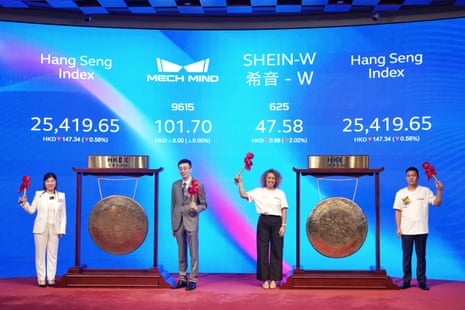
More on 's stock market debut in Hong Kong.
"Let global consumers enjoy the sound of fashion," said , Shein's chief financial officer, after a gong was struck to mark the start of trading.
The lacklustre launch as a publicly listed company comes after one of the longest-awaited initial public offerings in recent years, after plans to list in New York were blocked by regulators over forced labour concerns.
Shein also considered a £50bn flotation in London, but faced similar questions about its supply chain from campaigners, MPs and investors.
The plunge in value has been driven by regulatory changes around the world that threaten its business model of shipping goods in small packages out of China to take advantage of tax breaks on low-value imported goods.
Shein swung to a loss of $99m in the first three months of this year, compared with a net income of $395m the year before, after the US removed its "de minimis" import duty exemption on small packages, hitting its sales in the country.
The EU is also cracking down on the loophole – introducing a €3 (£2.56) duty on small parcels imported from outside the trading bloc in June – and intends to phase it out, while the UK has said it will do the same by October 2028.
Nevertheless, the company has still become one of the world's biggest listed fashion groups with a valuation around the same as Swedish retailer H&M. Zara owner Inditex has a market capitalisation of around $213bn.
Good morning, and welcome to our rolling coverage of the global economy, the financial markets, the eurozone and business.
Global government bonds are selling off again, pushing yields to new highs, as oil prices have risen above $91 a barrel, stoking inflation fears.
Renewed fighting in the Middle East pushed Brent to $91.13 a barrel, up 0.7%, following Monday's 2.7% drop. US West Texas intermediate, the other oil benchmark, is up 0.77% at $86.42 a barrel, after a 2.8% fall on Monday.
The US and Iran exchanged fire for the first time in a month on Monday, with missiles and drones fired at Iranian rocket launchers on an island in the strait of Hormuz, prompting Iran to target US military bases in Jordan and the United Arab Emirates in response. threatened further action, telling Fox News: "We're going to hit them hard."
Japan's 10-year benchmark government bond hit 3% for the first time in a generation, and is now up nearly 5 basis points at 2.99%. The US 10-year Treasury yield rose 2.6bps to 4.78%, the highest since early 2025. The equivalent UK gilt yield was up slightly at 5.14%.
Inflation fears have boosted expectations of interest rate hikes. Markets are pricing in a rate increase in New Zealand on Wednesday, while the European Central Bank is widely expected to raise its key interest rates by 0.25 percentage points at its next meeting on 10 September. Traders also see a better-than-even chance of rate hikes in the US and Japan this month.
The Bank of England is not expected to move until later this year, with markets pricing in a quarter-point rate hike to 4% around November or December.
Stock futures are pointing to a lower open when European markets open in about 15 minutes, with Wall Street also expected to fall later after modest declines on Monday.
In Asia, shares were mixed – Japan's Nikkei was flat while Hong Kong's Hang Seng lost 0.8% and South Korea's Kospi eked out a 0.2% gain after earlier losses.
Shein shares tumbled 10% after the online fast fashion retailer's stock market debut in Hong Kong. Its share price later recovered somewhat but still closed 4% below its offer price, at HK$46.62.
The company – once estimated to be worth nearly $100bn (£74bn) – went public with its shares priced at HK$48.56, valuing the business at just over $26bn.
-
9am BST: Eurozone Manufacturing PMI
-
9.30am BST: Bank of England data on mortgage approvals and consumer credit
-
9.30am BST: UK Manufacturing PMI
-
3pm BST: US Manufacturing PMI