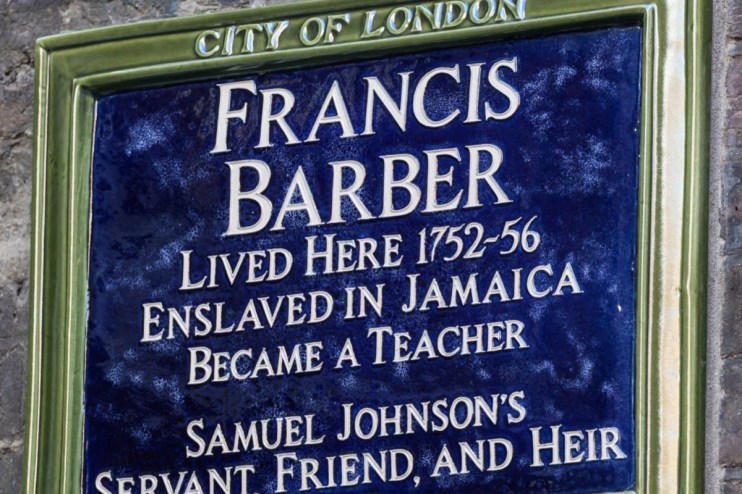
As the Toast the City Awards approaches, we’re looking at some of the cultural highlights in the Square Mile that could take home a coveted Slice of Toast. Today we look at Finalist Dr Johnson’s House and the new Blue Plaque for his brilliant mentee Francis Barber.
Doctor Johnson’s House is a worthy Finalist in our Toast the City Awards. But did you know there is another fascinating cultural figure linked to the site – and that you can visit it right now?
Dr Samuel Johnson will be a name recognisable to many – he was a writer, critic and lexicographer perhaps best known for writing A Dictionary of the English Language in 1755, an incredibly important work that helped define the way the English language was thought of and studied. He resided at what we now call Dr Johnson’s House in Gough Square in Fleet Street Quarter, a Grade I-listed late 17th-century building that he rented for 11 years (it became a museum in 1912).
Dro Johnson’s House was the first landmark in the City of London to be given a Blue Plaque, earning the accolade 150 years ago. Now another Blue Plaque joins it – one dedicated to Francis Barber, Dr Johnson’s servant, friend and heir who would become Britain’s first black school teacher.
The wonderful Francis Barber
Barber, a West African man born into slavery in Jamaica, came to London as a child and lived at Dr Johnson’s house from 1752 to 1756, working there as his servant. Dr Johnson supported him and his family and helped secure his financial future, including making Barber the sole heir and beneficiary of a trust established in his will, something that was sadly controversial at the time.
Stay in the know
Three daily briefings with the key market moves and top business and political stories.
SUBSCRIBE HEREDr Johnson’s House is now a charity that runs a museum at the site and is believed to be the only surviving property in the City that was home to a formerly enslaved person who later lived there as a free man.
Of the 140 plaques in the Square Mile, most of them commemorate institutions and organisations, such as the Samaritans, the Great Synagogue and Royal College of Physicians, with only 32 plaques representing individuals. Following a comprehensive review, the scheme has been redesigned to provide a modern, transparent, and inclusive process with clear guidance, embedded equality, equity, diversity and inclusion principles.
While each plaque will be funded primarily by applicants or their sponsors, a new annual City of London Corporation funding pot will support at least one outstanding application each year.
Brendan Barns, chair of the City of London Corporation’s Culture, Heritage and Libraries Committee, said: “Our Blue Plaques Scheme makes a welcome return and highlights the City of London Corporation’s renewed commitment to commemorating remarkable people, places and institutions that have shaped the Square Mile.
“It is our hope that the redesigned scheme will attract thoughtful and persuasively-written applications from a wide range of backgrounds, all of them reminding us that, behind every Blue Plaque is a story worth telling.”
Celine Luppo McDaid, the Hyde director of Dr Johnson’s House, said: “We are thrilled to celebrate the remarkable life of Francis Barber with this Blue Plaque. Enslaved on a Jamaican plantation, Barber came to London and, in this house, he learned to read and write, going on to become the first Black teacher in British history. His story is central to our commitment to bringing long-overlooked lives into the present day.
“As the House of Words, Dr Johnson’s House explores and represents the experiences and legacies of Francis Barber and the extraordinary people who were living here in the middle of the 18th century. By engaging with issues such as friendship, grief, gender, identity, slavery and mental health, the lives of those who went before us resonate with our 21st century audiences.”