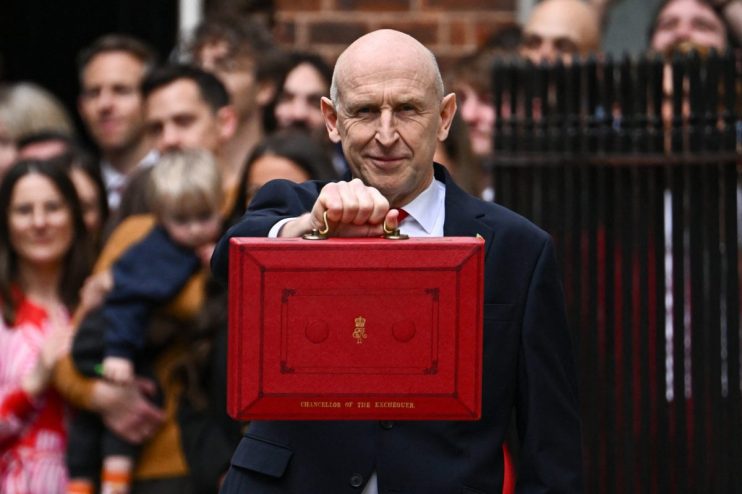
The ballooning benefits bill, the terrifying lack of economic growth, our inadequate defence programme: Labour’s Budget had nothing to offer for Britain’s biggest issues, writes Emma Revell
Word on the street ahead of John Healey’s first Budget was that the mantra in Whitehall when preparing the document was “do no harm”. Unfortunately for the country, mandarins and Treasury boffins seem to have confused that idea with “do as little as humanly possible”. In seeking to do no harm, Healey did at least, as my colleague Robert Colvile put it on Budget day, “ignore many of the more lunatic ideas being proposed by his parliamentary colleagues” but that doesn’t mean he has actually done anyone any good.
The biggest challenges facing Britain are our terrifying lack of economic growth, the ballooning size of the benefits bill, the ticking time bomb that is serving our national debt and the total inadequacy of our defence programme, for which John Healey has already resigned once.
The Budget ignored them all.
On welfare, Healey has been able to hide behind Labour grandee Alan Milburn and his as-yet-unfinished review into the rise of workless young people. While there is every chance Milburn will make serious recommendations into how to tackle this issue, it is one narrow element of the overall problem we have with the benefits bill and with worklessness, and one Labour has explicitly contributed to by hiking up the minimum wage to the ludicrous point where a 21-year-old working full-time on the minimum wage is already half way towards being a higher rate tax payer. Milburn’s focus on young people won’t address worklessness in older people, or the massive surge in health-related benefits driving much of the increased spending. Nor will anything he says likely prevent Labour backbenchers or the campaigning classes adjacent to Labour activists from fighting tooth and nail against even the mildest benefit reforms.
Stay in the know
Three daily briefings with the key market moves and top business and political stories.
SUBSCRIBE HEREHealey also kicked the can down the road on defence, maintaining departmental budgets at the level previously set out by Rachel Reeves – give or take a billion a year which the Conservatives are claiming is a cut in defence spending but the government insist is just an accounting measure, moving pensions spending to the Treasury rather than sitting with the Ministry of Defence. Instead we were told that details on how the government will increase spending to 3.0 per cent, then 3.5 per cent of GDP, and get our Armed Forces in a position to tackle the very real threats that seem to be mounting up – whether from Russia, the Middle East, or stateless AI-powered terror – would come ahead of next year’s Spending Review.
Was this a pre-election Budget?
Labour likes to talk about growth, and on occasion you feel as if certain members of the Cabinet do actually understand what it means to get growth back into the economy. Sadly they, and governments for the last two decades, have enacted policies which almost seem designed not to give us any. The general public likely do not comprehend how poor our growth has been since the financial crisis but The Prosperity Alliance calculated that if growth had continued along pre-2008 trends the median household would be £16,000 a year better off. Yet the Budget contained no measures that even come close to driving growth – even the trade bodies name-checked by the Chancellor in his Budget speech as supportive of some of the smaller measures announced had little positive to say overall.
The CBI said the Budget “lacks the bold moves” needed to make businesses’ lives easier, the FSB rightly pointed out there was “nothing to ease sky-high energy bills” and the British Chambers of Commerce said the announcements lacked “the big calls that would really shift the economic dial”.
If you are inclined to be generous, you could say John Healey did a good job of avoiding the summer of misery inflicted upon the economy by Rachel Reeves’ two Budgets. This summer didn’t include months of drip-fed headlines about black holes and enormous tax rises, but if not spooking the bond markets ahead of the Budget is the best you can hope for, we really are setting the bar low. It would also be fair to point out some measures that would dramatically boost growth sit outside the remit of a budget.
Unfortunately, our economic situation is so dire we cannot afford to give Labour the benefit of the doubt. A Budget utterly lacking in vision, peppered with small retail offerings designed to appeal to the public and paper over the cracks can only mean one of two things: Labour has no stomach for the difficult decisions needed to save us, or Andy Burnham has urged his Chancellor to postpone those decisions until after an early general election.
As disruptive and depressing as the latter might be, and as much as Burnham might deny that is his plan, the idea that we are trapped with a government bereft of ideas and lacking in gumption is so unpalatable even Brenda from Bristol might hope we’ll soon be going to the polls.
Emma Revell is external affairs director at the Centre for Policy Studies