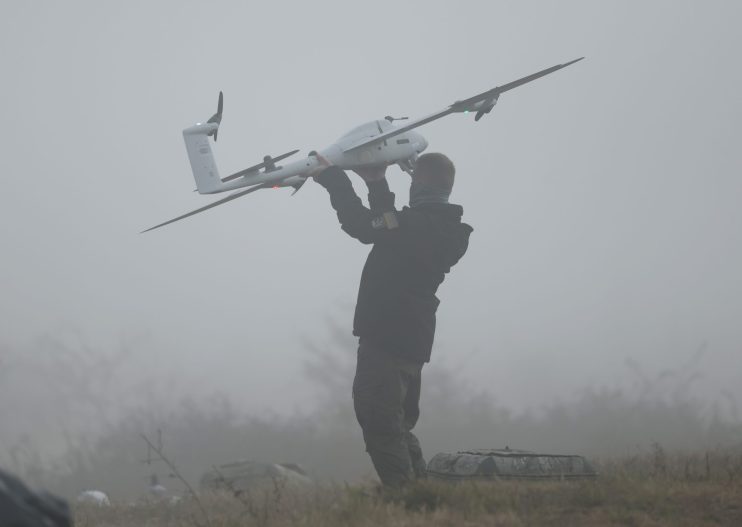
As Ukraine’s domestic defence-tech sector has rapidly scaled through wartime innovation and decentralized procurement, the military relationship between the West and Ukraine is evolving into a symbiotic exchange, says Tom Bailey
When Russian tanks streamed over Ukraine’s border in 2022, Western military aid was vital for Ukraine’s heroic defence. But as the war has ground on, Ukraine is increasingly becoming reliant upon its own locally developed and produced technology and weapons. In April this year, the Ukrainian government noted that over 50 per cent of weapons used on the frontline were Ukrainian-made. Ukraine’s Defence Procurement Agency reported that 95 per cent of the drones it procured were Ukrainian-made.
This was largely achieved through the necessity of war. In the early days of the war, civilian volunteers were adapting commercially available drones for military use, often working directly with frontline units. Since then, Ukraine’s government has initiated reforms and policies that have led to the number of Ukrainian defence-tech companies growing from 10 in 2022 to 1,500 by 2025.
These companies have been able to develop and adapt their technologies in real-world conditions, with soldiers reporting back on the effectiveness of different weapons. An interesting attempt to harness this is through the launch of the Brave1 marketplace. Units within Ukraine’s military earn “points” for verified successful strikes or missions, with more awarded for higher value categories. These points are then used by the unit to buy military equipment, including drones, from a list of approved vendors. Drones deemed the highest performing by those whose lives are on the line are likely to receive more orders. Around 600,000 drones have been ordered via the market-place since the start of the year.
The benefits of the marketplace
This “marketplace”, however, goes beyond providing a real-time feedback loop. Rather than relying upon government officials to determine which drone should be bought from which supplier in which quantity, Ukraine has decentralised these decisions. As often happens in centralised systems, those at the top may have inadequate information or not appreciate certain nuances in all situations or environments. Better, at least in some instances, to trust those on the ground, risking their lives, to choose which drone will best serve their specific mission. At a recent Brave1 event I attended in London, this marketplace was directly contrasted with the almost centrally planned way military procurement often works – a comparison that resonates in a country trying to shake off its Soviet legacy.
Stay in the know
Three daily briefings with the key market moves and top business and political stories.
SUBSCRIBE HEREThis marketplace approach also lowers the barriers to entry for smaller companies looking to sell their drones. Globally, smaller defence manufacturers often struggle to secure big government contracts without first showing their ability to manufacture at scale. Yet without those contracts, scaling production can be difficult. Ukraine has found an innovative way around this problem.
Despite Rheinmetall’s CEO once dismissing Ukraine’s drone industry as “housewives” with 3-D printers in the kitchen, there is growing interest among global defence companies in partnering with or acquiring Ukrainian defence-tech companies
So, despite Rheinmetall’s CEO once dismissing Ukraine’s drone industry as “housewives” with 3-D printers in the kitchen, there is growing interest among global defence companies in partnering with or acquiring Ukrainian defence-tech companies. According to the Kyiv School of Economics, at least 180 defence-industry partnerships have been initiated between Ukrainian and foreign companies since the war began.
Earlier this year, Ukrainian drone company General Cherry signed a letter of intent with Finnish defence company Patria to manufacture drones. General Cherry has consistently topped Ukraine’s rankings tables for verified battlefield strikes. Another drone company, Skyfall, has partnered with Airbus to develop air defence technologies. Nasdaq-listed Swarmer, which provides AI-software for drones, is currently in the process of acquiring Ratel Robotics, a Ukrainian firm which produces unmanned ground vehicles. Draganfly, a Canadian-drone maker, has made an investment in DoD Solution, an Estonian-Ukrainian drone software company.
So while at the beginning of the war, Ukraine depended heavily on Western weapons, as Europe confronts its own geopolitical vulnerability, it is starting to find itself depending on Ukrainian ones. The defence relationship between the West and Ukraine is becoming symbiotic.
Tom Bailey is head of research at HANetf