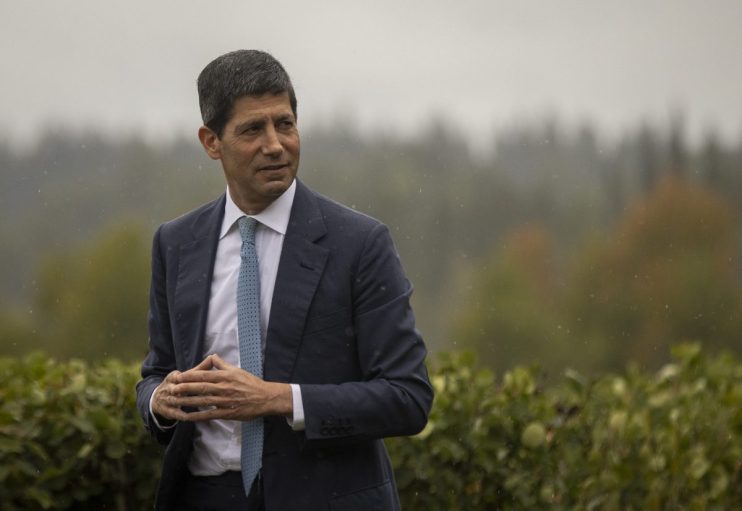
Federal Reserve Chair Kevin Warsh is urging markets to stop relying on central bank guidance and instead independently interpret economic data, signalling a shift toward a paradigm where higher interest rates are accepted as a component of a high-growth, prosperous economy, says Helen Thomas
“We should not indulge a regime in which market participants are looking primarily to the Fed for their next trade.” Despite this warning from new Federal Reserve Chair Kevin Warsh in his keynote Jackson Hole address last Friday, the market preferred once again to latch onto the familiar simple question of whether he had been dovish or hawkish, plumping for the latter.
Warsh certainly noted with sanguinity that “business capital expenditures – the seed corn of future economic growth – are rising rapidly” and “the labour markets are consistent with full employment”. But that doesn’t mean an aggressive hiking cycle is on its way. It might, or it might not. The point is that Warsh doesn’t want to be the one signalling it to the market. He wants investors to make up their own minds: “Market participants themselves should be tracking real information across the economy. They should draw their own conclusion.”
But how is the Fed to extricate itself from what Warsh noted Ben Bernanke described in April 2004 as a “hall-of-mirrors problem”? If the market watches the Fed and the Fed watches the market, the information value of both market prices and Fed communications is reduced to almost nothing.
That feedback loop was useful during the deflationary bust after the Global Financial Crisis, when the world risked becoming stuck in a depressive doom loop and monetary policy was, to use another Fed Chair’s phrase, pushing on a string: unable to resurrect the velocity of money and revive animal spirits. The Fed had to guide markets towards sunnier climes or the dark days might have persisted.
But we are no longer in a deflationary world. Nowhere is that clearer than Japan, where huge amounts of debt caused little concern during two lost decades of negligible inflation. For the last four years, Japanese headline inflation has run above the Bank of Japan’s target, prompting the BOJ to raise interest rates five times to their highest level in thirty years.
Higher inflation has also driven up yields across almost all developed-country government bond markets. This has been accompanied by ever more exclamatory headlines: in August, the US auctioned 30-year bonds at the highest yield since 2001; the French 10-year hit its highest level since 2008; and so on.
The US spends more on interest than on defence
The concern is a fair one. The more heavily indebted governments must pay to service their debt, the less room they have for other spending commitments. The US now spends more on interest than on defence, with both at eye-watering levels above $1 trillion. Annual US interest expense has risen to a record 18.5 per cent of federal government revenue, above the previous peak of 18.4 per cent set in 1991. It is not just the scale that matters but the speed: the proportion of GDP spent on interest payments has quadrupled in four years.
This is what happens when a global pandemic begets higher debt and is followed by two commodity-supply-shock wars. The arithmetic is unlikely to change course any time soon. But there is another side of the ledger that can provide relief: growth.
Warsh frequently cited the pace of technological change before concluding that “the potential for substantially higher growth is on the rise”. In a world of high growth and high inflation, higher interest rates are not only a rational response but also nothing to fear.
It is this Pavlovian response that Warsh is seeking to squeeze out of markets. Almost two decades of governments and central banks intervening to prevent terrible crises have conditioned investors to believe that higher interest rates inevitably lead to disaster. Worse, there is now a sense that volatility itself must be avoided at all costs.
But life always springs surprises. There will always be shocks. Markets should reprice when they receive fresh information rather than wait to be guided by an illusory omnipotent central bank administering sedatives to ease any unexpected pain. As Warsh told his audience at Jackson Hole: “If markets rely materially on the Fed’s guidance and the Fed relies on market prices, we are all more likely to be blinded to new developments, more likely to be caught unprepared for a turn of events and more likely to commit errors in policymaking.”
Under Warsh’s new approach, markets will have to tolerate more short-term volatility in the hope of avoiding bigger long-term mistakes. They will have to stand on their own two feet rather than be spoon-fed a smooth and predictable path by central bank forward guidance. With Warsh evidently upbeat about the outlook for the US economy, he may even welcome higher US yields as markets can do some of the tightening for him.
This will present a challenge for his ultimate boss. President Trump told the Detroit Economic Club in January of his frustration with the Fed: “in the old days, when you had good numbers, interest rates would go down… When there’s good news, the market should go up, not go down… You have a good quarter, and they want to kill it because they’re so petrified of inflation.”
Warsh is unlikely to change Trump’s reaction function, so instead he is trying to change the market’s. He is deliberately breaking the paradigm that stock markets can only rise when interest rates fall. Instead, he wants investors to accept that a hawkish Fed can not only coexist with a booming economy and buoyant stock markets, but may be the natural consequence of them. The message from Warsh is simple: if higher rates are the price of prosperity, markets should learn to enjoy paying it.