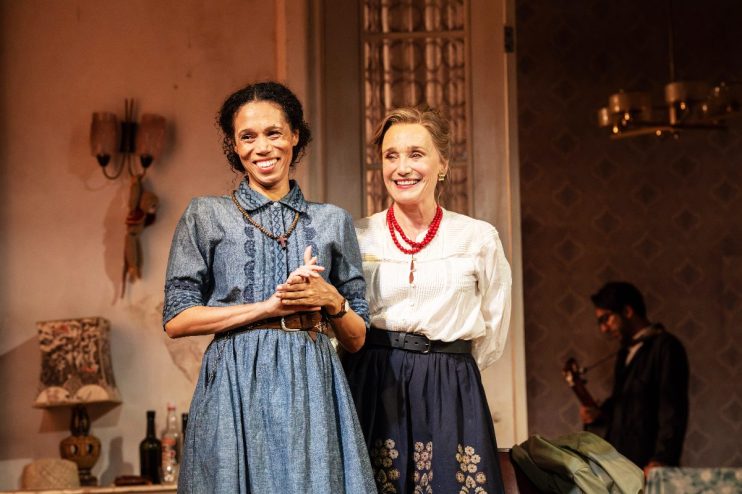
Luminous Kristin Scott Thomas is the perfect choice for eccentric, blinkered stateswoman Lyubov Ranevskaya in Anton Chekhov’s The Cherry Orchard, a mound of gesticulating passion and nostalgic delusion as the broke matriarch being slowly and painfully dethroned from her Russian country pile.
In the twentieth century’s first great play, written between 1901 and 1903, the aristocrats are fading from power against the rise of the upwardly mobile middle class, represented by Stephen Mangan’s self-made merchant, Yermolay Lopakhin. He is both a saviour and irritant to Ranevskaya in that he pitches to buy the family’s estate, but at the cost of sawing down the property’s prized cherry orchard and transforming the land into a series of smaller holiday homes.
The cherry orchard motif represents the bounty of life, and the presence of beauty, and Chekhov’s towering metaphor plays out against Chloe Lamford’s sparse set, the cold, crumbling opulence of a family drawing room in the house Ranevskaya is fighting to save.
Conor McPherson and Ian Rickson’s new production is fluid and naturalistic, and leans into the script’s farcicial quality. In particular, Rickson has exploited Mangan’s comedic nose, pairing his delivery with a physical effeteness to modernise the bright and cocksure salesman. With both actors hamming up the physicality, he is a worthy provocateur opposite the Four Weddings and a Funeral star’s airily out of touch matriarch.
The Cherry Orchard: a contemporary case
Chekhov’s secondary characters feel remarkably fleshed-out, even by today’s playwriting standards. Particularly strong are Ranevskaya’s daughter Anya and the academic, forward-thinking Petya, whose romanticising is hemmed in by their family duty.
Then there is 87-year-old servant Firs, the leading tragi-comedy figure whose ridiculous homages to old household furniture expose his dated value system, but whose vulnerable, genteel take on the famous act 2 outro brings a wonderful tenderness, even if the play’s final conceit feels flawed. To that end, the idea Firs represents in the final scene, that homeless people will be let down after the generous Ranevskaya moves out, doesn’t acknowledge the potential generosity of the new middle classes; in fact, people who have experienced poverty are often more likely to donate than those who haven’t.
As this bunch of nervous aristos raise a glass or five at what could be their final knees-up, it all hangs off of Scott Thomas, who feels birthed to deliver Chekhov’s profundities. “Maybe it is an illusion, but I’m as entitled to mine as you are to yours,” she gushes, and pitted against the backdrop of today’s ailing upper classes, Ranevskaya makes a brilliant, contemporary case.
The Cherry Orchard plays at the Harold Pinter Theatre until 9 January