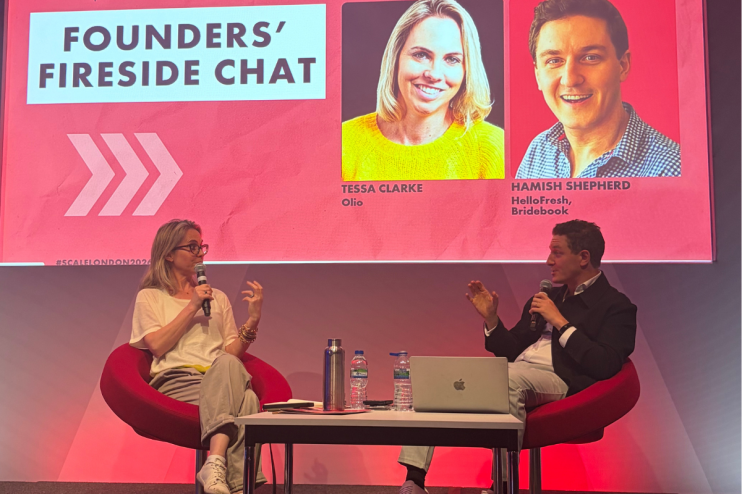
Tessa Clarke spent three and a half years trying to sign Tesco. Another large retailer took her six years and a third is still at the pilot stage after eight.
In a fireside chat at SCALE Summit in London, Tessa talked to HelloFresh co-founder Hamish Shephard about the reality of selling into large corporates.
It’s slow, it rarely follows the founders’ plan, and if you bet everything on closing one big commercial relationship, you are probably taking an unnecessary risk.
I’ve been reflecting on their conversation, which took place at the Business Design Centre in April, and looking forward to the Selling Into Enterprise panel happening at SCALE Manchester on 25 November. For Commercial Directors like me, these are the scaleup lessons that matter most.
Gather your evidence first
Tessa Clarke’s Olio app has rescued over 100 million meals that were destined for the bin. Led by a female-majority team, Olio tackles household and community waste by connecting neighbours so they can give away spare food and household items rather than throw them away. Olio’s growth has been driven by its business proposition: unsold food is collected from supermarkets, schools, hospitals, restaurants, and corporate canteens, then listed on the app for locals to collect within minutes.
“We charge businesses for the service; instead of paying waste contractors to throw away surplus food, they now pay us,” Tessa explained.
She described pouncing on a Tesco representative at a conference in Coventry ten years ago, when Olio had around 10,000 users, and being dismissed. So, instead, she started with three or four corner shops in Crouch End and Finsbury Park, before working up to bigger corporate partners like Planet Organic and Pret A Manger.
The lesson for founders is that you’ve got to prove it first. “You don’t start with Tesco,” said Tessa. Build a case study at a small scale before approaching the big corporate accounts you really want. For Olio, pilots with corner shops generated the data and proof points needed to make the pitch to a national chain credible. It’s a principle that translates across virtually all sectors.
The pincer movement
Tessa was also clear that the relationship only counts once it has been prioritised internally at C-suite level. I’ve seen this over my career in newspapers and events: low-level relationship-building can feel like progress, but let’s be honest – until you get to the decision-makers, there’s no real prospect of closing a deal.
Once a large corporate does commit, the pace changes almost immediately, which Tessa described as an “incredible whiplash effect”. After years building relationships slowly and carefully, a signed client suddenly wants to be rolled out across its full estate within weeks. Tessa has learned to prepare for that shift by agreeing commercial terms before a pilot begins. That way, a successful pilot can move straight into a scaleup phase without a second negotiation, which is where deals can frustratingly slip through your fingers.
When Hamish asked her whether a personal introduction to a chief executive could have shaved a year off the Tesco deal, Tessa said ‘no’, and described the “pincer movement” used at Olio. The sales team work on building relationships low down in the organisation, while the founders go straight to the top. Speaking at industry events like SCALE, where senior decision-makers are in the audience, is part of this strategy.
“When you’re on the stage, they come to you and it changes the power dynamic. Once you’ve got a CEO excited, they send missives down the organisation and it can really help unblock conversations,” Tessa explained.
Match your pitch to the person in front of you
Any scaleup doing business with corporates knows the agony of waiting for sign-off. Tessa’s advice was to scope the proposal to match the seniority of the person in the room, rather than pitching something bigger that requires approval from someone else.
“If the contact can only authorise two stores, the pitch should be for two stores,” she said. That’s the result to aim for in the first instance.
Pilots should be paid for
Olio moved away from free pilots after finding that clients didn’t have enough incentive to make them a success. Pilots are now paid by default, though the fee is sometimes waived to keep momentum if a procurement process is particularly slow. However, if a client wants to extend a four-week pilot and run it for a further four weeks, that additional time is billed.
Tessa also pushed back on the idea of discounting pilots in exchange for marketing exposure, since early adopters and industry-leading clients typically want to promote the partnership anyway.
“In our experience, they’ve enjoyed the opportunity… they want to protect that exclusivity to get the branding benefit. I wouldn’t necessarily be going in there and dropping my price on a pilot in exchange for marketing,” said Tessa.
I couldn’t agree more. Exclusivity is a paid-for privilege. At SCALE, ‘contra’ partnerships are an important way to build our ecosystem allies and grow our audience, but exclusivity is reserved for our biggest clients, and in sectors like banking and finance, being the first name on the list is worth every penny.
Build patiently, test cheaply
Hamish Shephard, who led HelloFresh’s early US expansion, described his test-and-learn approach to finding what actually works commercially. “In our first year we did 650 tests to find viable partnership channels”. Most of them went nowhere, but he and his team showed “amazing resilience” when 95 per cent of the tests they did failed. According to Hamish, the secret to getting through it and finding success was “a really curious mindset, not a defeatist mindset.”
Curiosity may have killed the cat, but that mindset paid off when HelloFresh landed an unlikely partnership with a dog food brand.
“Everyone was like, ‘Why on earth is HelloFresh partnering with dog food?’ You don’t want to be associated with them,’” Hamish recalls. “We had to work out why it was doing well, and we started to learn that people with dogs have structured lives. They can’t go home and choose to go out to a restaurant.” Suddenly, it became clear why dog owners would get more benefit from HelloFresh than customers in less predictable, younger urban markets. His advice to founders testing new channels was: “Move fast and keep it cheap if you can.”
Continuing the conversation
What the audience learned from Tessa and Hamish at SCALE London is that selling into enterprise can’t be unlocked through a single high-level connection. Whatever your business, and whoever you’re trying to pitch to or partner with, landing those big deals still requires old-school sales structure and discipline. And to close, you need to get in a room with the decision-makers.
For scaleups building, piloting and pitching to giants right now, SCALE Manchester on 25 November features a dedicated Selling into Enterprise session, to help UK scaleups land their first major corporate or public sector contract.
Two entrepreneurs scaling out of the North West – Steph Scholes, co-founder of corporate gifting company Needi, and Chris Gore, co-founder of IT installation specialists SPOR Group – will chat to experts from DBIST and Greater Manchester Business Growth Hub about unlocking the enterprise-level deals that have accelerated their growth. To join us, register for SCALE Manchester.