Everyone’s been to the Highlands, so minimise travel and visit the spectacular Scottish Lowlands for your next Scotland trip, by Alexandra Pereira
The first thing I notice at Glenapp Castle are the curling stones. Wedging open the heavy doors, these granite boulders are hewn from Ailsa Craig, the island you can see from the windows of this mighty Scottish property.
Inside, every corridor gives period drama; every staircase evokes a mysterious aristocrat descending at midnight.
This is The Wicker Man country, where remote islands, peculiar local traditions and mist-shrouded seas lend themselves to cinematic drama. The 1973 cult classic, starring Edward Woodward and Christopher Lee, was filmed around these stretches of south-west Scotland. Thankfully, our own story is more relaxing.
Scotland’s luxury travel industry places so much emphasis on the Highlands. But Glenapp, a Relais & Châteaux hotel near Ballantrae, makes a compelling case for staying in the Scottish Lowlands. Take a scenic train up through the Lakes from Euston to Glasgow (3.5h) and arrange a Glenapp transfer (90min).
Stay in the know
Three daily briefings with the key market moves and top business and political stories.
SUBSCRIBE HERE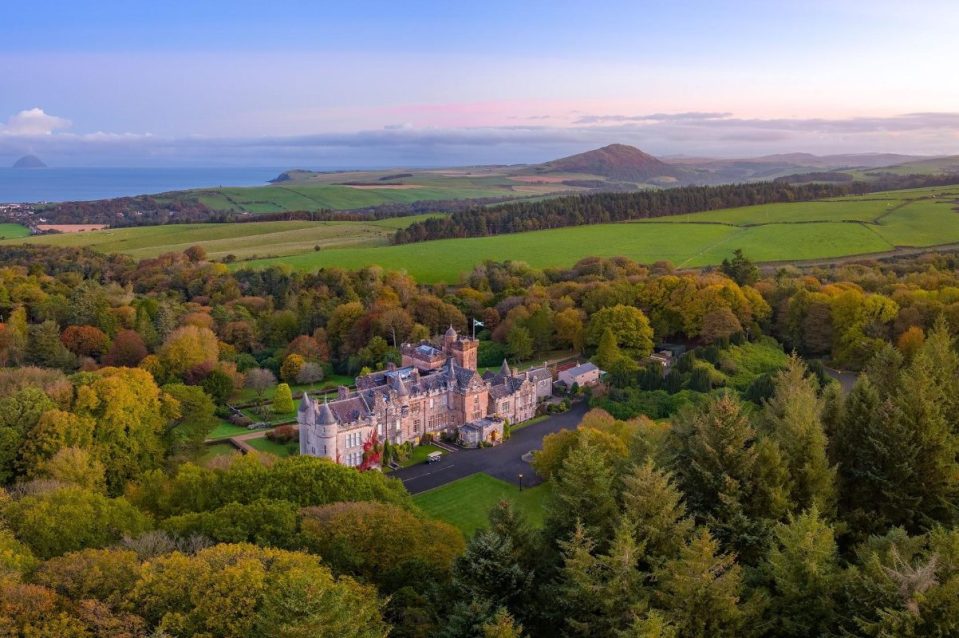
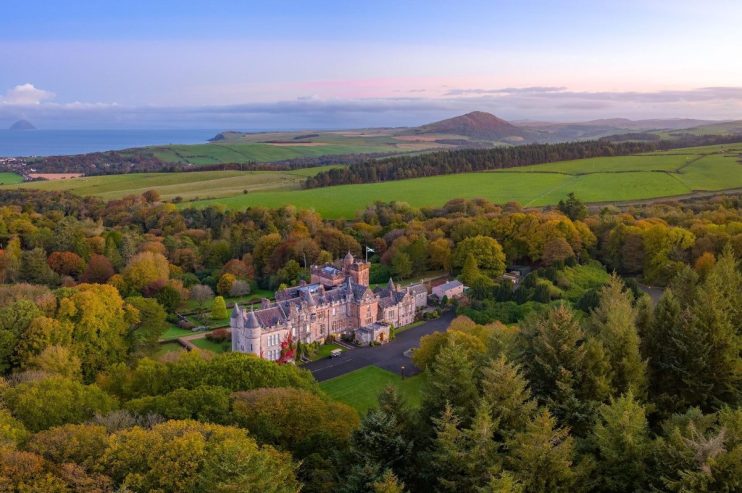
Set in 36 acres of gardens and woodland, the 21-bedroom castle looks across the Irish Sea towards the 99 hectares-wide Ailsa Craig and the Mull of Kintyre. Roe deer move through the grounds, woodpeckers provide the soundtrack, and the staff are warm rather than starchy. This feels like a house with real history, rather than a hotel striving to manufacture one.
My dear friend Will – my top companion for rogue country rambles, and my trusty deliverer of room service in robes – is a television producer with an eye for a location. We’ve been here five minutes and he’s already mentally casting this place.
Scotland holidays: windows frame Ailsa Craig
I’m staying in The Nest, a one-bedroom cottage suite in the estate’s 1830s walled garden. Converted from a former tearoom, this property, which launched in the summer, offers 60 square metres of period antiques, rich fabrics, a log burner and woodland views. In the garden I spot frogs and dragonflies. Outdoors, a private sauna, ice plunge tub and shower are hidden by hedgerow, and beyond, there are magnificent grounds.
The gardens benefit from the region’s mild microclimate, influenced by the Gulf Stream. Three botanical gardens in the wider area, including Logan Botanic Garden, testify to the conditions that allow plants to flourish here despite Scotland’s northerly latitude. Snow is less of a fixture, making getting here a safe bet unlike some of Scotland’s more northerly castles.
Dinner begins with cocktails in the drawing room, where ceiling-high windows frame Ailsa Craig. An optical illusion gives the impression the island is close, but it is actually ten miles from the mainland. Will is still scouting locations while I’m more interested in what’s being poured.
Scrambles to the black, glossy waters
Executive chef Peter Howarth and his team serve a seven-course tasting menu, with a three-course alternative. Highlights included fat scallops, earthy potatoes, wonderful rhubarb dessert. Extra points for the silver service, which justifies itself in these surroundings, and chats with staff in the candlelit dining room.
The restaurant holds three AA Rosettes, and its kitchen draws on the estate’s garden, polytunnels and 150-foot glasshouse. A wine flight is a worthwhile indulgence; as is a dram from the castle’s single-malt range afterwards. For lunch or dinner, The Azalea, housed in the Victorian glasshouse, offers a relaxed alternative.
Paths go through woodland and down into the glen towards the coast. We enjoy multiple scrambles down to the black, glossy waters under the shadows of the firs, enjoying that the only sounds are of the water and the snaps of twigs.
The Scottish Lowlands’ epic Galloway Hills complete the view on clear days. The weather supplies its own filmset values: shafts of sunlight, sudden rain and skies that change mood between footsteps. I remain forever and newly enchanted by these lands and the way light falls, reminding me of Scandinavia where I once lived.
Birds make a racket
Eventually, the island demands more than a supporting role. We head out to sea. Ailsa Craig rises from the Firth of Clyde nine miles offshore, its granite prized by sporting curlers for around 250 years. An estimated 60 to 70 per cent of the world’s curling stones are still made from it, including those used at every Winter Olympics since 2006.
Perhaps the strangest team sport, athletes play a sort of chess-on-ice, sliding granite rocks towards targets. The stone is carefully prised from the land in 20-tonne chunks, before a laborious sculpting and sanding down to begin fashioning these obscure, elegant instruments.
Tens of thousands of gannets crowd the island’s cliffs alongside guillemots, razorbills and kittiwakes. They make an absolute racket as we near, the waves bouncing our boat around.
Rats introduced in the 19th century devastated eggs and chicks, and puffins disappeared as breeding birds. Following an eradication campaign in 1991, puffins returned to breed in 2002.
Watching the birds wheel above the cliffs, I grasp the region’s cinematic appeal. My bird-lover pal Will grips his binoculars ever tighter as more and more come, his elbows doing laps of the horizon as he moves them backwards and forwards.
Piles of lobster and mackerel
We are cold and ready for that next dram, and a spot of lunch. Back on the mainland, we drive south to Portpatrick, near Scotland’s southernmost tip, where the harbour occupies a natural amphitheatre in the coast. Personal drivers can be arranged with Glenapp should you be carless, and these trips are especially welcome on bad weather days when the boat can’t go out.
In this tiny, hilly town, a giant anchor and a gate opening towards the sea tell the story of this place, shaped by its relationship with the water. Steps, like those of an amphitheatre, lead to the sea, and in the distance we just about make out Belfast.
It’s a Tuesday afternoon, but the Crown Hotel is busy. It’s a harbour-front homely pub with laminated menus and a lively, welcoming vibe. Winner of the AA Seafood Pub of Scotland award, the area is increasingly championed for oysters. We study laminated menus and end up with piles of fresh local fish and shellfish: half a lobster and mackerel, with salads and cobs.
The Highlands will always have drama
Along this same short part of coastline, some 22km from Portpatrick, Cairnryan’s Stena Line ferries connect Scotland with Northern Ireland. Tourism in this corner of Ayrshire isn’t fully realised. The campaign for a Galloway National Park reflects the desire to give this landscape greater recognition, which will help the local economy.
As for the locals, pride extends to the produce. One claim I hear is that Galloway has the best milk in Scotland, thanks to its grass, sea air and mineral-rich soils, the humble brag capturing the region’s confidence in its produce.
At nearby Bladnoch Distillery – a 40 minute drive from Portpatrick – the connection between landscape and spirit is summed up in one memorable phrase: “Today’s rain is tomorrow’s whisky.” I don’t visit this time round, but our driver has samples, and this wisdom to share, and we order another dram back at the Castle after being pelted with rain on another glen amble.
The Highlands will always have drama but Ayrshire and Galloway offer something more understated. For a cinematic year-round weekend escape, it’s every bit as compelling and cosy.
Book this Scotland holiday
Glenapp Castle’s Garden View Suites start from £595 per night. The Nest B&B rates start from £837.25 per night in low season, rising to £1,575 per night in peak season. The Ailsa Craig Boat Trip is £1,250 for a half-day experience. The Hebridean Sea Safari’s five-day, five-night adventure starts from £17,500 for two people, with an additional £3,500 per adult glenappcastle.com