Here's our full story:
France was hit by a fresh wave of selling in its bond and stock markets on Monday after violent protests over the weekend left public buildings burned, hundreds of shops looted and thousands of arrests across the country.
The French and Italian stock markets have both tumbled more than 1%, while the sell-off in French government bonds deepened.
This has pushed the yield, or interest rate, on the benchmark 10-year bond up by 7.5 basis points to 4.855%.
The Stoxx 600 index of Europe's leading shares is down 0.4%. The UK's FTSE 100 lost 0.6% or 66 points to 10,815, while the German market slid 0.7%.
France's political and fiscal problems gained another complication over the weekend as nationwide cost-of-living protests descended into some of the country's worst unrest in years. Around 550,000 people demonstrated on Saturday according to the Interior Ministry, although the CGT [Confédération Générale du Travail trade union] put the figure at 800,000, and the violence continued into Sunday with fresh clashes in Paris and Marseille. The latest official figures put arrests at 2,400 and police injuries at nearly 1,000.
This won't make it easy for the international community to be totally comfortable buying OATs, so the modest recovery in French spreads over the last week or so will be tested today. In a televised address last night, appealed for calm, saying France felt "anger and shame" at the violence.
He stopped short of declaring a state of emergency, but said prefects could ban protests where necessary to protect public buildings and businesses, while distinguishing peaceful demonstrators from ultra-left groups and criminals blamed by the government for the rioting. With France already facing a difficult fiscal backdrop and the 2027 election approaching, the weekend adds another layer of political risk for markets.
, chief China+ economist at , has looked at the Chinese GDP figures.
Policymakers are likely to view their efforts to stabilise headline growth in the third quarter as successful, despite persistent structural imbalances and weak underlying domestic demand.
Headline industrial production rose in September partly as coal mines resumed operations after safety inspections prompted by a major accident. Manufacturing output growth remained robust at 6.0% year on year in September, buoyed by stronger export demand for electronics, AI-related equipment and autos.
High-tech manufacturing output continues to outperform traditional sectors, as China climbs the value-added ladder.
Policymakers will probably feel confident that China can hit the 4.5-to-5% annual growth target, as targeted policy support gains traction in Q4. This includes policy bank funding for local infrastructure and manufacturing investment – with 550bn renminbi of the 800bn renminbi annual quota still to come - fiscal subsidies for mortgage interest payments and 550bn remminbi in additional local government bond quota.
This round of targeted support will provide only a modest short-term boost before soft underlying soft domestic demand reasserts itself, notably through falling property construction and muted household spending. Policymakers will continue to prioritise promoting innovation and high-tech sectors over short-term growth in 2027. Export growth is likely to slow as trade friction intensify, increasing the need for further targeted support.
Good morning, and welcome to our rolling coverage of business, the financial markets and the world economy.
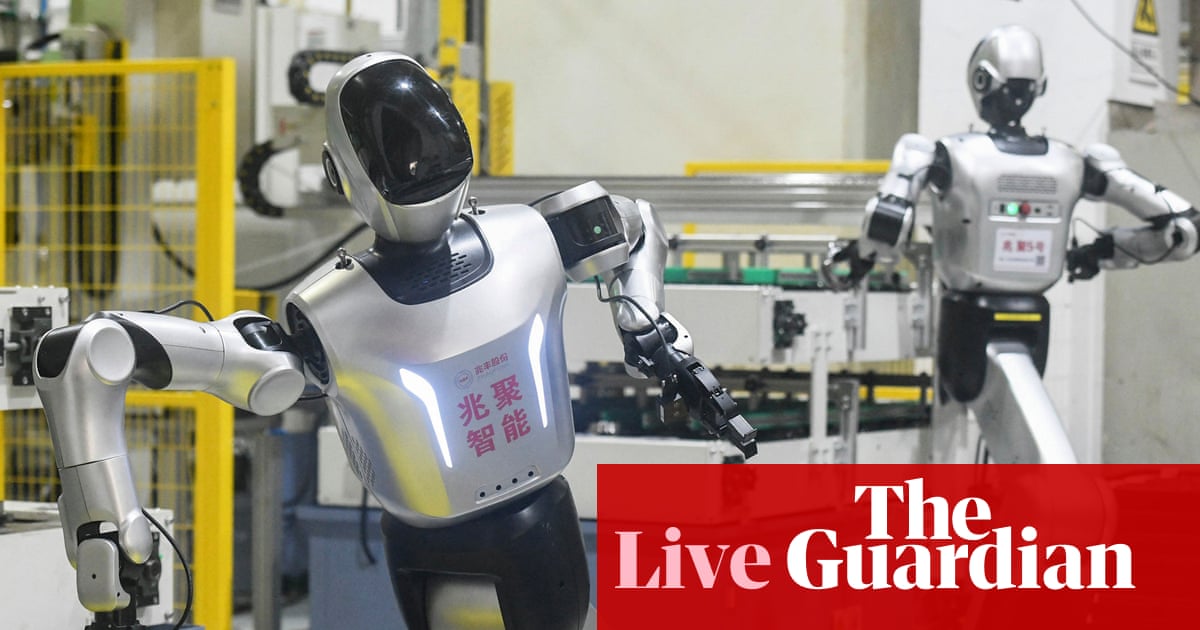
Roaring exports lifted China's economic growth in the third quarter despite lacklustre consumer spending, which lagged far behind factory output.
The country's GDP grew by 4.5% year on year between June and September, better than economists had expected and up from the second quarter's 4.3%. The economy grew by 4.6% in the first nine months of the year, putting it on track to hit the government's 2026 target of 4.5% to 5% growth without extra stimulus measures.
Industrial production rose 5.5% in September, up from 5.2% in August, while retail sales increased 1.1%, up from 0.4%.
However, fixed-asset investment fell 7.2% over the first nine months, property investment tumbled by 20.6%, and infrastructure spending remained weak.
The headline GDP number tells you the economy is still moving forward; the internals tell you the factory floor is doing most of the running while households, property and investment are still somewhere behind looking for their shoes.
Contracting fixed investment and another deep property decline leaves the domestic economy badly out of step with the factory sector.
The semiconductor boom is increasingly a price story rather than a volume story…
Beijing now has less urgency to ease aggressively, but unless local demand catches up, China remains dependent on the rest of the world absorbing what its factories produce, bringing the trade imbalance increasingly into view.
In Asian stock markets, Japan's Nikkei fell 0.6% while China's CSI 300 rose 0.2%, Hong Kong's Hang Seng climbed 0.5% and South Korea's Kospi added 1.5%.
Increasingly violent street protests in France have put pressure on the euro, while French bonds sold off, pushing yields higher, ahead of a bond auction later in the day.
The yield, or interest rate, on the 10-year French government bond rose more than 6 basis points to 4.842%. The European single currency dipped 0.2% to $1.1218 versus the dollar.
The spread between 10-year German and French government bonds has widened by 6.5 basis points, indicating the premium investors pay for French debt over what is considered ultra-safe German debt.