eet the new chancellor. Same as the old chancellor. Although, on reflection, that might be a little hard on Rachel Reeves. At least Rachel had given the job some thought before she got it. She had had some experience working at the Bank of England and, whether you liked it or not, she had some kind of plan. John Healey? Not so much. No one can remember him ever having given the economy much thought until Andy Burnham offered the job. He was more the strong and silent type.
As defence secretary, Healey had looked like a man of principle. A defender of the armed forces, a guardian of the realm. He had even resigned over Keir Starmer and Reeves's refusal to guarantee increasing the defence budget to 3% of GDP by 2030.
Now that he's in charge of the purse strings, he's remained silent. Though not so strong. It feels as if he doesn't know what he thinks. Or if he even thinks at all. Almost as if, were he to spend too much time in deliberation, he might have to resign all over again. He doesn't even come across as a career opportunist. A well-trodden route for cabinet ministers over the years. Instead, he's just a rabbit caught in the headlights.
There again, for your first major speech as chancellor, you'd probably prefer it if the cost of government borrowing wasn't at a record high since the financial crash and that Jaguar Land Rover hadn't chosen that morning to announce 4,000 redundancies. On the plus side, Healey could be guaranteed everyone's attention. The trickier question to answer was whether he would want it.
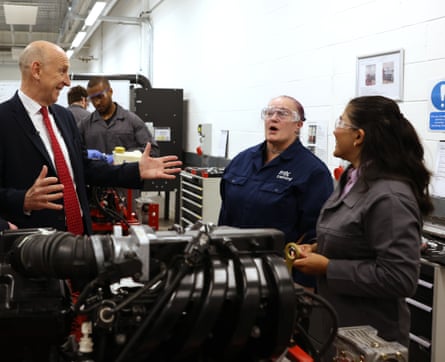
Burnham had stayed away from the Manufacturing Technology Centre in Coventry because he didn't want to steal his chancellor's sun. Amazingly though, Healey somehow managed to eclipse himself. It was like watching a man in negative space. The lights were off and no one was at home. One of those occasions when to have barricaded himself in the Treasury, refusing to come out, would have been a massive improvement all round. With John, less really is more. At least that way there's the possibility of authority.
You would have hoped Healey's ability with numbers was rather better than his time-keeping. He was 15 minutes late for his own debut and the business secretary, Jonathan Reynolds, and the entire Treasury ministerial team were getting decidedly fidgety before his arrival. Perhaps they were wondering whether the chancellor was going to throw a sickie. Had decided he wasn't the right man for the gig after all. We'd have all understood. It's a tough job and it isn't for everyone. I'd hate to do it.
It was a very nervy-looking Healey who eventually appeared. Occasionally having to grab hold of the lectern to make sure he didn't fall over. Not the most reassuring sight. Less rock. More Northern Rock. Even when you know the news is going to be bad, you want your chancellor to appear strong and coherent. In the same way you want your doctor to tell you she has a plan and you are not going to die, in the same breath as she has said you have a life-threatening illness. A chancellor is someone you need to believe in. Not someone who will agree with you that we are probably all screwed.
Healey started downbeat. The global situation was terrible. The Tories had trashed the economy. Politicians don't get to choose the time and circumstances in which they are asked to serve. It rather suggested he would have much preferred not to have landed up at the Treasury just now. But hey! We were all in it together so we might as well make the best of it. He would do what he could to make things a bit better, but if it didn't work out he hoped there would be no bad feelings. You couldn't help feeling it was the blind leading the blind.
Then came the continuity Rachel stuff. Fiscal discipline was his priority. He would be maintaining his predecessor's fiscal rules. He would be honest about government spending. Manifesto promises would be honoured. It made you wonder why we had changed prime minister if it was all going to be much the same. Had we been through all that psychodrama just to get someone with a little more personal charm, had twinklier eyes and who looked good in a T-shirt?
Having made all his excuses, Healey turned to the good vibes stuff. The hallmark of Andy's two months in office so far. Yes everything was terrible. Yes everything was going to stay the same. But not to worry because if we all just sat in a circle, chanted "Om" and had positive thoughts then we could turn this around. We were going all out for growth through devolution. He wanted to bring hope to every postcode. John is one of the few people who can make hope sound like a sexually transmitted disease.
It was all a bit painful. Unconvincing. Boring. You longed for him to stop because the speech was as painful to listen to as it was for him to give. Healey isn't cut out for all this positivity stuff. It dies on his lips. He was far better off where he had come from. He has the look and the gravitas of a man who had been born to make a television announcement that the UK was under nuclear attack. It was time to hide under the kitchen table with the dog and a can of baked beans and wait to die in half an hour's time. Thank you and goodbye.
The questions were no more revealing. Everything was either met with a dead bat, "You can't expect me to comment before the budget" or was brushed aside with mindless waffle as Healey tried to fill the dead air. Still, his speech didn't cause any extra volatility in the bond markets, so that was something. Then again, as he had spent half an hour saying nothing of interest, it would have been remarkable if the bond markets had moved. Perhaps he had sent the traders to sleep for a thousand years.
They wouldn't be the only ones. The whole of the government appeared to be in a Healey-induced sense of torpor. There was no sign of the home secretary, Shabana Mahmood. Normally, she would have been quick to crack down on the balaclava protesters in Dover and Portsmouth. But she too had been silenced. Almost as if the government wasn't quite sure if it was OK to call out the protests.
Strange that, given even Nigel Farage thought they weren't OK. It was fine to attack migrant women and children, just so long as you did it out in the open. Take a leaf out of the Reform conference where members had been filmed apparently attacking female protesters. That was the Britain we all knew and loved.