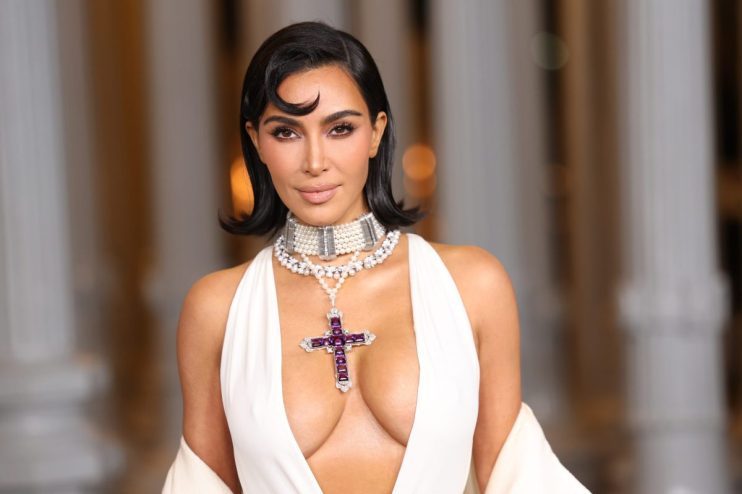
On this day, 21 October 1980, Kim Kardashian was born. Eliot Wilson traces the rise of the new form of celebrity she forged
I am old enough to remember the O.J. Simpson trial of 1995, when the former football legend was accused and sensationally acquitted of murdering his wife Nicole Brown Simpson and her friend Ron Goodman. Next to Simpson sat a 51-year-old college friend, thick hair with a streak of white at his hairline brushed back, immaculate in Italian-tailored suits and expensive silk ties. He had renewed his attorney’s licence to practice to join Simpson’s “Dream Team”, as moral support for Simpson.
His name was Robert Kardashian.
The trial put Kardashian and his family under uncomfortable scrutiny: he had three daughters and a son but had divorced his wife in 1991. Anxious about the future, longing for reassurance, he had even visited a psychic, which sat uneasily with his religious faith; he was a Molokan, a radical Biblically-focused Armenian sect. But she was unconvincing, he later told his middle daughter. “She saw my last name and said, ‘Kardashian’ will be internationally known. This is how I know they’re full of shit.”
His daughter Kim, who is 46 today, may beg to differ. With her sisters Kourtney and Khloé, half-sisters Kendall and Kylie, and their mother Kris Jenner, they have become a multi-industry media behemoth so famous and so ubiquitous it is difficult to remember a time when they were not household names. With that fame has come enormous wealth: mother and daughters are collectively estimated to be worth $3bn.
Stay in the know
Three daily briefings with the key market moves and top business and political stories.
SUBSCRIBE HEREThe early life of Kim Kardashian
Kimberly Noel Kardashian was born on 21 October 1980 at the famous Cedars-Sinai Medical Center in Los Angeles. She was Robert and Kris Kardashian’s second child, and the couple had recently moved into a 1950s mansion in Beverly Hills. This was no hardscrabble childhood: Robert had just sold his shares in music trade publication Radio & Records for $3m dollars (worth four times that today). The family was not rich-list wealthy but affluent, and Robert was well connected in the LA milieu of law, finance, commerce, property and always, always, celebrity.
Kim attended the elite Buckley School in Sherman Oaks – alumni include David Niven Jr, Bret Easton Ellis, Matthew Perry and, significantly, Paris Hilton and Nicole Richie – then Marymount High School in Bel Air, where Pat Hitchcock, only daughter of Sir Alfred, and Mia Farrow had been students.
After high school she worked at Body, an Encino boutique. There have been attempts to retrofit Kim’s current hypercelebrity on to her childhood and teenage years, but none quite works. Kim was pretty, fashion-conscious, generally well-behaved but gregarious; she neither dropped out nor attended college. On the level of the glossy magazine, her teenage snaps could have been of any of thousands of still-anonymous, affluent young women from Southern California with ambitions to be the proverbial actress, model, whatever.
But there – and still is – something different about her. Her father was the grandson of hard-working Armenian immigrants from Kars, and he believed in the power of education and industry. Kim left school at 16, moving straight into employment at Body and retains positive memories: “I loved it. I worked there for four years… and then I never stopped working.”
Her rise to fame was not the one she might have chosen. In 2006, she started working as a stylist for schoolmate Paris Hilton. It was the height of The Simple Life, Hilton’s reality television show with another Buckley alumna, Nicole Richie, and Kim appeared in several episodes, as well as accompanying Hilton to social events. She began to have a public profile, which exploded in 2007 when a sex tape she had made with singer Ray J four years previously appeared on the internet.
Vivid Entertainment was already selling the footage unlicensed and she reached a settlement by which she received $5m and allowed sales of Kim Kardashian, Superstar to continue. The video made $1.5m in six weeks. Was this, as many believe, proof of Kim’s thirst for fame at any price? Maybe. Or could it be a hard-headed assessment that the footage could not be suppressed and the monetisation of unalterable reality?
Sceptics and sneers were thick on the ground. October 2007 saw the launch of the show that changed everything, Keeping Up with the Kardashians. This was a platform not just for Kim but for her gimlet-eyed mother, Kris Jenner, and her family as a whole. It ran for 20 seasons over 14 years, comprising 286 episodes and 14 spinoffs in all, and was one of cable network E!’s most popular shows.
From there Kim could do anything she wanted, and did: fragrances, fashion, cosmetics, a joint autobiography with her sisters, production, fiction writing, acting, lucrative endorsements, even a private equity firm. An eight-year marriage to controversial rapper and producer Kanye West, which ended in 2022, ensured her name was never far from the headlines.
More than just ‘famous for being famous’
It is easy to dismiss and condemn Kim Kardashian as a rich girl who is “famous for being famous”, the phenomenon explored by historian Daniel J. Boorstein. It contains truth but is incomplete. Only heiresses inherit an estimated personal fortune of $1.9bn; she made hers, not least from her 35 per cent ownership of the shapewear and clothing brand she co-founded, Skims, now worth $5bn.
Another thesis: Kim Kardashian is a transformatively successful and talented entrepreneur. Let’s go back to Isfahan, then the recently declared new capital of Safavid Iran. In 1606, Shah Abbas I resettled around 300,000 Armenians in an area of the city called New Julfa, and it became the centre of a trading network that reached from Amsterdam and London to Manila and even Acapulco.
Now only 10,000-12,000, it is still one of the largest ethnic Armenian quarters in the world. Armenians are not uniquely gifted merchants and entrepreneurs, but consider the success of a few: oil trader Calouste Gulbenkian, hotelier and investor Kirk Kerkorian, art dealer Larry Gagosian, biotechnology entrepreneur Noubar Afeyan. Between 1375 and 1918 – more than half a millennium – Armenians had no independent sovereign state of their own. They were a nation in diaspora, but they had trade routes and an identity underpinned by one of the world’s oldest living languages and scripts with a distinctive educational and literary tradition.
Particularly striking is how many Armenian merchants and businessmen have gained an edge through the ability to see opportunities across sectors, to look beyond a product and understand where the value really resides.
Kardashian has done that. She sells beauty products and clothes and books, and dabbled in private equity, not because she is dilettante or superficial but because she grasped that she sells not products but aspiration, association and identification. She may be “famous for being famous”, but how many celebrities have been able so successfully to transform their mere fame into a remarkably durable commercial asset?
“The way that my parents taught me,” Kim said in 2018, “was, hey, when you’re 18, you’ve seen this lifestyle, I’m sure you’re going to want to upkeep it. If you’re going to want to live this way you’re going to have to get a job.”
She did, for a time. Then she did something much more remarkable. Maybe drawing from centuries of collective experience and instinct which could make Armenians rich even though they were homeless diasporan communities, she has deconstructed and rebuilt the nature of celebrity, and shown that if it’s properly understood and cultivated, it can underpin almost any business. Look at the market, look at your opportunities, and ask two simple questions: what will people pay for, and why do they really want it? Understand where the value lies.
Far-fetched? Perhaps. But while Kim Kardashian’s fortune puts her in the company of the easily defined success of Taylor Swift, Sir Peter Jackson and Jay-Z, it’s worth considering.
Eliot Wilson is a writer and historian. He is a senior fellow for national security at the Coalition for Global Prosperity and a contributing editor at Defence on the Brink