Good morning, and welcome to our rolling coverage of business, the financial markets and the world economy.
The global economy faces the prospect of $100 a barrel oil again, as the conflict in the Middle East continues.
Brent crude has risen back over the $98 a barrel mark already this week, its highest level since 24 July. Oil has been pushed up by reports that Yemen's Iran-aligned Houthis attacked energy facilities in Saudi Arabia.
Saudi authorities said operations at some energy facilities had been halted today following attacks by Yemen's Iran-aligned Houthis that wounded more than 70 people.
Yesterday, the Financial Times reported that Saudi Aramco's oil facilities in the Saudi Arabian city of Jizan – where one of the country's largest refineries is based – have been attacked
Earlier today, Iran threatened to create a new restricted zone in the Gulf if the US pressed on with its 'economic warfare' against Tehran.
Such a zone would, presumably, further undermine US efforts to reopen the strait of Hormuz.
the secretary of Iran's Supreme National Security Council, said Iran had " fundamentally recalibrated" its posture towards US forces.
posted on X:
In recent days, Washington has received a clear warning from Iran's new missiles. Economic warfare will be met by a maritime exclusion zone across the Persian Gulf to the blockade perimeter. The operational posture toward U.S. warships and bases has been fundamentally recalibrated.
Shipping traffic through the Strait of Hormuz has already slowed this week – just seven commodity vessels sailing through the Strait of Hormuz on Monday, down from eight on Sunday. Before the war began, about 130 ships a day would cross the strait.
This is all a headache for central bankers, as high oil prices create inflationary pressures through the economy. Later today, MPs in London will question Bank of England governor Andrew Bailey, and colleagues, about their recent decision to hold the Bank Rate at 3.75%.
The agenda
-
7am BST: German trade data for July
-
7.45am BST: French trade data for July
-
2.15pm BST: Bank of England policymakers appear before the Treasury select committee
Optimism among US small business owners has dropped, as they are hit by rising prices.
The NFIB Small Business Optimism Index dipped in August to 98.7, down 1.1 points compared with July.
chief economist explains:
"Uncertainty remains elevated among small business owners as they face a mixed set of challenges with weakened sales, supply chain disruptions, and inflation pressures.
"While expectations for the overall economy dimmed, Main Street owners remain largely positive in the health of their own businesses."
Ouch! European gas price have continued to rise, and are at their highest levels since January 2023.
The month-ahead UK gas price is now up more than 3% at 188p a therm, over the highs seen yesterday.
Continental European prices are also the highest since January 2023, at €75.70 per megawatt hour, which will fuel fears of a winter gas crisis in Europe.
Newsflash: South Africa's economy is on the brink of recession after contracting in the second quarter of this year.
New data shows that South Africa's GSP fell by 0.2% in April-June, ending a run of six quarters of growth in a row.
Mining, trade and manufacturing drove down economic activity on the production side of the economy, while a sharp rise in imports and subdued investment constrained growth on the expenditure side, reported South Africa's statistics body, adding:
Following six straight quarters of growth, the trade industry wobbled in the second quarter, shrinking by 1.9%.
This was due to a decline in wholesale trade, motor trade and the food & beverages industry. Consumer activity remained relatively upbeat, reflected in stronger retail trade and accommodation. Motor trade was dragged lower by softer fuel sales, but new vehicle sales continued to strengthen.
Yemen forces took over from Iran, attacking Saudi Arabian oil facilities, confirming that, despite reports of an imminent agreement between Oman and Iran about the Strait of Hormuz, the termination of the seven-month-old regional conflict remains elusive.
Expectations that the US President might try to sort out this conflict soon, so he can almost entirely focus on the critical November 3 midterm elections that could upset the current balance in the Senate, have yet to be confirmed.
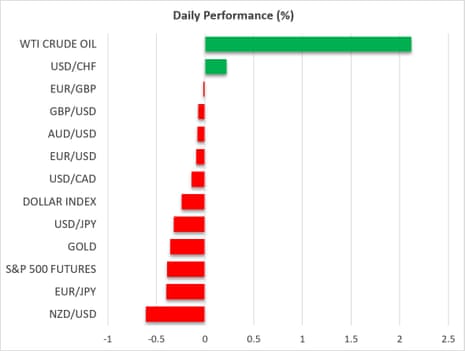
Oil is the focal point for markets today, reports , investor strategist, with bond yields up and stocks trade broadly lower.
Brent crude trades higher for a third straight session, approaching $100 amid reports that Yemen's Iran-backed Houthis have hit energy facilities in Saudi Arabia. Operations at energy sites near to Yemen have been halted.
It comes after reports that Saudi Aramco's Jizan refinery was hit, whilst Iran said it's close to doing a deal with Oman to manage the waterway. With Brent approaching $100 markets are pricing in a longer war and more disruption to global energy markets. Brent rallied +2% to above $99, where it's closed the gap to the 24 July close.
A sense today of disruption and conflict being a feature rather than a bug, and the implications for global markets that follow from structurally higher inflation dynamic alongside fiscal pressures. It's unclear whether there is a way out for Trump here. Look for a breach of $100 to potentially get driven up on technical momentum to $102, the 23 July peak.
UK mortgage rates have risen again today, as the recent bond market turbulence hits borrowers.
Data provider Moneyfacts reports that the average two-year fixed residential mortgage rate is at its highest since 7 June, while the average five-year is at its highest since 10 May.
This follows the rise in swap rates last week, which made it more expensive for lenders to borrow.
Here's the details:
-
The average 2-year fixed residential mortgage rate today is 5.65%. This is up from 5.63% the previous working day.
-
The average 5-year fixed residential mortgage rate today is 5.70%. This is up from 5.68% the previous working day.
Lenders are also withdrawing some products from the market. There are currently 7,417 residential mortgage products available, down from 7,485 yesterday.
partner, banking & finance at legal firm has warned that businesses should be concerned too:
"The recent increase in bond yields and market expectations of higher interest rates is not just a concern for homeowners. Businesses across the UK should also be paying close attention because movements in the wider debt markets ultimately influence the cost and availability of corporate finance."
"For companies with existing facilities approaching maturity, refinancing may become more expensive than anticipated. Businesses considering acquisitions, capital investment or expansion plans may also find that the economics of those projects look different as borrowing costs rise."
"While lenders remain open for business, we are likely to see greater scrutiny around cashflow forecasts, leverage levels and covenant compliance. In that environment, preparation becomes increasingly important."
Oil is getting jolly close to the $100 a barrel mark, for the first time since July.
Brent crude, the international benchmark, is now up 2.2% and just touched $99.25 a barrel.
Swiss pharmaceuticals group Novartis is heading for its worst day on the stock market ever, after releasing disappointing medical trial data.
reported this morning that its experimental drug for a muscle wasting disorder failed in a late-stage study.
The drug is called del-desiran. had been testing whether it helped patients with myotonic dystrophy type 1 (DM1), but found that it did not demonstrate statistically significant improvement versus a placebo.
, president, development and chief medical officer, , explains:
"Despite decades of research, there are still no approved treatment options for DM1, and patients and caregivers continue to face a significant daily burden.
"Developing therapies for a complex disease like DM1 remains challenging, and setbacks are part of scientific progress. As we continue to evaluate the full HARBOR dataset, we remain committed to identifying the most appropriate development path for the del-desiran program and advancing innovative approaches for people living with DM1 and other serious neuromuscular diseases."
shares are down 10%, which would be their biggest daily fall on record.
The company was created by the merger of Swiss chemical and pharmaceutical companies and in 1996. The family remain its third-largest shareholder, through their Foundation, founded by sculptor and painter .
Gas prices are rising this morning, putting pressure on European countries who need to stock up their storage levels before the winter.
The month-ahead UK gas price is up around 1% at 184p a therm, close to yesterday's highs when gas hit its highest since January 2023.
Continental European gas prices are up 1.3%.
, chief economist, reports that European gas prices are being pushed up by growing nervousness over "the relatively low storage levels ahead of winter."
UK government borrowing costs are a little higher this morning.
The yield, or interest rate, on 10-year UK bonds has risen by 2 basis points (0.02 of a percentage point) to 5.19%. Thirty-year gilt yields are also up around 2bps at 5.83%.
These are small moves, and yields remain lower than last week – when 10-year yields hit their highest level since the 2008 financial crisis.
But they're also a reminder of the pressures which higher oil prices, and resulting higher inflation, put on the public finances.
Boom! The copper price has hit a new alltime high this morning.
The three-month copper contract on the London Metal Exchange hit a record high of $14,617 a ton this morning, surpassing the previous record set on Monday.
Copper is generally seen as a gauge of economic growth prospects. But the current rally is also being attributed to hoarding in the US, as importers try to stock up before Donald Trump imposes new tariffs on copper (as some people anticipate).
Saudi Arabia has now said operations at several energy facilities in the kingdom's south were halted after attacks ignited fires in the region bordering Yemen (where the Houthis are based).
Bloomberg has the details:
The strikes took place on Tuesday and wounded a number of people, the state-run Saudi Press Agency reported, citing officials at the energy ministry that it didn't identify. It didn't name any of the facilities. The Saudi energy ministry and Saudi Aramco didn't have any further comments.
A series of attacks have targeted Saudi Arabia's southwestern region since Yemen's Iran-backed Houthi militants said they would blockade Saudi Arabia's oil flows in response to Riyadh's siege of the Yemeni capital, Sana'a. Oil facilities in Jazan, where a 400,000 barrel-a-day refinery has been shut since an earlier attack in July, were hit again on Monday.
The summer heatwave has dampened demand at British homeware retailer Dunelm, sending its shares sliding.
reported this morning that trading had been significantly softer in the first six weeks of its new financial year (which began at the end of June). It blamed "the extended period of unusually hot weather".
, which sells home furnishings such as bedding, curtains, furniture, beds and mattresses, added that "we have seen better trading following cooler weather".
Shares are down 8%, putting at the bottom of the FTSE 250 index of medium-sized companies listed in London. The company also reported a 3.1% rise in sales in the last financial year, but profits were flat.
Trade war tensions have also risen today, as Canada imposes retaliatory tariffs on US goods.
The tariffs kicked in this morning, targeting sectors including steel, dairy, appliances, agricultural equipment, pulp and paper, and electronics.
The move is in response to the US's decision to impose a 50% tariff on $20bn of Canadian goods last month.
chief investment strategist atsays:
"Trade tensions and geopolitical stalemate are adding to inflationary concerns – pushing prices up across a large basket of commodities, which will feed through to household and business costs. The moves are adding to the note of caution reverberating on financial markets, as investors assess the likelihood that interest rates may have to stay higher for longer to keep a lid on consumer prices.
Tariff wars have reared up again after Canada slapped billions of dollars of retaliatory tariffs on American goods, after talks with the US administration collapsed. The former trade allies have turned foes, with President Trump turning up the heat, and the latest measures are likely to add another layer of uncertainty for businesses and consumers. Canada's retaliatory tariffs on around $20 billion of US goods came into effect today, with duties ranging from 15% to 50%.
European stock markets have opened in the red, as the rising oil price weighs on sentiment.
The 100 share index has dipped by 0.2%, or 20 points, to 10,801 points, with banks among the big fallers. Energy firms (+0.9%) and (+0.35%) are higher, though.
Other markets are weaker, though – France's has dropped by 0.4%, and Spain's is 0.2% lower.
Germany has been hit by a surprise drop in exports, knocking hopes that its economy was rebounding.
German exports fell by 0.8% in July compared with the previous month, data from the federal statistics office showed this morning.
This was due to a fall in shipments to European Union countries.
There is a renewed inflation risk coming from energy markets, warns CIO of Zaye Capital Markets.
Oil has now risen for a third consecutive session, and the market is increasingly questioning whether higher energy costs could feed into transportation, manufacturing and consumer inflation.
That matters for both U.S. and European equities because more expensive oil can squeeze corporate margins while simultaneously forcing central banks to keep monetary policy restrictive. Energy companies may benefit from higher crude prices, but airlines, industrial companies, retailers and other fuel-sensitive businesses face a less favourable cost environment.
Good morning, and welcome to our rolling coverage of business, the financial markets and the world economy.
The global economy faces the prospect of $100 a barrel oil again, as the conflict in the Middle East continues.
Brent crude has risen back over the $98 a barrel mark already this week, its highest level since 24 July. Oil has been pushed up by reports that Yemen's Iran-aligned Houthis attacked energy facilities in Saudi Arabia.
Saudi authorities said operations at some energy facilities had been halted today following attacks by Yemen's Iran-aligned Houthis that wounded more than 70 people.
Yesterday, the Financial Times reported that Saudi Aramco's oil facilities in the Saudi Arabian city of Jizan – where one of the country's largest refineries is based – have been attacked
Earlier today, Iran threatened to create a new restricted zone in the Gulf if the US pressed on with its 'economic warfare' against Tehran.
Such a zone would, presumably, further undermine US efforts to reopen the strait of Hormuz.
the secretary of Iran's Supreme National Security Council, said Iran had " fundamentally recalibrated" its posture towards US forces.
posted on X:
In recent days, Washington has received a clear warning from Iran's new missiles. Economic warfare will be met by a maritime exclusion zone across the Persian Gulf to the blockade perimeter. The operational posture toward U.S. warships and bases has been fundamentally recalibrated.
Shipping traffic through the Strait of Hormuz has already slowed this week – just seven commodity vessels sailing through the Strait of Hormuz on Monday, down from eight on Sunday. Before the war began, about 130 ships a day would cross the strait.
This is all a headache for central bankers, as high oil prices create inflationary pressures through the economy. Later today, MPs in London will question Bank of England governor Andrew Bailey, and colleagues, about their recent decision to hold the Bank Rate at 3.75%.
The agenda
-
7am BST: German trade data for July
-
7.45am BST: French trade data for July
-
2.15pm BST: Bank of England policymakers appear before the Treasury select committee