The slow burn success of this playful malt has inspired a bevvy of rival brands to enter the category. But Monkey Shoulder’s fans are not drinking it because it’s a blended malt. For many it is just a cool, lifestyle brand discovers Tom Bruce-Gardyne.
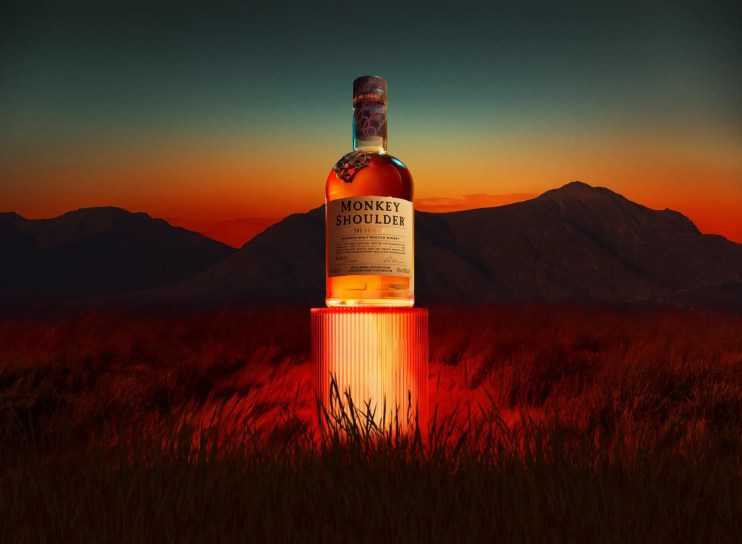
That cheeky, fun-loving malt from William Grant & Sons, known as Monkey Shoulder, has undergone ‘a global brand relaunch’.
The three little monkeys that sit on the shoulder of the bottle have been slightly enlarged, given ‘a premium antique-copper finish’, and moved from right to left! It’s the kind of thing that gets PR agencies fizzing with excitement.
For a whisky that doesn’t take itself too seriously, there’s a nice irony in how seriously they take things behind the scenes. “We put an enormous amount of care into the finer details of our packaging because it’s a new challenger brand that people are still discovering,” says Ifan Jenkins, Monkey Shoulder’s global brand MD.
“Most people meet the brand for the first time through the packaging, which has to say why we’re special, and why we’re different. Packaging is probably the number one responsibility of any marketer – it’s the point of entry for every bar and every eCommerce site around the world.”
Stay in the know
Three daily briefings with the key market moves and top business and political stories.
SUBSCRIBE HEREThe story behind the brand
Launched in 2003, Monkey Shoulder is hardly new, but it is certainly younger than Chivas Regal or Johnnie Walker. For Ifan, “the three monkeys embody the three malts that we use, and link to a nice story of how we got our name.” This blended malt is from Speyside, “home to where the best single malts come from,” he claims.
The name comes from the old days of floor maltings, when men turned the malt with shovels, flipping it over their shoulder. So, in a strapline yet to be used – it’s the repetitive strain injury you can drink.
As for moving the monkeys around the bottle, that is “because most people read from left to right,” he explains. “And on the backbar, you’re getting greater standout.” That may be true, but rather more newsworthy is his claim that annual sales of Monkey Shoulder have doubled in the past six years to 800,000 cases.
If it was a slow burn at first, he sees similarities to William Grant’s Hendricks gin, where he used to work, and which he calls “the overnight success that took ten years.”
Seeding such brands for the long-term requires no end of patience, and that’s something where this privately-owned company believes it has an edge over its publicly quoted rivals.
Ifan is at pains to stress the importance of the bar trade. “Bartenders have always been a key part of the Monkey Shoulder brand story ever since we started,” he says. “Every year we do lots of training and hold competitions. We have our ‘ultimate bartender championship ’, and we run ‘Camp Monkey’ where we take fifty bartenders from some of the best bars on the planet.”
In the on-trade, he talks of “three things coming together – great drinks, great people and great music.”
The brand has been running its Studio Monkey Shoulder for three years to support grassroots music, and this summer it signed Fred again, the British producer, songwriter and DJ, to be its first ever creative partner.
“We use the on-trade as a marketing lever,” admits Ifan. “We passionately believe in the power of bar advocacy.”
And yet, if it’s selling 800,000 cases, there must be an awful lot pinging through the tills on the High Street. It is in all the major UK supermarkets at around £30 for a 70cl bottle, dropping to £25 on promotion. You wonder if some of the more edgy bars this whisky aspires to be in are put off by its presence in Asda and Tesco.
Monkey Shoulder: Made for mixing
The team behind Monkey Shoulder has always pushed the idea of it being a whisky made for mixing.
This is something of a holy grail for a category that often feels sidelined when it comes to cocktails – a market dominated by white spirits and those bright, neon, Instagram-able spritzes like Aperol.
Scotch seems to suffer from a certain colour prejudice in how it’s served, and this was surely part of the inspiration for Chivas Crystal Gold, which was launched a year ago.
Stripped of its amber hue, this almost clear spirit has been seeking to win over cocktail drinkers from premium vodka, gin and Cristalino tequila. Whether Crystal Gold will succeed remains to be seen.
With Monkey Shoulder, Ifan insists “consumers have no problem having it in great cocktails they were introduced to in a bar, or at a music festival or event.”
For busy occasions, the brand has developed a line of kegged cocktails to provide “high quality drinks served at great pace,” he says. In the past, a fleet of cement mixer trucks were converted to pump out cocktails at live events.
With all this time and effort devoted to promoting the mixability of Monkey Shoulder, an obvious question arises. Why hasn’t William Grant’s launched a ready-to-serve version in a can? A 100ml Monkey Shoulder Old Fashioned feels like a no-brainer.
“It’s partly prioritisation,” Ifan replies. “At the moment we’ve got enormous headroom for growth in what we’re doing. Numerous consumers around the world haven’t yet discovered Monkey Shoulder. We’re putting our energy into people discovering the brand in bars and on-line and in supermarkets.”
He talks of building it “bar by bar, dram by dram,” and says: “We carefully take out time to make sure we’ve got the fundamentals in place when we launch into a new market. It’s about making sure we’re in the right bars.” As for the most exciting new markets, he immediately mentions India, where the partnership with Fred again kicks off in December.
More than just a blended malt
Monkey Shoulder may be the most popular blended malt, but that’s not why people buy it.
Ifan believes its quality credentials from Speyside give new consumers reassurance, and that its provenance matters, however, he accepts that for many people it’s just a “cool, lifestyle brand.”
He puts its success down to having “the right brand attitude, and always trying to do things differently.” Not having the baggage of a heritage whisky brand must also have helped.
Award-winning drinks columnist and author Tom Bruce-Gardyne began his career in the wine trade, managing exports for a major Sicilian producer. Now freelance for 20 years, Tom has been a weekly columnist for The Herald and his books include The Scotch Whisky Book and most recently . This content has been produced for Whisky Business in collaboration with , the Scotch whisky trading platform for distillers, independent bottlers, and private investors.