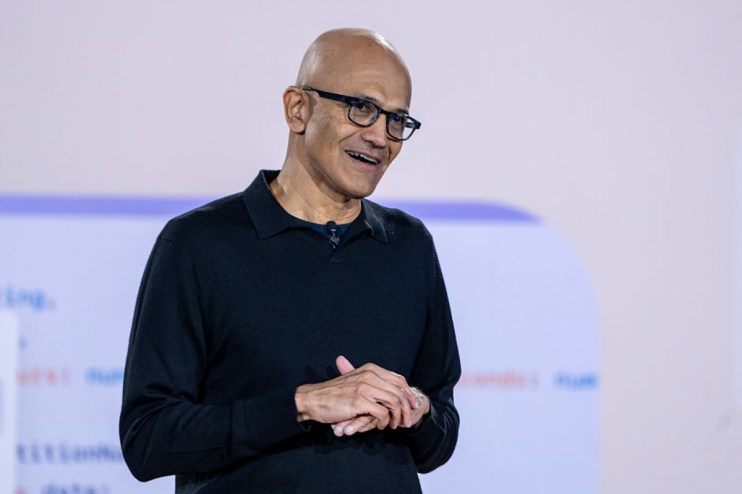
Microsoft chief executive Satya Nadella has warned that increasingly powerful AI systems are becoming less trustworthy, as new research exposes a widening confidence gap between UK bosses and their employees.
Speaking at Microsoft’s Frontier Tour in London on Wednesday, Nadella urged businesses to embrace AI while retaining human oversight, warning that the technology’s growing capabilities bring new risks.
“Our scaling laws are producing even more powerful models that are less and less trustworthy”, he said, arguing that businesses must treat AI systems as “new forms of insiders” and build safeguards around them.
His warning comes as Microsoft research revealed that 84 per cent of UK business leaders believe Britain can become a world-leading AI economy within five years, compared with just 41 per cent of employees.
The findings suggest a disconnect between executives pushing ahead with AI adoption and workers concerned about what the technology means for their jobs.
Stay in the know
Three daily briefings with the key market moves and top business and political stories.
SUBSCRIBE HEREEmployees cited fears over job security and fewer opportunities for younger workers among their concerns.
Nadella said businesses must ensure AI strengthens rather than undermines employees’ ability to work.
“How do you put the human in the loop?” he asked. “How do you really ensure that, ultimately, that sense of empowerment is not lost?”
He also warned that businesses risk losing control of valuable knowledge generated through AI systems, urging organisations to retain ownership of both their employees’ expertise and the information produced by AI.
Britain’s AI ambitions face a reality check
The warnings come as the government seeks to position Britain as a global AI powerhouse, with billions pledged towards computing infrastructure and greater adoption across public services.
But questions still remain over whether that investment will translate into higher productivity, particularly as businesses grapple with the cost of deploying AI systems and managing their risks.
Microsoft itself has committed billions to UK infrastructure, although the country’s AI expansion is increasingly constrained by electricity shortages and lengthy grid connection delays.
Earlier this week, Microsoft withdrew from a planned £2bn AI data centre project in Essex after developer Nscale faced delays securing sufficient power until the 2030s.
The setback highlighted the difficulties facing even the world’s largest technology companies as they race to expand Britain’s computing capacity.
Meanwhile, Nadella highlighted Yorkshire Ambulance Service’s use of Copilot to reduce administrative work in the NHS, ahead of plans to make the technology available to as many as 500,000 clinicians and support staff.
But expanding access to AI tools is not the same as demonstrating sustained improvements in productivity or patient care.
Microsoft’s UK and Ireland chief executive Darren Hardman said businesses needed to establish clear limits on what AI systems could access and do.
“You can set clear boundaries on the data AI can access. And the actions it can take. With human approval where it matters” he said.