Why do so many restaurants get their acoustics all messed up? Is sound the final frontier of luxury? Adam Bloodworth spoke to the experts attempting to quieten the cacophony
A pal’s in town. You’ve booked a trendy new restaurant. It’s been a while and you’re looking forward to catching up. There’s one issue: the place is so loud you can’t chat and you end up shouting over your sashimi.
“Restaurants don’t realise they’ve got it wrong until people start complaining,” says Steven Saunders, co-founder of interior design firm Fabled Studios. “Railway arches in places like Bethnal Green are the worst offenders. Any curved ceilings are the perfect enemy…”
No one would accept bad food, drinks, or service, so why pay to go where we can’t hear ourselves think? “It defeats the object of being there, really, doesn’t it?” says Bob Albon, founder of Sandy Brown acoustics. “It affects everybody. Everyone wants to be able to have a conversation when they go into a restaurant. That is ultimately the driver.”
Quietening the cacophony
Good conversation might be the final frontier of luxury. London’s most switched-on restaurateurs have been steadily quieting the cacophony, attempting to offer the best sonic environment to pair with their cuisine and aesthetics.
Stay in the know
Three daily briefings with the key market moves and top business and political stories.
SUBSCRIBE HEREFor The Wolseley in the City of London, it wasn’t a case of silencing, but fine-tuning the racket. For Saunders, who worked on the launch, noise is “part of the experience.” The sounds of cutlery, footsteps on the marble floor and plates on the table add to the ambience but, crucially, none of it is loud enough to prohibit conversation.
Fabled Studio and Sandy Brown worked together soundscaping The Wolseley, applying acoustic plaster to the domed and vaulted ceilings to soak up sound without ruining the atmosphere. “There was the concern that putting sound-absorbing materials would kill the vibe,” says Albon. “But this material doesn’t look like it’s sound absorbent, so it doesn’t conflict with the aesthetic of the space.”
London restaurant sound design
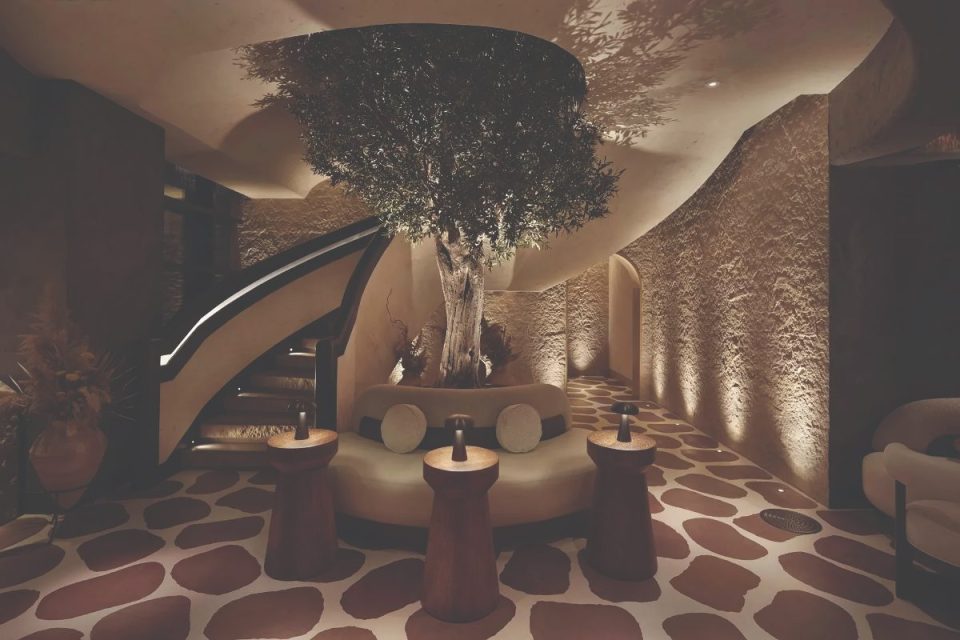
Absorbent plaster has been used to swallow noise since the 1920s. Manufacturers mix cork, wood, mineral wool or recycled glass granulate into plaster to stop sound waves from bouncing directly off it. Some modern variants are so clever that, on the surface, the material looks exactly like traditional plaster.
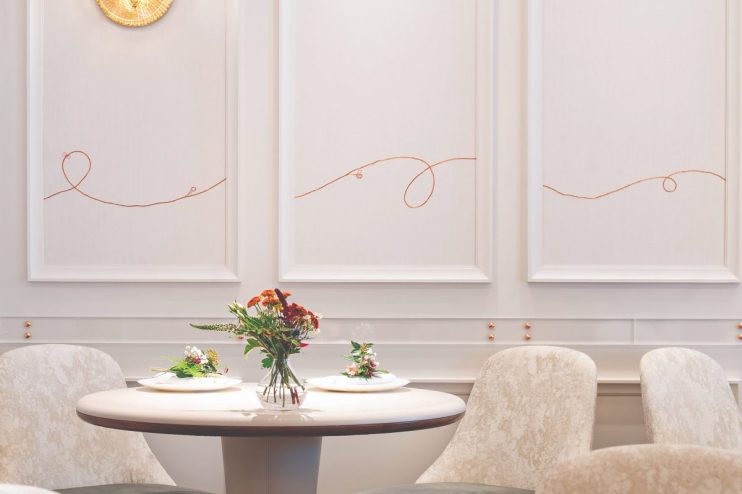
Core by Clare Smyth, one of six thrice-Michelin-starred restaurants in London, was another of Saunders and Albon’s projects. Instead of relying on discreet solutions like plaster, Smyth incorporated sound dampening into the decoration of the restaurant to create the perfect atmosphere. Saunders went to Ireland, where Smyth has heritage, to buy absorbent Irish linen to coat the walls. “We had it stitched with this copper thread to recreate the grapevine from Clare’s logo, and that wraps itself all the way around the room,” he says.
George Orwell was writing about the problem of clattery venues way back in 1946. In his essay entitled The Moon Under Water, he described the perfect pub. In the titular venue, “it is always quiet enough to talk. The house possesses neither a radio nor a piano, and even on Christmas Eve and such occasions the singing that happens is of a decorous kind.” This description inspired Tim Martin’s JD Wetherspoon venues (indeed, he likes it so much, no fewer than 13 of his pubs bear the name). They might serve cheap drinks, but those thick carpets mean even when the venue’s full of drunks, at least they can hear one another.
Simple fixes like drapes and rugs
Even with the landlord on side, good sound design isn’t guaranteed. “It’s always a bit of a fight,” says David Graham, director of Sound Division. Interior designers are often “paranoid” about the visual effect of sound dampening, he says, particularly about speakers interfering with feature walls or mirrors.
Clients, too, can be unrealistic with their expectations. “I tend to call them magic speakers,” jokes Graham. “Where a client says ‘We want the most amazing sound in our restaurant, but we don’t want to see the speakers.’ I say, ‘Well, if you want amazing sound, you have to have speakers that are big enough to reproduce it.’”
Saunders would go so far as to say that the “vast majority” of London restaurant owners don’t properly consider the acoustics of their venue. But restaurateurs don’t have to splurge to help diners allay their headaches. Intuitive fixes like plush carpets go a long way, and worst-offender venues – those with a large floor area, low ceiling and reflective finishes – can do some simple things to help. “Drapes, rugs, the lining of the tables, that kind of thing,” says Saunders. “When you can approach sound design beyond the more utilitarian, rudimentary ways of hanging acoustic panels from the ceiling, it can be incorporated sensitively and very beautifully into the room.”
Sonic Design Studios thinks the current methods are getting it all wrong. Their Cognitive Load Index gives every venue a score of 1-100 to determine how much effort it takes to hold a conversation there, taking into account surfaces, occupancy and time of day. “Every internal space should be specified for the cognitive performance of the people inside it,” says founder Tariq Ibrahim, whose clients include Claude’s Club at Chotto Matte, a members’ listening lounge in Soho.
“Homes, workplaces and hospitality venues are all still designed room-blind,” he says. “One acoustic specification is applied across a whole site, when a bar, a dining room and a private room make completely different demands on a person. A restaurant can currently meet every acoustic standard and still be exhausting to sit in for two hours. Diners never say the reverberation time is wrong, or that the hard modern finishes on the walls and ceiling are too reflective. They just don’t rebook.”
Ibrahim says this human-centered approach has been popularised in healthcare and offices but “hospitality and residential have been slower to catch up”.
The rise of listening bars
For Nick Wood, who runs his own sonic consultancy, sound should change regularly, like the food. “We’re constantly trying to tell a story,” he says. “Like when a chef’s obsessed with seasonality or farm-to-table, that story is an ongoing experience. If the chef is telling a story from his summer to his autumn menu, we feel the music should evolve.”
As we continue to shout over our dinners, there is one major development that suggests we could finally be entering a new era where more people think more about the sound of their evenings as well as the look and taste of them. Listening bars, venues priding themselves as much on their music as their food and drink, have been rising in popularity, alongside food and wine events with a focus on how music enhances flavour.
There are currently over 20 bars in London that pair music with food. They’re largely clustered in areas to the east and centre. These novel spots should provide inspiration to restaurants to improve what drifts into their diners’ ear holes.
For more on London restaurants go to Life&Style