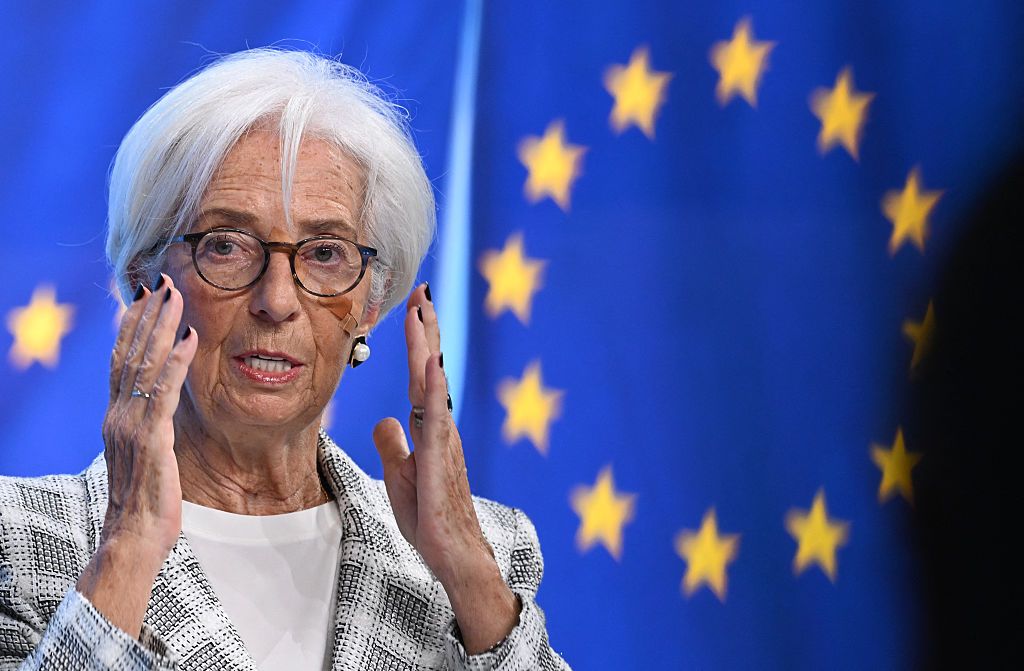
It had been rumoured for months that Christine Lagarde would leave the European Central Bank (ECB) before her term as president expired. Last week, it was finally confirmed. She will depart in just a few months' time. She may well have lined up a role running the World Economic Forum, which organises the annual Davos conference, or be planning a role in France's upcoming presidential election, either as a candidate herself or alongside the centrist Edouard Philippe. The jostling for her job is already underway, with the former governor of the Bank of Spain, Pablo Hernandez de Cos, and Klaas Knot, formerly of the Dutch central bank, the two early front-runners. It may well be months before a candidate is agreed upon by the member states.
Christine Lagarde leaves the ECB on the brink of crisis
It is hard to think of a more delicate moment for Christine Lagarde to leave. France is on the edge of a full-scale bond crisis. The country's debt-to-GDP ratio has risen to 120%. It is running a deficit of more than 5% of output this year, even though there is no special crisis to deal with. Political paralysis means there is little hope of passing a Budget for next year, while repeated rioting on the streets means there is even less chance of making any serious cuts to public spending. The state already collects close to 50% of national output in taxes, so there is very little scope to raise any more. And as GDP figures made clear last week, the economy has stagnated and is close to recession, meaning it can't grow its way out of trouble either. The country is heading into a bitterly contested presidential election next year in which all the leading candidates are promising yet more spending. It is a mess. The yields on French debt have already started to soar and threaten to spiral out of control at any time. If that happens, the eurozone will be plunged into a crisis.
Against that backdrop, you might think the ECB needs clear and decisive leadership to find a way through a difficult few months. True, in some ways it might be better if someone else were at the helm. Lagarde herself is partly responsible for the mess. By printing money on a vast scale and capping yields in Italy when they threatened to rise too high, she allowed France to borrow too much for too long. And, of course, she is French. A French president of the ECB organising a bail-out of France, with the rest of the bloc expected to pick up the bill, would not be a good look. It would be easier if the president was Dutch, Spanish, or even German. Even so, this is a dangerous moment to be leaving the Bank without a leader. As soon as the boss announces their resignation, their authority ebbs. Everyone starts plotting their next role and thinking about the succession, instead of getting on with the job in hand.
Start your trial of MoneyWeek today
Get unparalleled financial insight, analysis and expert opinion you can profit from.
Start your trial
Sign up for MoneyWeek’s free twice-daily newsletter.
Join more than 165,000 subscribers and keep yourself informed with latest financial news, insights and expert analysis to help you understand what really matters when it comes to your finances.
Join more than 165,000 subscribers and keep yourself informed with latest financial news, insights and expert analysis to help you understand what really matters when it comes to your finances.
Is Christine Lagarde playing a bigger game?
Christine Lagarde may be playing a clever game with her friend, French president Emmanuel Macron. There is speculation that her resignation has been timed to allow Macron to choose a successor before his great rival Marine Le Pen is elected. Whatever plans Le Pen has for the economy could be thwarted by central bankers. If true, it is a very high-risk strategy. But either way, Christine Lagarde's resignation could easily backfire. The squabbling over the succession may well trigger a full-scale loss of confidence in France and Lagarde will be to blame. The only reason for buying French debt right now is the assumption that, if a crunch comes, the ECB will find some way to come to the rescue. France is, after all, too big to fail and if its bond market collapses it will bring the single currency down with it.
Yet it only takes a few tiny doubts in the minds of investors, or a few loose remarks from one of the potential candidates for the top job, for confidence to unravel. If that happens, investors will sell French bonds as quickly as possible amid a full-scale panic. That is how markets work. To make sure that doesn't happen, the ECB needs strong leadership to steer its way through the next few critical months. Instead, it has been left with a lame duck serving out the few months before she departs at the worst possible moment.
This article was first published in MoneyWeek's magazine. Enjoy exclusive early access to news, opinion and analysis from our team of financial experts with a MoneyWeek subscription.