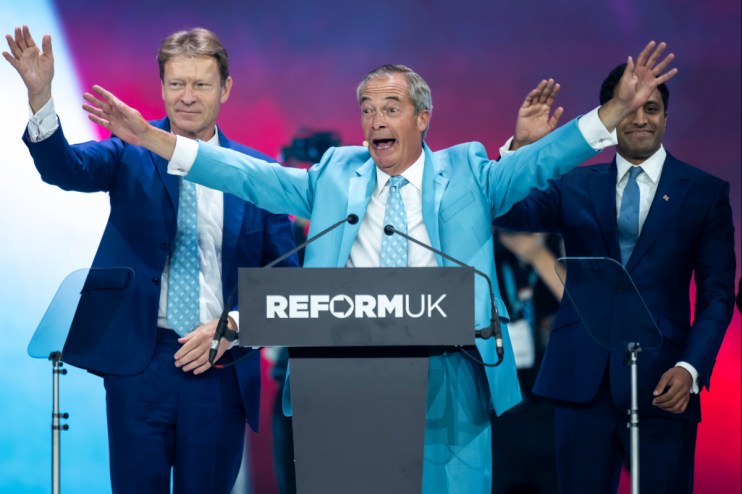
Facing allegations of racism, bigotry and sexism, can Nigel Farage clean up Reform UK’s act? It’s not even clear that he wants to, writes Eliot Wilson
The news that a year-long undercover investigation by ITV News has revealed racism, bigotry and sexism among a number of Reform UK’s candidates and office-holders was not a surprise. This problem has deep roots.
Former currency trader and hotelier Catherine Blaiklock established the Brexit Party, out of which Reform UK grew, with Nigel Farage’s support in January 2019. She lasted exactly two months as its leader before Farage took over, after she was revealed to have written and retweeted racist social media posts. Her own work included “Islam = submission – mostly to raping men it seems” and “I want my country back. I want seaside donkeys on the beach and little village churches, not acid attacks, mobs and mosques”. She also retweeted 45 posts by Mark Collett of the BNP including a caption of a photograph of a classroom of multiracial pupils which read “This is a British school. This is white genocide.”
During the last general election campaign, the party had to disassociate itself from three parliamentary candidates. One accused immigrants from sub-Saharan Africa of “diluting” the UK’s collective IQ and another said black people should “get off [their] lazy arses” and stop acting “like savages”. A third responded to news of a boat carrying illegal migrants landing at Dover by saying, “I hope I’m near one of the scumbags one day I won’t run away I’ll slaughter them then have their family taken out”.
At the time, Farage defended his party by claiming it had been “so desperate for people to stand that people stood, and then we employed a big vetting company who didn’t do the job”. He also argued that Reform UK had “an awful lot of candidates being stitched up in the most extraordinary way, with quotes taken out of context”.
Stay in the know
Three daily briefings with the key market moves and top business and political stories.
SUBSCRIBE HEREReform faces fresh revelations
Last week’s documentary, ITV Exposure—Undercover: A Year in Reform, was more comprehensive but wholly recognisable. Alan Feeley, a Reform UK councillor in Solihull, described Asian people as “absolute parasites” and wanted the authorities to “drag them out of their homes, stick them on planes and f*** them off to Pakistan”. He expressed the belief that “no more than one per cent of British population can be non-white”.
Dean Miller, a councillor in Bromley, played fast and loose with the Treason Act 1351 when he said: “Apparently, King Charles is a fucking Muslim.. cut the cunt’s head off”. He claimed that immigrants had “come to rape and pillage and fucking kill us”, and that white people had “been ethnically cleansed out of London”. He added, “Like all the ethnic fucking kids, they’re not white, they’re all fucking black, and they’re like fucking animals. It’s horrible to say it. I’m not racist.”
The response of Reform UK and its leader to these accusations has been predictable and rote. A statement said that “from time to time, a handful of individuals who do not share our values will initially make it through vetting. This is the same for all organisations”. However, the party claims to have “improved and prioritised its vetting procedures”, a promise Farage made more than two years ago. It has seemingly not been especially successful.
Attack is the best form of defence. Reform UK also criticised ITV’s “extreme methods of deception”. Richard Tice, the party’s deputy leader, alleged that one figure was “a Tory plant” who was “deliberately saying some things to make us look bad”. Reform UK may not need much assistance in that area. There were also accusations of entrapment, although it is not clear how people who are not racist are so easily “entrapped” into making such enthusiastically racist remarks.
Robert Jenrick, the former pro-Remain, centrist Conservative MP who managed to be dropped from Cabinet for lapses of propriety by Boris Johnson, dismissed the most recent allegations against Reform UK as “bad apples”. He misunderstands the proverb. It does not show that every sample has a few sub-standard elements; rather it warns that one malign presence can be corrosive to a whole group, or, as was more pithily written in 1340, “a rotten apple quickly infects its neighbour”.
Can Reform UK ever be a serious party?
Reform UK, despite seeming to be running out of momentum in opinion polls, attempts to present itself as a serious potential party of government. It cannot do so with any credibility while racists are dismissed as bad apples, vague promises are made of improved vetting procedures, accusations of serious financial impropriety are brushed aside by a smirking Farage and the party’s fundamental and universal defence is “a big boy did it and ran away”.
Nigel Farage is probably the most influential British politician of the 21st century so far, and he has proven himself often a brilliant campaigner. But he is not a leader of a party. He has carved out a 30-year career as the carney barker for a shifting coalition of the aggrieved: anti-EU, anti-immigration, anti-woke, anti-lockdown, anti-net zero. You cannot build a political party on the platform of “Fings Ain’t Wot They Used T’Be”.
There will be a general election in less than three years; less than three months, if some rumours are to be believed. The window is closing for Farage to demonstrate that he can turn Reform UK into a political party in a meaningful sense, and that he wants to. The jury is out on both counts.
Eliot Wilson is a writer and historian. He is a senior fellow for national security at the Coalition for Global Prosperity and a contributing editor at Defence on the Brink