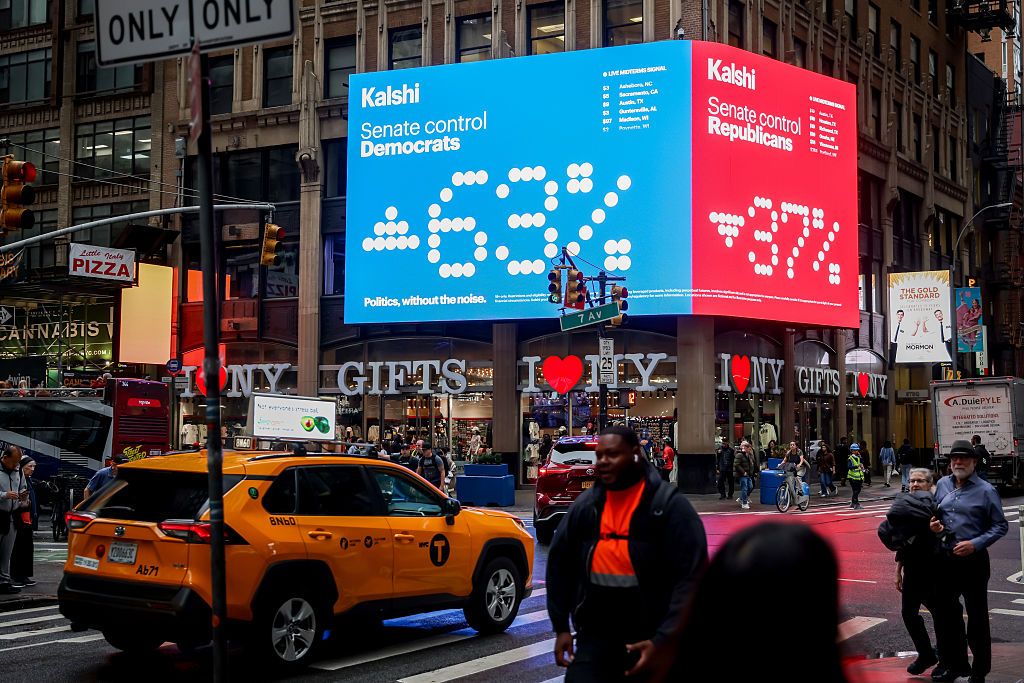
What are prediction markets?
Prediction markets are sites where users buy “yes” or “no” contracts on future real-world events. A contract pays $1 if it happens and $0 if not and its price is the implied probability.
Today, the biggest platforms are Kalshi and Polymarket. Both launched around the time of the pandemic but went mainstream during the 2024 US presidential race. In the week before that election, Kalshi processed around $750 million in trades.
Unlike a bookmaker, which sets the odds and takes the opposite side of every bet, prediction markets allow punters to trade against one another. You can bet on everything from the number of acres you think will get destroyed in wildfires and how often Donald Trump will say “Kamala” in a speech, to whether Jesus Christ will return this year.
Start your trial of MoneyWeek today
Get unparalleled financial insight, analysis and expert opinion you can profit from.
Start your trial
Sign up for MoneyWeek’s free twice-daily newsletter.
Join more than 165,000 subscribers and keep yourself informed with latest financial news, insights and expert analysis to help you understand what really matters when it comes to your finances.
Join more than 165,000 subscribers and keep yourself informed with latest financial news, insights and expert analysis to help you understand what really matters when it comes to your finances.
Kalshi's valuation has quadrupled in under a year to £22 billion and has more than 10,000 live markets, although sport still makes up about 78% of volume.
Are prediction markets new?
The basic idea isn't. Americans have bet on elections since George Washington. However, the New York Stock Exchange banned such markets during Prohibition, when gambling flourished underground, and polling later replaced their use for predictive purposes. In 1988 the University of Iowa launched the first serious election market and developed a better record than Gallup at predicting future results. The non-profit PredictIt followed in 2014. Now polling is in crisis and the markets are back.
Who uses prediction markets?
Prediction markets are used by young men for the most part, says the . According to Betterment, a US financial adviser, 52% of Gen Z investors diverted money intended for investment into sports betting last year. Firms target such investors through partnerships with celebrities and social-media accounts.
There have been attempts to court women too, considered more sceptical and risk-averse, by employing female “finfluencers”, hosting in-person events and offering bets on “female-friendly” topics such as pop culture. Kalshi told the that women's share of its users rose from 13% to 26% between early 2025 and early this year.
It's not just a fad. Polymarket's boss, Shayne Coplan, calls his site a “global truth machine”, a nod to Friedrich Hayek's belief that markets aggregate dispersed, local and tacit knowledge better than any planner. Morgan Stanley found in August that Kalshi was more accurate at predicting CPI inflation than economist consensus forecasts compiled by .
This ability to harness the wisdom of crowds has seen Kalshi strike deals with and ; Polymarket this year announced partnerships with Dow Jones and Substack.
Are people making money from prediction markets?
The founders pitch their platforms as being fairer than traditional bookies because there is no “house edge”. Polymarket and Kalshi together averaged some $1.6 billion of daily trading in August, up nearly 2,000% on a year earlier. Winning is another matter.
A study by the Centre for Economic Policy Research in June found that two-thirds of Polymarket users have lost money, with just 1% of profitable traders capturing more than three-quarters of profits, and 0.1% capturing half. reported in May that nearly half a billion dollars went to fewer than 2,000 accounts, while the median loss last year was $94.
The reason is structural, says Jane McManus in . The markets rely on “dumb money” users to supply the liquidity and mispriced odds that allow the “smart money” – professionals and increasingly AI tools – to take most of the profits.
Why do people still use prediction markets?
Ease is one reason. Prediction markets are always online, the financial commitment required is low, feedback is quick, positions are easily exited and – armed with AI tools – users can analyse markets themselves.
Other theories abound. Younger users have an underdeveloped pre-frontal cortex and a high appetite for risk. Other experts cite “financial nihilism”: the sense that the economy no longer rewards prudence or planning, and conventional pathways to wealth-building and stability have been cut off.
According to market researchers at The Harris Poll, nearly two-thirds of Gen Z and millennials think the only way to build wealth today is through gambling or crypto.
Aren't prediction markets illegal?
It's complicated. In the US, prediction markets are regulated not as gambling but as derivatives by the Commodity Futures Trading Commission (CFTC). That lets them sidestep state bans on sports wagering and means the influencers they pay needn't mention risk. Both Kalshi and Polymarket emerged after the Supreme Court lifted the ban on sports betting in 2018.
Under Donald Trump, the CFTC has gone from “watchdog to cheerleader”, says . Trump wants prediction markets to thrive; his son Donald Jr advises Polymarket and holds stakes in both platforms. Europe is less welcoming. Across the continent, the platforms remain largely unauthorised and the EU's markets regulator has warned of significant risks and insider trading.
And in the UK?
Since 2019, the Financial Conduct Authority (FCA) regulator has barred the kind of binary options offered by Kalshi and Polymarket for UK customers and regulates prediction markets covering financial or certain climatic events.
Political and sporting outcomes fall to the Gambling Commission, which says they are “akin to” betting exchanges, a model Britain has allowed since 2000. Betfair, Matchbook and Smarkets are the legal versions.
Savvy Britons determined to bypass regulation are using VPNs to access Kalshi and Polymarket to place binary bets on such things as by-elections. But the situation may change. The platforms have begun a “lobbying blitz”, says the , and hope soon to be regulated as financial services. The FCA is considering reforming its rules.
This article was first published in MoneyWeek's magazine. Enjoy exclusive early access to news, opinion and analysis from our team of financial experts with a MoneyWeek subscription.