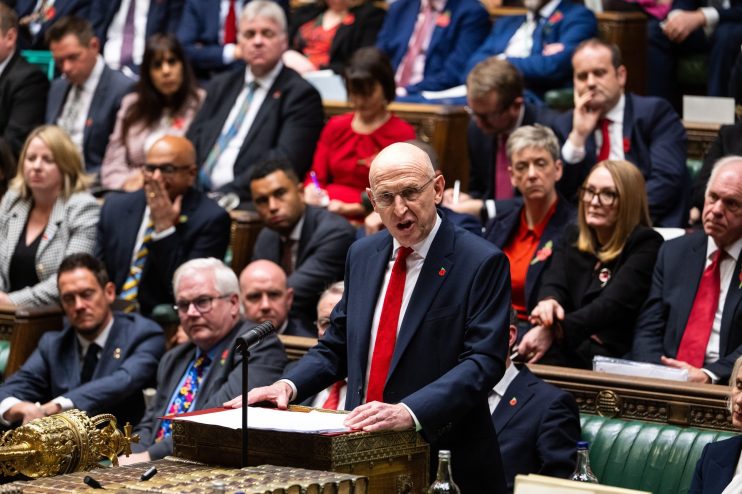
Britain is trapped in a “grim” decade of stagnant living standards, the budget watchdog has said, after John Healey kicked some of the government’s toughest spending decisions on defence and welfare into next year.
The government’s fiscal watchdog said that families are about to see household income drop as a result of the country’s rising tax burden and high levels of inflation caused by the Iran war.
The Office for Budget Responsibility’s forecasts show that real household disposable income will shrink next year. The body also said family budgets will be just two per cent higher in 2030 than before the pandemic.
OBR economist Professor David Miles said changes to living standards painted a “pretty grim picture”, adding that the minimal change in income over the decade was “unusual” by historical standards.
The daunting reflection of Britain’s economic woes was presented alongside Healey’s Budget, which raised taxes on banks, savers and landlords while increasing government borrowing to fund short-term support on the cost of living.
Stay in the know
Three daily briefings with the key market moves and top business and political stories.
SUBSCRIBE HEREEven as the Chancellor aimed the Budget at “workers” and entrepreneurs, he was accused of delivering a statement that failed to “meet the scale” of the government’s ambitions to deliver prosperity around the country.
His sweep of policy announcements were undercut by damning OBR revisions as the body slashed growth forecasts from 1.6 per cent to one per cent next year and raised average inflation projections to 3.4 per cent.
Unemployment is also set to peak at a higher level than previously expected. Should joblessness hit 5.1 per cent next year, as the body now projects, it would mean that some 320,000 more people will be unemployed than when Labour took office in 2024.
Healey’s Budget ‘lacks the bold moves’ for growth
Healey announced a raft of tax increases on banks, savers and landlords, and granted HMRC fresh powers to collect unpaid taxes. The measures helped Healey maintain a fiscal buffer of £15bn after absorbing costs created by higher bond yields and elevated borrowing levels, which cover a spike in inflation and rising interest rates over three years.
The Chancellor’s top energy support package costs taxpayers £2.6bn. It involves offering 20m households a one-off £100 payment.
Other measures to support households and businesses with higher costs include an extension on the fuel duty freeze and VAT cut on energy bills until the middle of next year. These policies, along with extra tax reliefs for founders and investors, are expected to push up borrowing in the next two years by billions of pounds.
The boss of the Confederation of British Industry, Rain Newton-Smith, who represents some of the country’s largest employers, said the Budget “lacks the bold moves that would have made it easier for firms to invest, hire and grow”.
“The government has set out big ambitions to boost prosperity – today’s Budget does not meet the scale of that ambition,” she added.
The spending challenge
Healey will now face a gruelling challenge to find funding for defence as he said next year’s Spending Review would aim to raise military spending to three per cent of GDP by 2030.
Figures in the OBR’s report, however, showed that planned growth on defence spending, the NHS and welfare would leave the government with a £11bn fiscal hole in departmental budgets between 2029 and 2032.
Deutsche Bank’s Sanjay Raja said the fiscal hole now facing the government could amount to as much as £40bn when plans for a new social care service after 2030 were also accounted for.
Goldman Sachs was among leading City firms to say the Budget broadly matched market expectations, with medium-term gilt yields falling by the end of trading hours.
But several analysts warned that the Chancellor’s plans for spending restraint and higher taxes at the end of parliament were “tight” and “ambitious” as watchdogs said Healey had just a 56 per cent chance of meeting borrowing targets.
After Healey’s address to MPs, Tory leader Kemi Badenoch said the Budget was “not good enough, not strong enough, not bold enough”.
Burnham leaped to support his Downing Street neighbour, arguing that measures to support millions of families with cost of living support was “pretty bold”.
He also ruled out the prospect of an early general election but bookies have slashed the odds of a snap vote being called in the coming months.