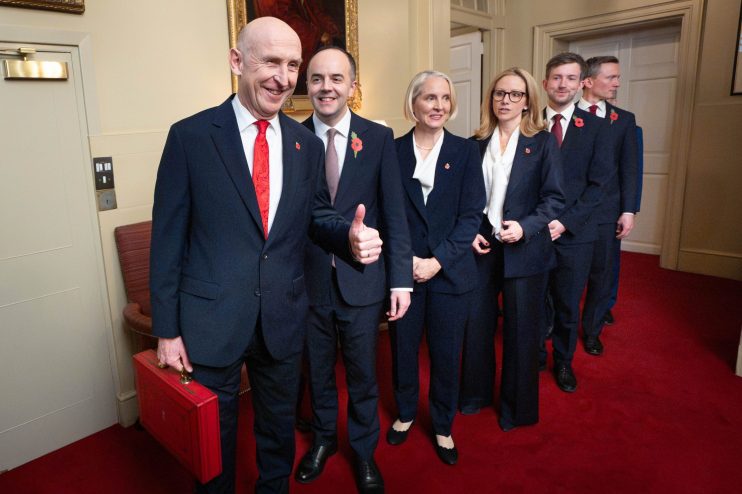
John Healey has managed to avoid punishment at the hands of the bond market through a “placeholder Budget” that delayed big decisions on defence and welfare and left questions hanging over the government’s future spending plans.
The Chancellor announced a raft of cost of living measures as part of his fiscal statement, funded by taxes on banks, savers and landlords.
Andrew Wishart, senior UK economist at Berenberg, said it was a “placeholder Budget… that respected the constraints of borrowing limits and Labour’s 2024 manifesto promises.
“In the meantime, subsidies funded by general taxation remain the sticking plaster.”
Healey chose not to implement any sweeping tax rises or spending cuts in a Budget that would narrow the governments’ fiscal headroom to £15bn.
Stay in the know
Three daily briefings with the key market moves and top business and political stories.
SUBSCRIBE HEREThe bond market shrugged off the Chancellor’s speech with 10-year gilt yields, a key metric showing the government’s borrowing costs, falling a modest two basis points. The 30-year gilt yield was down six basis points.
“The absence of a significant fiscal surprise is important given how sensitive the market remains to changes in the UK’s borrowing requirement and the quantity of duration investors will ultimately have to absorb,” Bryn Jones, head of fixed income at Rathbones, said.
Healey’s spending cuts ‘unrealisitc’
Healey pushed defence spending ambitions into the future, stating the UK had set 2030 as a “target date” by which to lift defence spending to the three per cent of GDP.
He also said the government would “look hard” at departmental spending and use more “innovative financing”.
“The bond market accepted the delay without any complaint amid more egregiously unsustainable fiscal policy elsewhere,” Wishart said.
Eoin O’Callaghan, macro strategist at Wellington Management, said: “The Chancellor has delivered what had been hinted at for weeks – a relatively low key, small measure budget.”
He added this would support gilts “in the short term” but there was a “significant question mark over the credibility of the projections”.
The watchdog’s forecasts include a real term freeze in departmental spending in the year that follows the expected 2029 general election and a three per cent cut to next year’s spend, which O’Callaghan said was “unrealistic”.
“That may not concern the market for now. But it highlights how challenging the UK public finances are,” he added.
Oliver Faizallah, head of fixed income research at Raymond James, said: “There was an immediate commitment to fiscal discipline, which was followed up by a Budget that was broadly in line with expectations.”
The Debt Management Office revised up its planned gilt sales marginally to £250.6bn for 2026-27, from the previous April forecast of £246.2bn.
“Despite higher inflation forecasts and a narrower fiscal buffer which leave little room for future shocks, we view the combination of limited additional issuance, adherence to fiscal rules and gradual structural reform is positive to gilt market sentiment,” Faizallah said.