Good morning, and welcome to our rolling coverage of business, the financial markets and the world economy.
Fears that the Democratic Party's blue wave in this week's midterm elections will sink the AI investment boom are roiling markets, following heavy losses on Wall Street last night.
Asia-Pacific markets are a sea of red (unlike the US election map on Tuesday night!), as investors ditch tech stocks after more than $3.2tn was wiped off the US stock market yesterday.
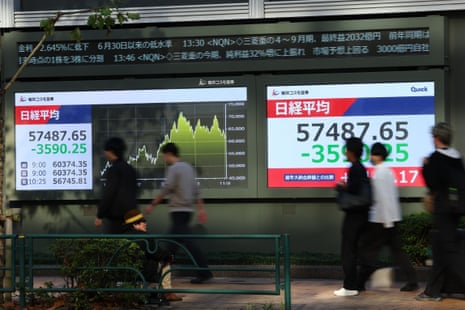
Today, Japan's stock index has slumped by almost 6% – its worst drop since April 7 2025 during the 'liberation day' tariff panic.
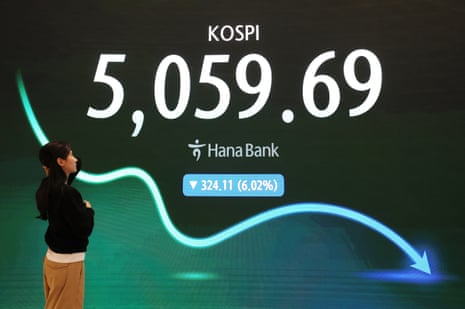
South Korea's is down 6.7%, and Taiwan's has dropped by 4.5% in a broad rout.
, head of Asia and Middle East at , called the market action "a bit of a disaster", explaining ():
"(Clients) were long index, long stocks, and they all got carried out.
"All night, all day – we had client margin calls, client complaints, ... because it's a very emotional thing, right? People are wedded to their positions and views on a stock or outcome and you're telling them, look, you've just lost money.
"And it's not just a slap in terms of valuation. It's basically a whole policy and six-year structural shift that says we're now going to pause, we're now going to cool AI, we're now going to cool data centres, approvals and equity capital markets."
After months of warnings that AI valuations were too high, and that the bubble might burst, US investors dashed to the exits en masse yesterday. The tech index slumped by 5.5%, while the dropped 1,833.06 points, or 3.44%, and the lost 4.36%.
Memory chip makers, who had been profiting from the AI boom, led the fallers – slumped 22% and both and lost 17% of their value.
Chip giant led the fallers on the , down over 9%.
Analysts pointed to policy uncertainty as Democrats are more critical of data centres, which could slow the rollout of AI investment – especially given public opposition to the sector.
The tumble in tech stocks that took hold in the immediate aftermath of the US midterm elections resumed as investors contemplated what a Democrat-controlled Congress may mean for tech regulation and the overall AI boom.
The regulatory and political risks arise at a time when the proverbial AI trade was already on shakier foundations. Earnings season has been an overall disappointment for the markets, with Magnificent Seven results so far undershooting growth expectations and flashing warning signs that the pace of AI spending is slowing down.
So, it could be a 'tin hats on' day in the markets. Investors will also be watching the latest US jobs report, for clues into the health of America's labour market.
The agenda
-
7am GMT: Lloyds house price index
-
9am GMT: UN's FAO food price index
-
1.30pm GMT: US non-farm payrolls jobs report
-
3pm GMT: University of Michigan's US consumer confidence report
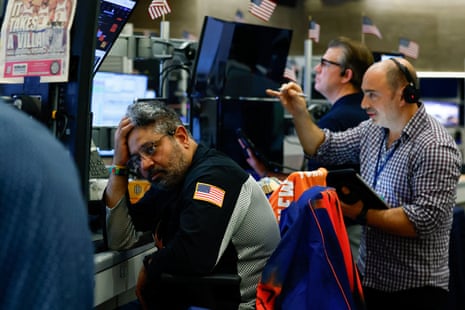
There were concerned faces on the floor of the New York stock exchange yesterday, as the market suffered its biggest one-day drop in about 19 months:

This fed though to Tokyo, where pedestrians were shown the damage on the stock exchange, which fell 6%:
Dealers were busy at Hana Bank in Seoul, South Korea, where the share index lost 6.5%.

The companies rolling out AI data centres might actually benefit, in the long term, if politicians throw some sand into the wheels of the industry.
That's because the planned pace of AI rollout has been so quick that it's forced these hyperscalers (such as Amazon, Meta, Microsoft and Google) into hectic sales of debt and shares to fund new multi-billion dollar supply deals.
of explains that this could actually make hyperscalers a more attractive investment, saying:
Indeed, a regulatory-induced slowing of AI-related projects may actually help ensure that the pace of growth is more sustainable going forward.
Over recent months, constant upward revisions in spending plans have led to a deluge of debt and equity issuance, which has been weighing heavily on markets, with demand failing to keep pace with supply.
Should this now slow somewhat, RBC BlueBay think that spreads for hyperscalers may stabilise. Consequently, the firm consider adding exposure in that space, having previously been very sceptical of the prospects for AI-related debt over the course of the past year.
Just in: Wall Street appears to be on track for a calmer day than yesterday!
Technology shares are expected to rise a little after Thursday's slump.
That's based on the latest futures market data, which gives an indication of how shares might move when trading begins in New York at 9.30am EST (or 2.30pm UK time).
They show that futures are up 0.2%, 100 future are up 1.1%, but futures are down 0.8%
Some context: The is a broad measure of the US stock market, tracking companies in sectors from financials and healthcare to technology, industrials and energy.
The is much narrower – just 30 large US companies.
And the 100 is the one hundred largest tech stocks on Wall Street (eg Apple, Microsoft, Nvidia, Amazon, Alphabet, Tesla…)
But there's still more than five hours until Wall Street opens, so we shall see!
"Yesterday's brutal session marked a dramatic turnaround from Wednesday, but with AI fears still prominent there is a risk that there is much more selling to come. Investors remain on watch for a potential resumption of the Iran conflict, likely to drive a risk-off move across a broader swathe of equities, and are nervously watching the oil price after its slump earlier in the week. All in all it remains a very febrile atmosphere."
Technology stocks have been dropping since early October, when the Nasdaq Composite hit a record high.
Those losses have been painful for hedge funds who had used borrowed money to back tech stocks (using 'leverage', in market jargon).
As the markets have fallen, those leverage bets will have turned sour, prompting margin calls (when your broker demands more cash or collatoral to cover a losing position).
Several large multi-manager hedge fund platforms have cut leverage and laid off loss-making teams in recent weeks, said market participants, who expect more layoffs if declines continue.
The post-US midterm market turmoil extended losses after a bruising October, when sentiment was dampened by elevated AI-related borrowing costs and worries over returns.
The Nasdaq 100 index, which contains many tech heavyweights, plunged 6.6% last month, its biggest monthly fall in 18 months. JPMorgan estimates global hedge funds lost 3% in October.
Interestingly, economist doesn't believe yesterday's losses are "the start of the unwind of the AI trade".
argues:
We do admit that policy uncertainty after the Blue Tsunami raises concerns over AI investment and the pace of data center buildup.
However, data centers and AI infrastructure also create jobs and Democrats would be reluctant to let those jobs move onto other states or outside the country. AI investment has been a key driver of US growth, and we do not see Democrats as giving up on this growth engine.
There was a huge slump in the most AI-exposed parts of the US stock market yesterday, of told clients this morning:
In fact, the scale of the moves ranked among the biggest in years, and the Philly semiconductor index (-12.25%) had its worst day since the pandemic slump in March 2020. And in turn, that cascaded elsewhere, with the S&P 500 (-4.36%) posting its biggest slump since the Liberation Day volatility in April 2025.
So that drove a huge surge in the VIX index (+11.6pts), which also saw its biggest daily jump since the Liberation Day period, ending the session at 28.2pts, its highest since March.
economist at investent bank , doesn't expect a quick rebound from yesterday's losses.
He writes:
In previous episodes of retail selling, institutional investors have stepped in to find value. The approaching year-end complicates the behaviour of institutional accounts as risk appetite would be limited….
The geopolitical uncertainty around possible US action in Iran also suggests that investors would not rush to add risk.
, portfolio manager at , points out that the dominance of the tech sector exacerbated yesterday's selloff:
"The blue wave at the ballot box has quickly been replaced by a sea of red on investors' screens. Technology stocks have sold off sharply, with the immediate catalyst appearing to be concerns around tougher AI regulation, covering both the models themselves and the vast data centre infrastructure required to support them.
"The scale of the falls in some of the market's biggest names has been striking. But it also highlights the concentration risk that has built up in US equity markets. With a relatively small number of technology and semiconductor stocks now carrying so much weight, weakness in those names quickly translates into sizeable falls for the Nasdaq and S&P 500.
Ahead of this week's losses, there were plenty of warning signs that markets might have risen too fast.
As my colleague Richard Partington and I wrote in late September, the warning lights were "flashing red" as the fighting in the Middle East intensified, a slowdown loomed in the AI arms race, and government borrowing costs hit multi-decade highs.
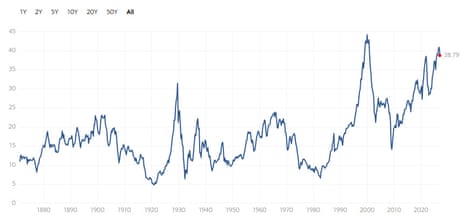
One popular measure used by investors to assess whether a market is overvalued – the CAPE ratio – or cyclically adjusted price-to-earnings ratio – had risen to its highest level since 2000 by September, showing that the US stock market is unusually highly valued compared with its profits.
This week's losses have pulled the CAPE ratio down (you can see it here), but it's still historically high:
Amid the scary-everything-is-bad-in-stocks news, it's easy to feel a bit worried about pensions or savings, my colleague Siraj Datoo writes.
And yes, yesterday was a bad day in particular for technology stocks, with the Nasdaq losing $2.5tn in market capital in a single day.
But it's worth taking a second to pause. While many of the charts leading newspaper homepages are fairly narrow, showing the dramatic fall in just a few days, if you look at the Nasdaq, the US index mostly dominated by tech stocks, from the start of the year, 4.6% YTD (see previous post for more details).
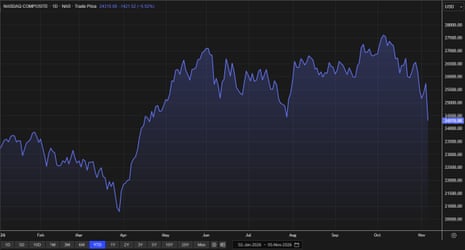
Of course, this correction still could have room to run and markets are famously emotional. But there have been warnings about this. Michael Burry, the famous fund manager behind The Big Short, has been screaming from the sidelines about overvaluations in the tech world.
One of the major concerns right now is the huge data centre buildout in the US and whether Democrats will place restrictions or slow things down. That's a problem for investors because so many of the world's biggest companies have invested enormous amounts of money -- often taking on additional debt -- to fund their deep investment. The bet is that the artificial buildout will eventually generate big returns but investors are now increasingly worried about just how long that will take.
Despite the sharp losses suffered on global stock markets around the world, most indices are still up for the year.
The index, for example, is still up 4.6% since the start of January – even though it's more than 10% below its peak.
Britain's 100 share index has gained almost 6.9% in 2026, even though – at 10,615 points – it's more than 300 points below the record high set in July.
South Korea's is up over 29% year to date – which sounds impressive until you remember that it doubled in the first half of 2026, driven by huge demand for chipmakers Samsung and SK Hynix from the AI industry.
China's stock index, though, are down over 12% this year – its AI stocks fell sharply a few months ago.
Europe has joined the global selloff.
The 100 index, which tracks blue-chip shares listed in London, has dropped by 166 points, or over 1.5%, at the start of trading to 10,615 points. Most of the hundred stocks on the index are down.
Pharmaceuticals giant (-2.8%) are the top faller on the .
Other fallers include (-1.5%) which owns British Airways, after it which missed profit forecasts this morning and warned that its annual capacity would be slightly lower than a year earlier.
Germany's index is down 1.5%, France's 40 has dropped by 1.2% at the open, Spain's is down 1.1%.
chief investment strategist atsays:
"The tech sell-off has intensified, with the pain of the brutal sell-off on Wall Street carried straight through to Asia and knocking sentiment in Europe.
Big worries are colliding – the build-out of data centres looks set to slow, which risks shredding the spending spree underpinning the boom, right at the time that investors have become super nervous about returns on this massive investment.
correct to say that the stock market "suffered one of the worst days in history".
Yesterday's 3.44% tumble on the certainly doesn't compare with Black Monday (October 19 1987), when the Dow crashed by 22.6%.
Since then, there was a 7.87% drop on 15 October 2008 (the financial crisis), a 12.9% tumble on 16 March 2020 (the Covid-19 pandemic) and a 5.6% drop in April 2000 (after the dot-com bubble burst), to pick a few recent bad days since.
Indeed, there seem to have been more than 70 larger falls on the since 1987 (based on my eyeballing of the data). The DJIA tracks 30 large US companies, including Apple, Amazon, Nvidia, Coca-Cola and Walt Disney.
But in value terms, it was a more significant selloff, especially for tech stocks.
The Nasdaq 100 Index sank 6.4%, wiping out $2.3tn in market value, the most on record, Bloomberg has calculated.
There were some dramatic scenes in Asia-Pacific stock markets today.
In Taiwan, the benchmark stock index plunged a record 3,737.67 points in early trading. It closed down 1,791 points, or 4.6%.
Taiwanese stocks had benefited from the AI boom – earlier this week, the Taiex index was up more than 50% for the year.
Over in Seoul, the index fell to its lowest level since early April, in a slump which triggered a 20-minute circuit breaker.
Stocks aren't the only thing dropping in value!
UK house prices fell by 0.6% in October, new data from Lloyds bank shows.
Prices were 1.2% lower than a year ago, the biggest annual fall since October 2023.
A Reuters poll of economists had predicted a 0.1% monthly increase and an annual fall of 0.3%.
reports that the average property price dropped to £296,285 last month, down from £298,167 in September.
, mortgages director at , explains:
"Housing demand is currently being tested by a challenging economic backdrop. Renewed inflationary pressures, driven in part by the conflict in the Middle East, are keeping borrowing costs high and adding to the squeeze on household finances, making some buyers understandably more cautious.
European stock markets are expected to join the selloff when trading begins, in around 45 minutes.
The UK's FTSE 100 share index is being called down over 1% in IG's futures market, as is Germany's DAX index.
Japan's Nikkei share average has posted its worst week in more than six years.
For the week, the benchmark was down 9.3%, its worst weekly decline since March 2020 during the pandemic, .
Donald Trump has blamed the Democratic party for the market selloff.
Posting on his Truth Social site, the president wrote:
The Stock Market suffered one of the Worst Days in History based on the results of the Election. Such a sad thing to watch! It took so much work to get us to a level that no one has ever seen before, and then this. Your 401(k)s have, therefore, dropped. Remember, it wasn't Republicans, it was Dumocrats. Do not fear, however, we will soon, one way or the other, be BIGGER AND STRONGER THAN EVER BEFORE. MAKE AMERICA GREAT AGAIN! President DONALD J. TRUMP
He then appeared to blame the voters too (!), adding:
The Stock Market crashed today because the Dumocrats had a big Tuesday — So sad to see, you only have yourselves to blame! President DONALD J. TRUMP
The Financial Times have calculated that US stocks shed $3.2tn on Thursday, in a day of "chaotic trading".
Thet explain:
The market value drop on the S&P Composite 1500 index, a broad basket of America's publicly traded companies, was the biggest since the turn of the millennium, according to FT calculations based on FactSet data
Good morning, and welcome to our rolling coverage of business, the financial markets and the world economy.
Fears that the Democratic Party's blue wave in this week's midterm elections will sink the AI investment boom are roiling markets, following heavy losses on Wall Street last night.
Asia-Pacific markets are a sea of red (unlike the US election map on Tuesday night!), as investors ditch tech stocks after more than $3.2tn was wiped off the US stock market yesterday.
Today, Japan's stock index has slumped by almost 6% – its worst drop since April 7 2025 during the 'liberation day' tariff panic.
South Korea's is down 6.7%, and Taiwan's has dropped by 4.5% in a broad rout.
, head of Asia and Middle East at , called the market action "a bit of a disaster", explaining ():
"(Clients) were long index, long stocks, and they all got carried out.
"All night, all day – we had client margin calls, client complaints, ... because it's a very emotional thing, right? People are wedded to their positions and views on a stock or outcome and you're telling them, look, you've just lost money.
"And it's not just a slap in terms of valuation. It's basically a whole policy and six-year structural shift that says we're now going to pause, we're now going to cool AI, we're now going to cool data centres, approvals and equity capital markets."
After months of warnings that AI valuations were too high, and that the bubble might burst, US investors dashed to the exits en masse yesterday. The tech index slumped by 5.5%, while the dropped 1,833.06 points, or 3.44%, and the lost 4.36%.
Memory chip makers, who had been profiting from the AI boom, led the fallers – slumped 22% and both and lost 17% of their value.
Chip giant led the fallers on the , down over 9%.
Analysts pointed to policy uncertainty as Democrats are more critical of data centres, which could slow the rollout of AI investment – especially given public opposition to the sector.
The tumble in tech stocks that took hold in the immediate aftermath of the US midterm elections resumed as investors contemplated what a Democrat-controlled Congress may mean for tech regulation and the overall AI boom.
The regulatory and political risks arise at a time when the proverbial AI trade was already on shakier foundations. Earnings season has been an overall disappointment for the markets, with Magnificent Seven results so far undershooting growth expectations and flashing warning signs that the pace of AI spending is slowing down.
So, it could be a 'tin hats on' day in the markets. Investors will also be watching the latest US jobs report, for clues into the health of America's labour market.
The agenda
-
7am GMT: Lloyds house price index
-
9am GMT: UN's FAO food price index
-
1.30pm GMT: US non-farm payrolls jobs report
-
3pm GMT: University of Michigan's US consumer confidence report