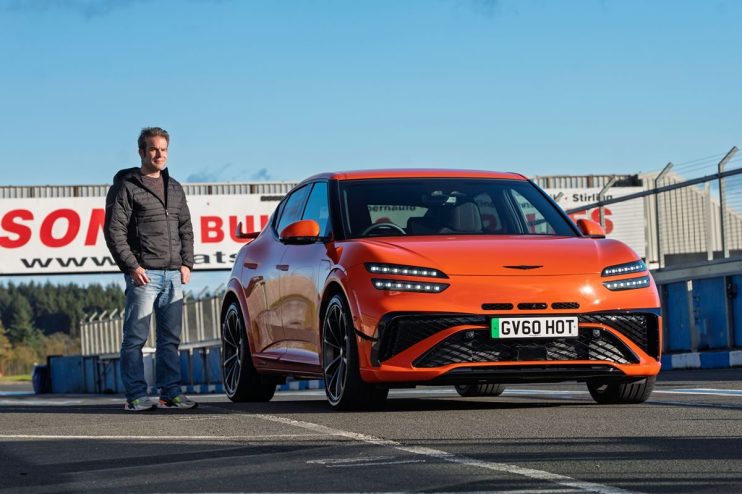
Genesis has a visibility problem – and not one that can be cured with parking sensors or a rear-view camera. Despite being present in the UK since 2021, many have still never heard of this South Korean car marque, let alone considered buying one instead of a Mercedes-Benz or BMW.
The numbers tell a similar story. Genesis sold just 1,225 vehicles in Britain last year, which compares to 93,124 for its parent company, Hyundai. Even Lexus, Toyota’s more-or-less equivalent premium offshoot, shifted 16,454 cars during the same 12-month period.
This is where Magma comes in. Taking on Mercedes-AMG and BMW M, the sporty sub-brand is on a mission to get Genesis noticed. And the signature Magma Orange paint seen here is just the start.
Genesis Magma Racing is also running its GMR-001 Hypercar in the World Endurance Championship (WEC). And anyone with a spare €120 can book the Genesis ‘Track Taxi’ at the Nurburgring – a high-speed passenger ride where thrill-seekers can choose between the V6-powered G70 or new electric GV60 Magma. It’s the latter car we’re testing here.
Make mine a Magma
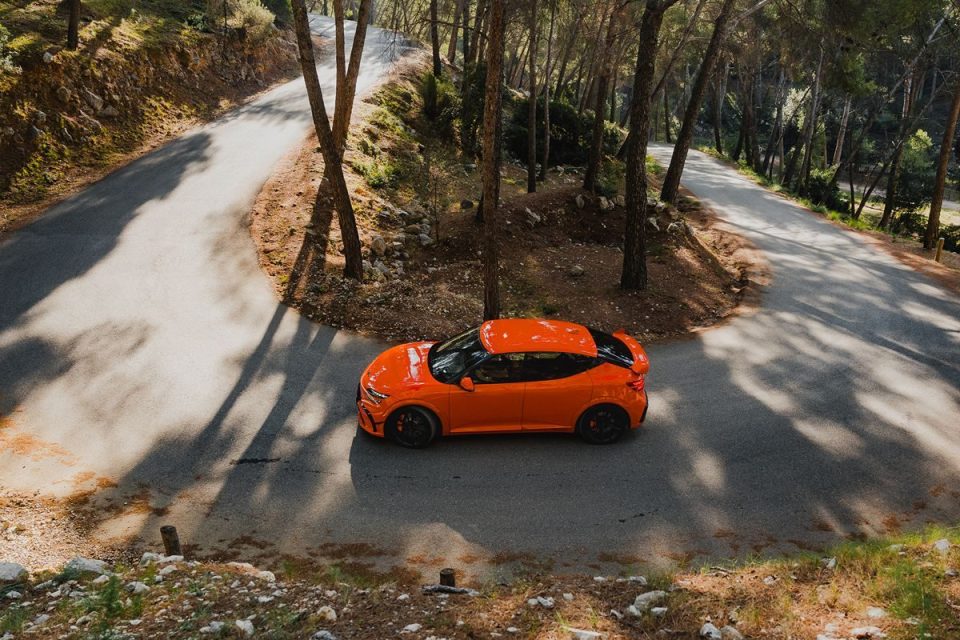
The GV60 Magma launch gets underway in Edinburgh, where Genesis has just opened a new ‘experience studio’ by the Westfield shopping centre. It’s a swish boutique aimed at building brand awareness, rather than selling cars, but more traditional dealerships have recently been opened in Guildford, Ashford, Leeds and Leicester, too. Genesis is determined to become a household name, and fast.
Stay in the know
Three daily briefings with the key market moves and top business and political stories.
SUBSCRIBE HEREThe GV60 is an electric crossover based on the same E-GMP platform as the Hyundai Ioniq 5 and Kia EV6. Ordinarily, its rivals include the BMW iX1, Polestar 2 and Lexus RZ, but the £75,915 Magma is more of an outlier. It squares up to sportier SUVs such as the Porsche Macan Electric and Alpine A390.
Underneath, the Magma shares its twin electric motors, 84kWh battery pack and 800-volt architecture with the Hyundai Ioniq 5 N. That means an identical 600hp – or 650hp for 15 seconds in Boost mode – and 583lb ft of torque. Zero to 62mph takes 3.4 seconds and top speed is 164mph.
As for EV-specific stuff, the official, WLTP-tested range is 264 miles, while charging speeds of up to 350kW allow for a 10-80 percent fillup in 18 minutes. Provided you can find a suitable ultra-rapid charger, of course.
Some like it HOT

“It’s a luxury GT, rather than an all-out track car,” says Robin Price, product manager for Genesis in the UK. Nonetheless, a track is where we’re going – albeit Knockhill rather than the Nordschleife. We just need to navigate our way out of Edinburgh city centre first…
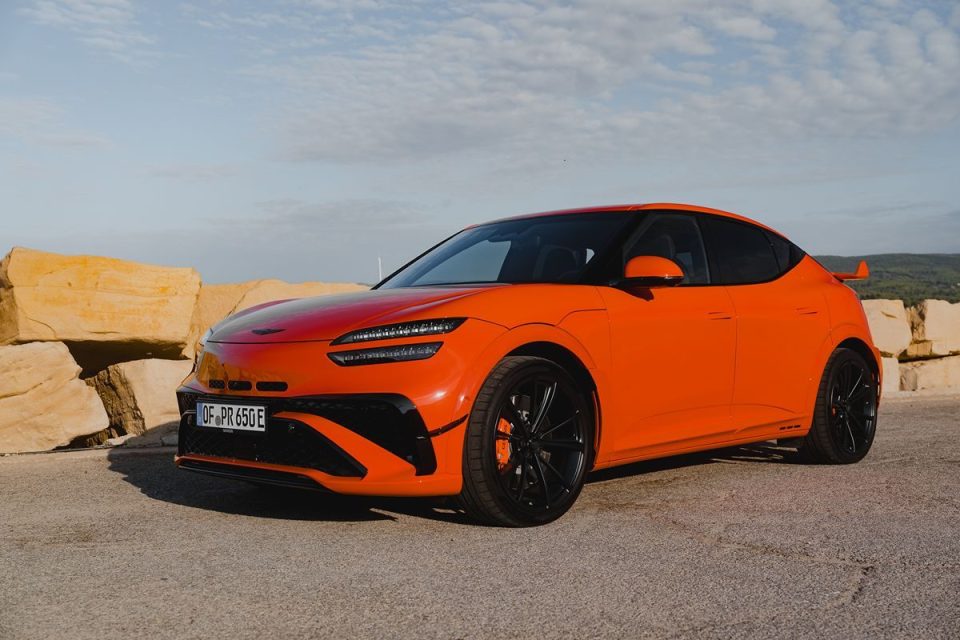
Wearing the registration ‘GV60 HOT’, the Genesis is already causing a stir outside our hotel. There are no Magma badges on its exterior – “the design speaks for itself,” says Price – but nor will anyone mistake it for a regular GV60. With 20mm lower suspension and a 50mm wider track, its 21-inch forged alloys sit snugly within flared wheelarches. Some visible negative camber adds to a hunkered-down, purposeful stance.
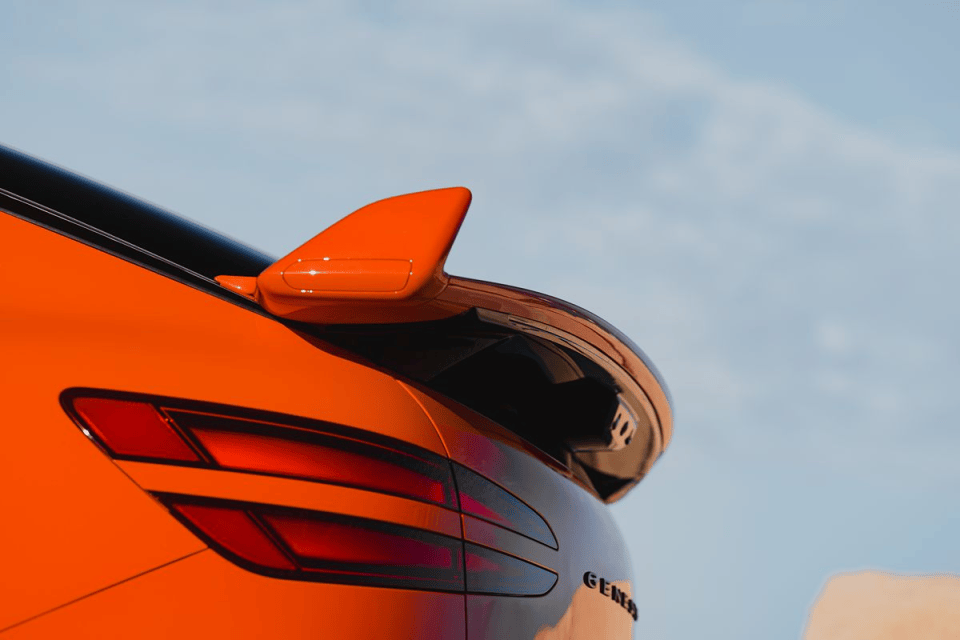
Up front, the Magma has three (functional) oval air intakes, plus racing-style canards sprouting from the bumper beneath. Further add-ons include shapely side skirts, orange brake calipers, gloss-black window surrounds and a jutting rear spoiler with upturned ends. See the car from behind (probably after it has just overtaken you) and they look like devil horns.
Buyers get a choice of nine paint colours, three of them matte finishes, although Magma Orange is surely the one to have. The only other option is the colour of the seat stitching: Magma Orange or Ash White.
Virtual gears and a 9,000rpm redline
This is more than merely a cosmetic exercise, however. The GV60 also gains a stiffer shell with more welding points, 400mm brake discs with four-piston monoblock calipers and an electronic limited-slip differential that enables a rear-biased drift mode.
Surprisingly, given its sporting bent, Genesis has also made efforts to improve the GV60’s refinement, such as reinforced door seals and thicker, sound-insulating glass. An active noise cancellation system helps filter out droning from the tyres, too (although sadly not from any children sitting in the back).
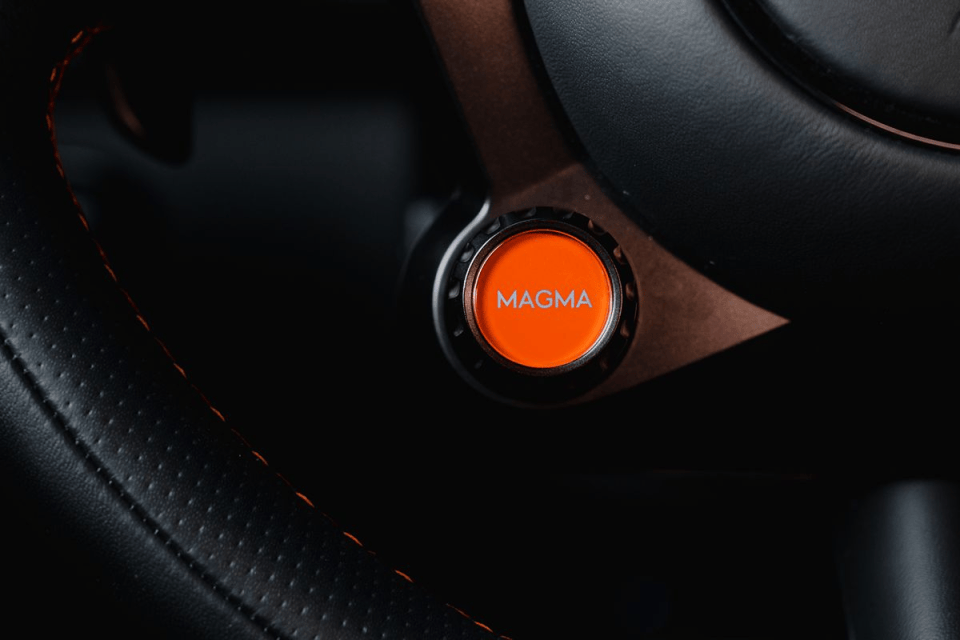
Along with the usual Comfort, Range and Sport settings, there are two new Magma drive modes, accessed via an orange button on the steering wheel. GT mode is designed for ‘effortless cruising and commanding acceleration’ on the road, while Sprint is for maximum-attack track use.
Like the Ioniq 5 N, the Magma has the Virtual Gear Shift system, which simulates a paddle-shift transmission: in this case an eight-speed dual-clutch ’box. However, while the Hyundai pumps the noise of a turbocharged four-cylinder engine through its speakers, the GV60’s hard-edged snarl is more akin to a V6 (or even a V8 when it woofles at idle). A higher ‘redline’ of 9,000rpm also gives it a wider vocal range.
Inside the Genesis GV60 Magma
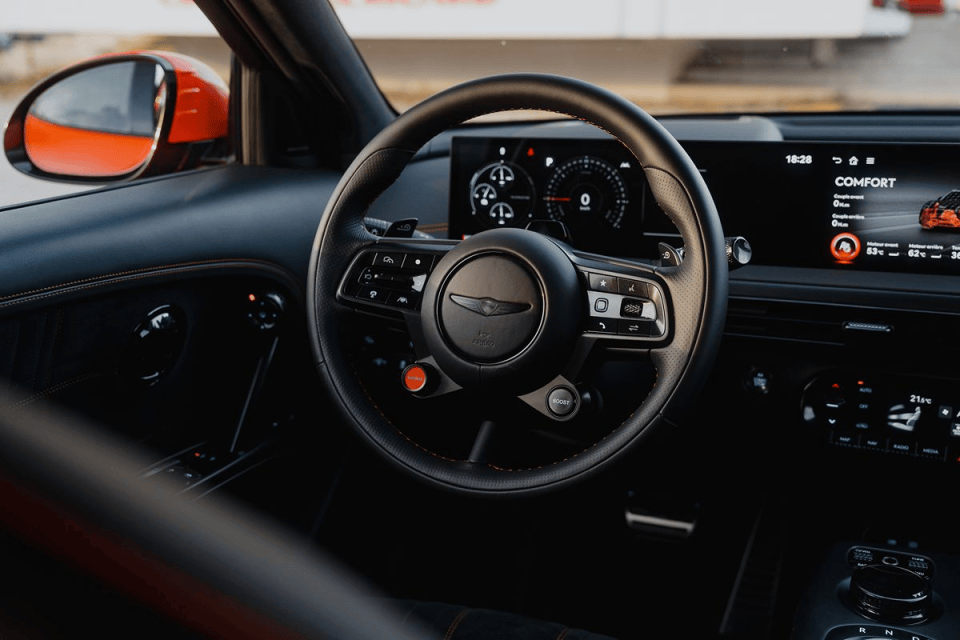
Step inside and the GV60 feels like a premium product – certainly more so than its Hyundai or Kia cousins. Its Magma-exclusive electric sports seats are trimmed in artificial suede, while the buttons and pedals are brushed black aluminium. There’s even a biometric fingerprint recognition system, which allows the car to be started without a key.
The slim 27-inch driver info and infotainment screen looks high-res, works intuitively and has a special Magma tab for performance data and activating the Virtual Gear Shift. Selecting Magma mode also brings up a more traditional three-dial display, with a large rev counter and shift lights to help you change up before bouncing off the artificial limiter.
You select Drive via the GV60’s quirky ‘crystal ball’ selector on the centre console, which takes some getting used to, but I was pleased to see ‘proper’ physical buttons for the heating and air-con. You can set up press-and-hold shortcuts to deactivate the driver assistance systems (ADAS), too.
As for practicality, there is enough headroom and legroom for taller adults in the back, but the boot is small-ish by SUV standards. It can carry 400 litres of luggage up to the parcel shelf – slightly more than a current Volkswagen Golf.
Doing a Dr Evil impression

With various road closures and diversions, not to mention dozy tourists on e-bikes, Edinburgh has contrived to make the first part of our journey stressful. The GV60 remains resolutely unruffled, though. It’s as straightforward to drive as any electric car, and rides the cobbled streets of the old town with calm composure. In true luxury SUV fashion, you feel isolated from the outside world.
As soon as we get beyond the city limits, it’s time to release the LIQUID HOT MAGMA. The GV60 musters the kind of accelerative force that was the sole preserve of supercars not so long ago, piling on speed with licence-losing intensity. Use the Boost button to overtake and ambling hatchbacks can be dispatched like swatted flies, aided by ever-present torque and four-wheel-drive traction.
It feels like I’ve spent the morning in two different GV60s. One is a smooth and easygoing EV that assiduously brings down your pulse-rate. The other is a high-riding hot hatch – the sort of car that could give an Audi RS3 or AMG A45 S a hard time on a twisty road. It’s all in the software, you see. And Hyundai, with its permanent Nurburgring test facility, has mastered this kind of calibration better than most.
Take it to the track
After a loop through the hills and a brief 350kW charging stop at Gridserve – more to refuel the assembled journalists with coffee and cake than to replenish the cars – we arrive at Knockhill. A narrow rollercoaster of a circuit that bucks and weaves across a hillside overlooking the Forth Bridge, it’s a stern test even for a BTCC car, let alone a family SUV.
The Virtual Gear Shift system really comes into its own here. Using the paddles not only makes the drive more exciting, it also helps to tailor your speed for the corners. I found the steeply diving McIntyre right-hander was best tackled in second gear, for instance, while Taylor’s, the uphill corner before the main straight, could be taken in third. The energy regen function, cleverly disguised as engine braking, means you can slow the car without overcooking the brakes, too. It’s all uncannily convincing, and with a hammering 9,000rpm soundtrack to match. Who needs a 911 GT3?
OK, let’s not get carried away… In truth, no amount of adaptive damping or tricky differentials can fully mask the GV60’s 2.2-tonne heft and SUV stature. Its steering isn’t the last word in feedback, either, and its chassis feels predictable rather than playful, only oversteering if you are deliberately lead-footed. On the road, though, you will be glad of that neutrality.
Sadly, we weren’t permitted to toast a set of Pirellis in Drift mode. Genesis only had two Magma press cars in the UK, so it understandably wanted to avoid any altercations with Knockhill’s tyre walls. Still, I’ve no doubt that 650hp could send you very sideways indeed.
If the Hyundai Ioniq 5 didn’t exist, we’d be lauding the GV60 Magma as a breakthrough: its ‘artificially analogue’ approach heralding a new era of fun-to-drive electric cars. However, the Hyundai has already stolen that thunder. And while there are detail differences, you’d have to really want the Genesis badge – or be set against having a Hyundai badge, perhaps – to pay £10,000 more for a GV60 Magma.
I’d also question whether 264 miles is enough range for a car costing near-as-dammit £76,000, when 300 miles or more is increasingly the norm. Needless to say, that predicted range will also tumble whenever you release the LIQUID HOT MAGMA (sorry, I’ll stop now).
These quibbles aside, though, there is much to like about this fast and curious EV. And judging by how many heads it turned in Edinburgh, the plan to get Genesis in front of a wider audience is already working.
Tim Pitt writes for Motoring Research