Jensen Huang wasn't always in his trademark leather jacket. When the multibillionaire, now former Nvidia chief executive was a teenager in the US, his first job was waiting tables and washing dishes at a branch of Denny's.
"It teaches you humility, it teaches you hard work, it teaches you hospitality," he said in 2023 of his time at the diner chain.
Decades later, having become one of the richest people on the planet, Huang put on a Denny's apron in tribute to his former employer at an Nvidia event in 2025.
By this point Huang had become a rockstar of the artificial intelligence boom – befitting his signature item of clothing – feted around the world by investors, fellow tech executives and politicians.
The company that Huang co-founded makes the computer chips that are integral to the development and operation of AI systems such as ChatGPT.
Demand for Nvidia's products has surged as hundreds of billions of dollars have been poured into a technology that, according to its many promotors, will transform the global economy. The crude analogy is that Huang and Nvidia have become the main purveyors of shovels in the AI gold rush.
In technical jargon, its AI chips are known as graphics processor units (GPUs), which were originally designed to handle the graphics for video games. But it turned out that a GPU's ability to carry out masses of technical calculations simultaneously and quickly is very handy for developing and operating AI systems, which have a voracious appetite for data crunching.
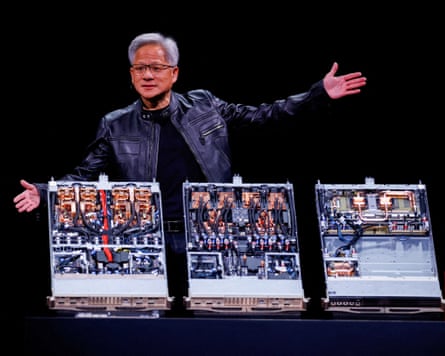
Nvidia is also very good at creating networks of its chips, which produces the computing power artificial intelligence needs, and provides the CUDA software that helps the company's GPUs perform so well for AI customers.
Jen-Hsun Huang, 63, was born in Taiwan to a chemical engineer father and a schoolteacher mother. Decades later, the island would become the centre of chip manufacturing and the foundry for Nvidia's highly advanced chips.
But his life was largely lived outside Taiwan. After a spell living in Thailand, Huang moved to the US when he was 10 – he is a joint citizen of Taiwan and the US – and has said he is "always an immigrant".
Accidentally enrolled by his uncle into a juvenile reform school in Kentucky, he anglicised his name and showed educational flair. Huang went to high school in Oregon and in 1984 he graduated with a degree in electrical engineering from Oregon State University, where he met his future wife, Lori, with whom he had a son and a daughter, both now Nvidia employees.
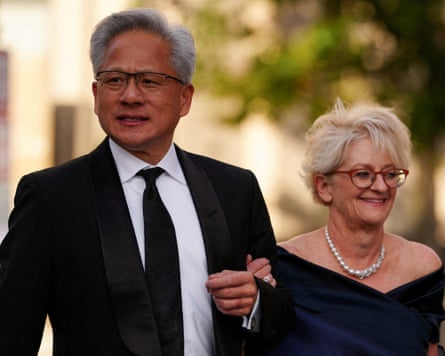
He then completed a master's degree in the same subject at Stanford University – in the heart of Silicon Valley – in 1992. A year later he founded Nvidia with fellow engineers Chris Malachowsky and Curtis Priem, during a meeting in a booth at Denny's. The name is a riff on the Latin term for envy, , an emotion that the company wanted its rivals to feel.
Huang's technical expertise also gave him an edge with customers and investors, according to The Nvidia Way, a biography of the company and its co-founder by Tae Kim.
The book quotes Tench Coxe, an Nvidia board member and early investor, who said Huang stood out.
"When you meet Jensen Huang, even with dozens of other graphics companies, you realise this is a guy you want to do business with," said Tench. "What made him great is he is an engineer and he is a computer scientist."
Nvidia started out making graphics chips for personal computers. It released what is widely regarded as the world's first GPU, the GeForce 256, in 1999 and as the technology became more and more powerful academic researchers realised it could accelerate AI development. Nvidia GPUs were used to create AlexNet, the neural network developed by Alex Krizhevsky, the OpenAI-co-founder Ilya Sutskever and the Nobel prize winner Geoffrey Hinton at the University of Toronto in 2012 – and a key moment in the history of modern AI.
Six months after the launch of ChatGPT, Nvidia's valuation reached $1tn (£756bn) in May 2023 and kept growing, hitting $5tn on October last year – the first ever company to reach such a milestone. However, it has fallen to about $4tn this week after allegations that Huang had conducted affairs with a Chinese spy and an Nvidia executive, leading to his resignation on Thursday.
Huang's 3.6% stake in Nvidia has given him considerable wealth. His fortune is valued at $145bn, according to Bloomberg, the 13th highest in the world.
The importance of Nvidia's products to the AI revolution have made Huang rich, powerful and famous. He is often seen at tech conferences or in the presence of global leaders, including Donald Trump with whom he has developed a rapport. Meta's Mark Zuckerberg, another mighty Silicon Valley founder, has described Huang as "Taylor Swift, but for tech".

One UK tech industry insider who has met Huang at various tech and government events describes the Nvidia CEO as having an "ability to engage" that marked him out from other executives in his peer group.
"He's like a good politician," said the source. "I think the sector has lost one of its best communicators."
The source added that Huang had no problem getting access to the upper echelons of governments. "Everyone wanted to meet him."
However, Huang's undoubted drive and charisma had a flipside, according to Stephen Witt, a journalist who interviewed the executive as part of his award-winning book about Huang and his company, The Thinking Games. In his final chat with a "visibly exhausted" Huang in 2024, Witt describes the interviewee's voice "crescendoing with anger" as he mulls a question about what new jobs will be created by AI.
Railing against the perception that AI will take jobs, Huang says to Witt: "We make the marginal cost of things zero, generation after generation after generation, and this exact conversation happens every single time!"
A shocked Witt writes: "His anger seemed uncontained, omnidirectional and wildly inappropriate."
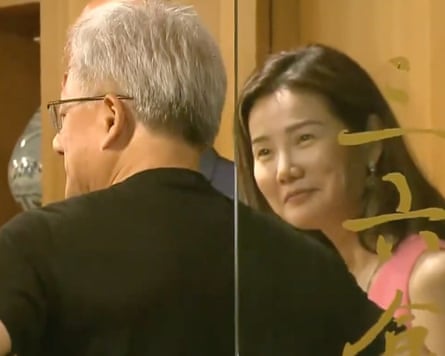
Although, to be clear, Witt also states in the book: "Huang possessed magnetic charisma, could be funny as hell, and, when he wasn't losing his shit, was capable of warmth and great empathetic understanding."
The anger in this last confrontation wears off, according to Witt, as Huang adds: "I am super normal."
And it is a very normal failing, extramarital infidelity, that has brought Huang down. It is a lesson in humility that Nvidia, and its investors, were not expecting Huang to receive decades on from those shifts at Denny's.