After a year marked by extreme heat and war sending fuel prices skywards, British travel executives hoped for solace in Madeira's benign subtropical climate, separated by hundreds of miles of blue sea from the overtourism protests and six-hour EU-entry queues seen on the Portuguese mainland.
As bosses admitted, holidays will be ever less affordable, AI is coming for their jobs, and the visitable world is shrinking – not least those parts where tourists remain welcome.
Some of the bigger anxieties in spring, such as widespread border chaos and planes running out of fuel, have not come to pass; others now appear chronic issues. New supplies of jet fuel, a major concern after the US first attacked Iran in February, have been established – but the cost is staying far higher for longer than most expected.
"Fuel is a huge part of any holiday and people are going to have to reckon with the cost," said Neil Swanson, Tui UK & Ireland managing director, among the attendees at the Abta convention.
Tui and airlines such as easyJet and Ryanair escaped the worst immediate impact by having secured much of their 2026 fuel supply at a fixed price. But the latter airlines are now slashing capacity for winter.
"It's not great for consumers, who are going to have to pay a lot more for their holidays. But airlines are going to be less and less hedged and prices are going to go up," Swanson added.
The oil price impact goes beyond jet fuel, said Mark Tanzer, the chief executive of Abta: "The bigger worry is the squeeze on household incomes that's going to come through their domestic costs. It will be a much tighter market."
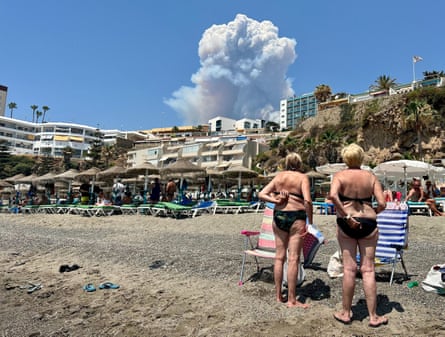
Perhaps surprisingly, numbers have held up – but customers have been leaving it ever later to book, he said, whether in search of a deal or because of uncertainty from disruption, war or weather.
Despite the intense heat, mass travel firms are clear that the template has not changed: most customers still want a hot holiday, in summer, on the beach.
Garry Wilson, the chief executive of easyJet Holidays, said: "Will there be long-term effects on demand? Perhaps. But in the short-term, no, we don't see it."
Growing "shoulder season" travel outside the school holidays for those who can, including city breaks, are driven by price more than climate, several people suggest. And talk of "coolcations" or people turning towards northern climes cuts little ice here. "We're not seeing any of that," said Swanson. "Nothing's changed, the destinations are the same."
When Tunisia was forecast a 10-day stretch of 45C temperatures this summer, Tui offered customers the chance to switch their holiday elsewhere. Swanson said: "We didn't get the interest and take-up. People were expecting it to be hot and were happy to go there, and we're not seeing any change in demand. Brits like a warm holiday – if it's got a pool and air-conditioning, that works for them."
Neither does Wilson see many heading north. Citing easyJet destinations such as Tromsø in Norway or Malmö in Sweden, he said: "They're all very nice to launch, but we send more customers to Majorca in a week than those in a year."
Outbound holidays prospered in the heatwave, he suggested. "People thought: 'You know what, we maybe don't need to go away.' But it became apparent that the UK doesn't have the infrastructure to cope … people actually were going abroad to escape the heat in the UK."
For now, the big firms see little change in destinations, Swanson said, but added: "We'll keep it under review. Who knows where the temperature's going to go in the next few years?"
More people could get priced out. At last year's convention, the Spanish tourist board started pushing its cooler northern destinations; but, said Tanzer, "I'm not sure the north has 100m beds" to accommodate the visitors who predominantly go to Spain's south, east and islands.
He added: "Certain types of holiday could become more expensive just because there's limited availability. If the snow is higher up the mountain, there's going to be fewer skiing holidays and the price is going to go up – there's little room at the top."
Tui has not been immune. Its river cruises in Europe were marooned when the Danube's water levels dipped last month to the point where some passengers spent most of their return Austro-Hungarian cruise on a boat-replacement bus.
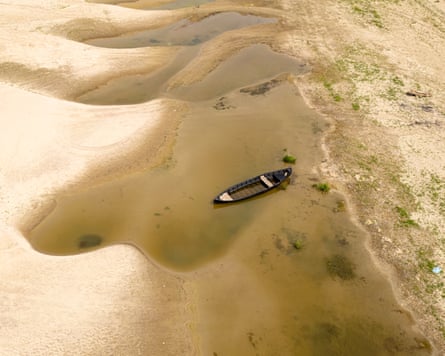
Katy Berzins, the head of river cruises at Tui, said: "Every year has highs and lows and it's part of river cruising, rivers are changeable." But 2026, she said, was "unprecedented".
The division is expanding nonetheless. Two new ships are joining its fleet – initially destined for the Seine and the Douro – that are built with lower draught levels (the vessel's vertical depth below the surface), meaning they are able to keep sailing in shallower rivers.
Others are seeing faster change. James Thornton, the chief executive of Intrepid Travel, said the firm no longer sold active travel group tours in southern Europe in the summer; few had wanted to trek or cycle in that level of heat.
Last year, Thornton said, there were 185 different extreme weather-related incidents that affected Intrepid holidaymakers around the world. "When we first started, there would be a handful."
Intrepid has long wrestled with its own impact on climate: for years, before offsetting fell into disrepute, it paid millions to offset its emissions. That did not cover the biggest factor, the flights taken by its customers to reach Intrepid tours – not entirely dissimilar from how an airport might declare itself net zero. Instead now the firm has a decarbonisation fund for local projects: "Ultimately you can't have sustainable travel, you can only limit the impact," Thornton said.
Having grown from backpacking to a A$1bn annual business, its own footprint is becoming significant. This year the firm is launching Timor-Leste, or East Timor. Thornton said: "Some customers have done 30 to 40 trips, so they're often looking for places that they haven't been able to travel to."
Asked about overtourism, Thornton said: "We're definitely worried about it." Intrepid tries to advertise the less visited destinations, he added. "We call it the not-hot list – drawing out the places where the infrastructure is available and the locals are willing to welcome travellers."
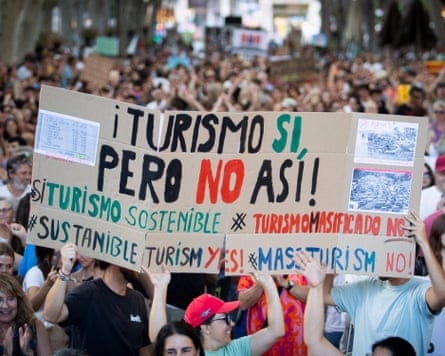
Rising tourist taxes around the world underline that many places feel they have more than enough visitors. For Wilson, it is "grossly unfair"; destinations such as Mallorca, he said, "built enormous economic positions on the back of mass tourism, and then pull up the bridge and put on an extra tax. All that does is go back to the days of travel being only for the rich."
How many of the UK outbound travel industry remain in sufficient paid work to afford it may also be in question.
Shaun Morton, the chief executive of On the Beach, laid off 20% of the Manchester-based online agency's staff this summer to "automate and streamline" processes. He told delegates: "You've got the technology, people, processes and you hold them all dear … We just started to ask not how do we get 10% more out of that, but how do we get 10 times that, you know?"
He added that "very bright people with a sharp head with technology" probably would keep their jobs longest, but acknowledged: "They're worried, because they can see a little bit further ahead than everyone else."
-
The Guardian's travel to the convention in Madeira was provided by Abta