The crypto industry is reeling from a massive hack at Binance, the world's largest cryptocurrency exchange.
Digital assets worth more than $6.3bn (£4.7bn) have reportedly been taken from Binance by North Korean hackers, apparently after a laptop belonging to one of its engineers was hacked.
The company said its teams are "working around the clock" to resolve the issue.
"Rest assured that user funds are completely safe," a Binance spokesperson said in a statement.
Binance said it had worked with partners to freeze the affected assets, with about $3bn located so far. It gave no update on the status of the remaining $3.3bn as Binance co-founder Yi He said the company would cover "all hacking losses".
The Binance theft raises 'serious questions' for cryptocurrency exchanges, explainsglobal cybersecurity advisor at security firm
"It is worrying just how quickly billions of dollars can disappear in a modern-day cyber heist, but it is unbelievable that a single laptop has enough privileged access to enable it. If a single device can authorise enormous cryptocurrency transfers, hackers can simply target systems and people until they find a weak link. And there is always one.
"While blockchain transactions can be traced, recovering stolen cryptocurrency is far more difficult, especially when attackers move funds across multiple wallets and blockchains extremely quickly using simple and well-known evasion tactics. North Korea has become increasingly sophisticated in using cybercrime to generate enormous sums of money, but this raises serious questions as to whether cryptocurrency exchanges are doing enough to protect customer assets and whether security and regulation is keeping up.
"Consumers who choose to keep cryptocurrencies should spread their digital assets across multiple reputable platforms and secure hardware wallets (such as their own USB) to reduce the risk of losing everything in a single attack."
News of the Binance heist could knock confidence in crypto assets, suggests , vice president of digital assets at
"The incident underscores the heightened cybersecurity risks associated with hot wallets, a component already exposed by the 2025 hack on Bybit cryptocurrency exchange. It also illustrates the risk concentration inherent in large, centralized intermediaries.
Stronger institutional controls can reduce some vulnerabilities, but the scale of assets under custody can amplify the impact of a successful breach.
The broader credit and industry implications will depend on the ultimate losses, affected counterparties, asset recovery, and importantly, whether the incident leads to wider disruption or loss of confidence across the digital-asset ecosystem."
Blockchain analysis company also believed the Binance hack was probably conducted by North Korea's TraderTraitor.
co-founder and CEO wrote on X:
We live in unprecedented times. But DPRK are up to their old tricks. We assess @binance hack for $6.4B was likely done by DPRK group TraderTraitor due to links to previous hack.
Industry partners have already frozen ~$3B and we @chainalysis continue to follow all of the funds.
have also produced a breakdown of the digital assets swiped from Binance.
accounts for about $3.79bn. That includes 200,630 ETH and 185 other tokens, among them 1.875 billion USDT, 823 million USDC and 88.5 million RLUSD.
outflows total 18,270 BTC, about $1.47bn.
outflows total 612.7 million USDT and 46.4 million TRX, about $628m.
The lost 233.46 million XRP, about $296m.
outflows total 970,500 SOL, about $96m.
, and combine to about $39m, including 74.6 million ARB taken on . Avalanche outflows total about $28m, and Polygon outflows total about $10m.
Most major cryptocurrencies have fallen in value since news of the Binance theft broke, Coinmarketcap data shows.
That includes:
-
: -2.35% over the last 24 hours, to $77,940
-
: -3.6%, to $2,227
-
: -5.6%, to $706
-
: -2.67%, to $97
-
: -3.1%, to $11.02
Richard Teng adds the Binance are 'working closely' with law enforcement.
He lists the actions which the digital exchange has taken since discovering the theft:
-
Temporarily suspended withdrawals while we complete a security revamp of the withdrawal service and its related addresses
-
Revoked the affected address authorizations
adds:
Our team hasn't stopped. We're working closely with law enforcement to ensure the matter is handled appropriately - and I'll share what I can, as soon as I can.
Binance co-CEO Richard Teng adds that around half the assets stolen in the hack have been frozen:
He's posted a list of points which customers 'need to know':
-
Your funds are safe
-
Estimated total impact: ~$6.3B, with ~$3B frozen on-chain so far, in coordination with our blockchain partners
-
No evidence of any wallet private key leak
Richard Teng, the co-chief executive officer of Binance, has pledged that customers money is 'safe', despite the hack.
Posting on X a few minutes ago, confirms that it appears the break-in came via an employee's laptop – but insists it was a 'more complex' attack than simply clicking on a rogue link.
says:
I want to speak to you directly about what happened.
Bottom line - your money is safe, and we're covering every loss.
Our initial investigation suggests this security incident may have started with a compromised DevOps engineer's laptop. That gave an attacker access to a service container, where they submitted unauthorized withdrawal transactions.
To be clear: the attacker did not simply use one engineer's permissions, and this was not a single "one-click" action. It involved a more complex attack process. Our investigation has not attributed responsibility to any individual.
So far, we have found no evidence of any wallet private key leak.
adds that Binance will share a detailed technical post-mortem once the investigation is complete and every fact is verified - and publish an updated Proof of Reserves once remediation is complete.
The hacker who swiped over $6bn of digital assets from Binance is in the process of switching stablecoins (which can be frozen) into etherium (which can't), according to media company Decrypt.
Stablecoin issuers Tether and Circle moved quickly to blacklist the suspected attacker's addresses in order to freeze a portion of the funds and make them inaccessible.
As centralized issuers, they each have the ability to blacklist addresses so their tokens cannot move, and more than $2 billion of those two tokens have been frozen so far by different stablecoin providers. ETH has no issuer, so every dollar converted before a freeze lands is out of their reach.
, market strategist at , reports:
Crypto assets have come under pressure after Binance, the world's largest crypto exchange, suspended deposits and withdrawals following a suspected hacking incident. Bitcoin is down -0.40% this morning, following a -3.03% slide yesterday.
TRM Labs, a blockchain intelligence firm that tracks the industry, has declared that an elite North Korean hacking unit called TraderTraitor was responsible for the security breach at Binance.
have also calculated that the breach is "the largest crypto theft on record".
In a report issued this morning, say:
-
On October 29, 2026, an attacker moved approximately $6.36bn out of Binance wallets on ten blockchains, most of it in about 20 minutes starting at 20:05 UTC. That makes this the largest crypto theft on record, about four times the $1.5bn Bybit hack of February 2025. Binance has confirmed a security incident and suspended withdrawals on several networks.
-
TRM attributes the attack to TraderTraitor, North Korea's elite hacking unit, based on robust on and off-chain intelligence. We make this judgment with high confidence. TRM is tracking the funds and alerting partners through the Beacon Network.
News of Binance's security breach sent bitcoin falling by more than 3% to a six-week low of $76,368 – although it's since recovered back to $78,335 (-0.6%).
US stocks linked to cryptocurrencies fell in afterhours trading.
Shares in crypto exchange are down 4.8%, while , the US company which has been a massive buyer of bitcoin, fell 5.75%.
The crypto industry is reeling from a massive hack at Binance, the world's largest cryptocurrency exchange.
Digital assets worth more than $6.3bn (£4.7bn) have reportedly been taken from Binance by North Korean hackers, apparently after a laptop belonging to one of its engineers was hacked.
The company said its teams are "working around the clock" to resolve the issue.
"Rest assured that user funds are completely safe," a Binance spokesperson said in a statement.
Binance said it had worked with partners to freeze the affected assets, with about $3bn located so far. It gave no update on the status of the remaining $3.3bn as Binance co-founder Yi He said the company would cover "all hacking losses".
Good morning, and welcome to our rolling coverage of business, the financial markets and the world economy.
Britain's housing market is feeling an autumnal chill, as rising mortgage rates hits demand.
UK annual house price growth slowed to 0.5% in October, the slowest pace since January 2024, new data from this morning shows. That's down from 0.8% in the year to September.
On a monthly basis, the average price of a house was unchanged this month.
The jump in fixed-rate mortgages to almost 6%, on average, appears to have dampened buyers' enthusiasm, pushing up the cost of repaying a mortgage.
chief economist, says:
"Market activity and house price growth have slowed in recent months, in part reflecting the uncertain economic backdrop. Geopolitical tensions remain high, with the conflict in the Middle East exerting upward pressure on energy prices, fanning inflation concerns.
"This in turn has led to mounting financial market expectations of Bank Rate increases, which have maintained upward pressure on the market interest rates which underpin mortgage pricing.
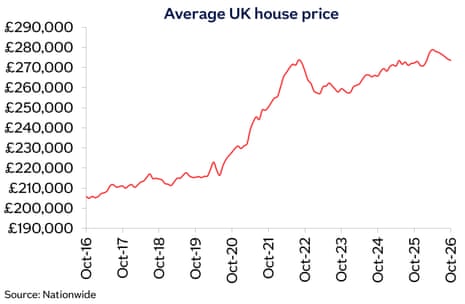
Forward-looking indicators suggest thee could be "further softness in the near term," adds:
Surveyors report that new buyer enquiries remain weak. Moreover, consumer sentiment dipped noticeably in October, with households becoming less confident about the outlook for the general economy as well as their own financial situation in the year ahead.
The agenda
-
7am GMT: Nationwide's October House Price Index
-
9.30am GMT: UK GDP quarterly national accounts: April to June 2026
-
10am GMT: eurozone GDP report for Q3 2026