he west has never been short of advice on how Africa should govern itself. It has produced rankings, attached conditions to aid and delivered lectures on corruption, often while its own banks and corporations have profited handsomely from the continent's governance weaknesses.
So, there was something refreshing about sitting in Cairo, listening to a Sudanese-born, self-made telecommunications entrepreneur and billionaire on why Africans needed to measure their own governments.
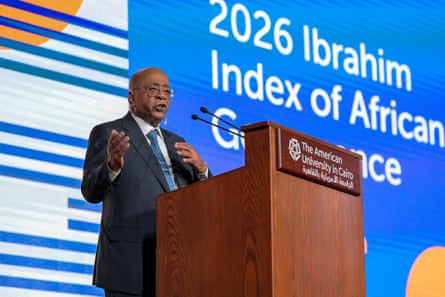
At the launch of the 2026 Ibrahim Index of African Governance (IIAG), now two decades in existence, Mo Ibrahim returned to a question he attributed to Nelson Mandela: "How could Africa be so rich while so many Africans remained poor?" His answer was blunt: "It is governance."
Yet, what Ibrahim means by governance is considerably more demanding than the narrow assessments so often used to pass judgment on developing countries. The foundation defines it as the provision of the political, social, economic and environmental public goods that citizens have a right to expect from their governments. It asks whether people are safe, children educated, hospitals functioning, women protected, opportunities expanding and leaders held accountable.
That differentiates the IIAG from others. Transparency International's Corruption Perceptions Index measures perceptions of public-sector corruption, not corruption in its entirety. The World Bank's Worldwide Governance Indicators cover six dimensions but also rely on perceptions and expert assessments. They offer useful evidence. Neither, however, should be mistaken for a complete account of how citizens experience governance.
The IIAG is an African-led initiative to ask a broader question. With 16 sub-categories, 96 constituent indicators and coverage of 54 African countries, five regions and eight regional economic communities over 10 years, the IIAG provides a comprehensive picture of governance across the continent, revealing patterns, progress and challenges extending well beyond aggregate scores.
It draws on 51 independent sources and makes the data freely available. It does not escape external influences: much of its source material is international. But Africans have had a decisive say in what counts, how it is assembled and why it matters.
And the results are uncomfortable.
Between 2016 and 2025, Africa's average governance score crept up by just 0.8 points, to 50.1 out of 100. Thirty countries improved, 23 deteriorated and one was unchanged. Foundations for economic opportunity improved by 3.7 points and human development by 2.5.
Yet security and rule of law fell by 1.7, while participation, rights and inclusion dropped by one point. Seychelles made impressive advances; Nigeria, the Democratic Republic of the Congo and South Africa gave cause for concern. On corruption alone, 28 countries, home to almost 60% of Africans, deteriorated.
A new road or hospital can raise a country's score while the political space available to its citizens shrinks. What kind of progress is that? Nathalie Delapalme, the foundation's chief executive, warned that without security and the rule of law, economic development is fragile and unlikely to last.
In an interview with Ibrahim, I asked whether a country could improve its anti-corruption performance even while political elites exerted undue influence over the institutions meant to restrain them.
"That's a brilliant question," he replied, pointing to attacks on civil society across African countries, but also to something governments struggle to contain: the mobile phone. Citizens can document unexplained wealth, expose misconduct and circulate evidence almost instantly. The public, he argued, has more means of scrutiny than ever before.
But exposure is not accountability. That requires investigators free to investigate, courts free to judge and governments accepting consequences.
I also pressed Ibrahim on the colonial inheritance. European powers did not design African administrations to serve African citizens. Much of the infrastructure was built to extract wealth, political institutions constructed to maintain control.
He was unequivocal about the damage. First, colonial borders, drawn with scant regard for ethnic and geographical realities, were among the most harmful legacies, he said. Second: "All the main roads or railway lines were really meant for extraction." They ran from mines to ports, not between communities or neighbouring states. Third, independence, often hurried, delivered flags and parliaments without the institutions necessary to safeguard democracy.
But after six or seven decades, Ibrahim argued, post-independence governments must take responsibility for their own failures. "The buck stops here."
Colonialism explains how power was organised; it cannot excuse every decision made by those who inherited it. Equally, asking Africans to take responsibility must not become an excuse to ignore the international economic arrangements that still drain resources from the continent or the fact that the US and Europe have contributed to keeping Africa destabilised for the past century.
Ibrahim was particularly scathing about the obsession with western aid. He has contrasted aid flows with what he said was about $90bn (£67bn) leaving Africa annually through illicit financial flows. Why beg for assistance, he asked, while multinational businesses avoid paying what they owe? It is a question western governments, so fond of anti-corruption sermons, might answer.
When asked what nearly two decades of measuring African governance had taught him about what will actually drive lasting improvements, Ibrahim's answer was emphatic. "It is the young people," he said. He pointed to a generation increasingly willing to organise, challenge authority and demand accountability from governments.
The influence of international donors, he argued, was diminishing, and the real pressure for change would have to come from within Africa itself.
Therein lies the strength and the limitation of the IIAG. It provides Africans with the evidence to scrutinise their governments, to question claims of progress and to expose the deterioration concealed beneath respectable national rankings.
But evidence alone does not hold governments accountable. That requires citizens who are free to question those in power, institutions capable of acting independently and leaders who understand that governing is about serving the public rather than preserving their own authority or enriching themselves.
The IIAG asserts itself internationally and at the same time asks: why should the power to define good governance remain concentrated in the same places that once claimed the power to govern everyone else?
An index alone cannot reform a country. But it can discount perceptions and make excuses harder to sustain – for African governments, for their former colonial rulers and for those who still profit from the distance between the two.