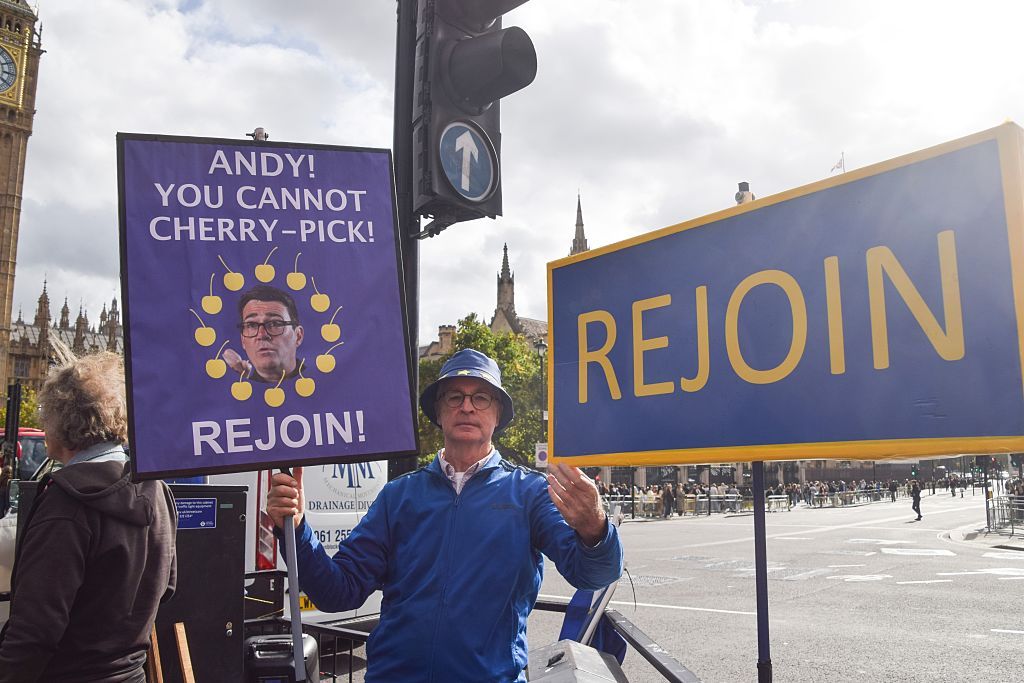
The Brexit debate was bitter and divisive – it is hard to believe that anyone has fond memories of it, or the even more furious arguments that dominated politics for the five years after the referendum. Families were split and friendships put at risk. Most of us are probably relieved it is now firmly in the past.
But not, it seems, the prime minister, Andy Burnham.
He has promised a “debate” on Britain's EU membership, opening up the possibility that we might well rejoin. Indeed, another referendum, or a straightforward promise to sign up for full membership if re-elected, may well be included in the next Labour manifesto.
Start your trial of MoneyWeek today
Get unparalleled financial insight, analysis and expert opinion you can profit from.
Start your trial
Sign up for MoneyWeek’s free twice-daily newsletter.
Join more than 165,000 subscribers and keep yourself informed with latest financial news, insights and expert analysis to help you understand what really matters when it comes to your finances.
Join more than 165,000 subscribers and keep yourself informed with latest financial news, insights and expert analysis to help you understand what really matters when it comes to your finances.
It is not hard to see what Burnham is up to. A promise to reverse Brexit and rejoin the EU will unite the centre-left vote. With the right vote split between the Conservatives and Reform, if the PM can unite the left, he can probably secure an election victory. Less cynically, he probably believes that rejoining the EU is important, both for the economy and for national security. The polls suggest that most people now agree with him.
Brexit uncertainty will hurt the British economy
The trouble is, that is the last thing the British economy needs right now. There will be plenty of people in business, and especially in the City, who would like to rejoin.
Most of the business community never wanted to leave the EU in the first place. They believe it has damaged trade and hurt investment and confidence. Indeed, we are already witnessing the start of a campaign to rejoin, with Goldman Sachs putting out a report earlier this month predicting a 6% boost to growth if it happens.
It won't be long before the pro-EU think tanks are getting big donations to push their case. All the familiar arguments about jobs and trade will be rehashed, along with plenty of suspiciously precise statistics.
But a long debate over rejoining the EU is not going to help the economy. To start with, the EU is likely to demand stiff terms. We will certainly have to allow freedom of movement. We will have to rip up the trade agreements we have signed since we left. We will have to impose lots of new regulations introduced over the last few years, even in sectors such as AI, where Britain has been doing well precisely because we do not need to comply with Brussels. We may well have to join the euro. And we will have to start making large budget contributions, with little chance of reclaiming the Thatcher-era rebate. Perhaps most seriously of all, we will have to accept our share of the massive borrowing the EU took on to finance the Covid Recovery Fund, even though we did not benefit from any of it.
Next, revisiting the Brexit debate is going to create uncertainty. Leaving might have been painful, but that disruption is now in the past. Supply chains have reconfigured, exporters have figured out how to cope with the paperwork, and even the City, despite the dire warnings of collapse, has retained its status as Europe's main financial centre.
But a renewed debate will mean businesses have no idea what trading regime they will face in five or ten years' time. Worse, by the time we finally reach a deal, it may well be vetoed by France, or even by Germany if the AfD has taken power by then.
We spent much of the 1960s debating membership of what was then the Common Market, only to be told we were not allowed to join. The whole circus could easily be replayed in the 2030s. With rising taxes and sky-high energy prices, there is little incentive to invest in the UK. Burnham is about to make that even worse.
A huge distraction
In reality, the EU is just a distraction from the real issues. There is a growing consensus around what needs to be done. Planning rules have to be relaxed to let us build more homes. We need to restore energy independence, instead of always prioritising net-zero targets. We need to reform a bloated welfare system so that people are encouraged back into work. And we have to simplify a tax system that destroys incentives.
None of those have anything to do with the EU. Another decade spent arguing over membership will only keep us from focusing on what really matter.
This article was first published in MoneyWeek's magazine. Enjoy exclusive early access to news, opinion and analysis from our team of financial experts with a MoneyWeek subscription.