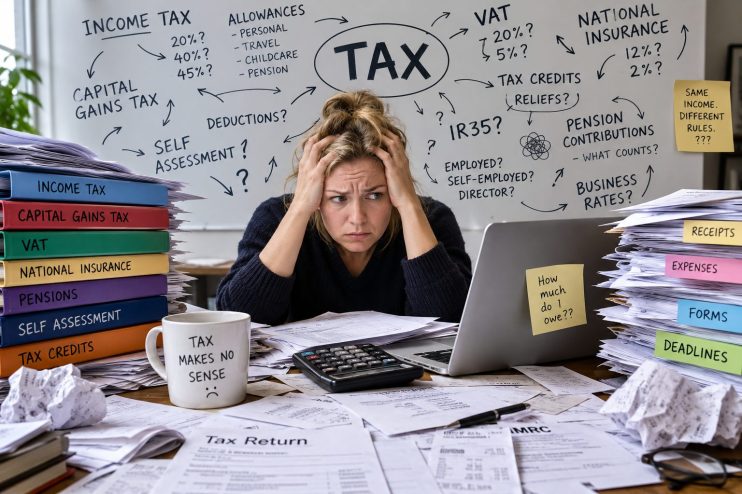
We spend a lot of time talking about tax as a revenue raiser and far less time asking whether the taxes themselves make any economic sense. We rarely think seriously about how the design of the tax system itself can encourage or inhibit growth, says Dan Neidle
Britain’s demographics are brutal. Spending on health and pensions is set to rise inexorably. There are two obvious answers, either substantial tax increases on the one hand, or substantial cuts to welfare and public services on the other. Neither option is particularly appealing, and you won’t find many politicians volunteering to campaign on either.
That leaves growth. Everyone in Westminster claims to want it, and yet there’s something rather odd about the way we talk about getting there. Tax is almost always treated as a way of raising money, or occasionally handing some back. We spend far less time asking whether the taxes themselves make any economic sense. We rarely think seriously about how the design of the tax system itself can encourage or inhibit growth.
We should be more ambitious.
Business tax
Take corporation tax. Decades of anti-avoidance legislation have left us with a system that is bewilderingly complicated. The UK now performs poorly internationally on tax competitiveness, not simply because of the headline rate but because of the complexity surrounding it. And making the system simpler wouldn’t necessarily cost the Treasury a penny. We just need to look at the rules we’ve accumulated over the years and ask how many of them we actually need.
Then there is stability. The speculation before the last Budget arguably did more damage than many of the tax rises themselves. I know entrepreneurs who left the UK because of rumours about an exit tax that never happened.
The Chancellor should impose much greater discipline on pre-budget briefing and kite-flying, and return to one fiscal event a year. Businesses can cope with taxes they dislike. What is much harder is making long-term investment decisions when the tax system appears to be in a constant state of flux.
We should also understand why so much tax owed by small businesses is going unpaid. HMRC estimates put the small business tax gap at somewhere between £30bn and £48bn a year. Yet we have remarkably little evidence about exactly why that money isn’t being collected. Before announcing another crackdown or another set of complicated rules, shouldn’t we establish what’s actually going wrong? Recovering even a fraction of that missing revenue could create room to reduce taxes elsewhere.
Then come the harder reforms.
Consider business rates. A company invests in improving its premises and gets rewarded with a higher tax bill. Stamp duty on shares makes investing in UK companies less attractive. Our R&D tax relief system has become an industry in itself, attracting questionable claims while too often making life difficult for businesses doing genuine research.
None of this is inevitable. These are choices we’ve made about how to tax businesses, and we can make different ones.
Personal taxation
The same goes for individuals.
We’ve created a system where earning more can sometimes leave people facing absurdly high effective tax rates. Child benefit, personal allowances and childcare support are withdrawn at different points, with the result that an extra pound of income can be taxed at a quite extraordinary rate.
Understandably, people cut their hours, turn down additional work or refuse promotions. A tax system supposedly designed to raise revenue ends up discouraging economic activity.
Capital gains tax is another area where the rules don’t make much sense. We tax gains that are simply the result of inflation, give people a reason to hold on to assets until they die, and make it possible to pay less tax by treating income as capital gains. Surely we can design a system that supports investment and entrepreneurship without creating so many opportunities to avoid tax.
We should also make it easier for businesses to invest by extending full expensing, allowing them to deduct more of their investment costs straight away. There’s much better evidence that this encourages investment than there is for many of the smaller tax breaks governments seem so fond of announcing.
Some of the bigger changes are ones politicians have been putting off for years.
Take income tax and national insurance. Why do we have two separate taxes on earnings? And why should the tax someone pays depend on whether they’re employed, self-employed or working through their own company? Bringing income tax and employee national insurance together would be a good start.
Employer national insurance is an even trickier question. At the end of the day, it’s a tax on employing people. We should be looking at whether that burden could be moved elsewhere over time, while making sure employees actually see the benefit.
Property taxation is another obvious candidate for reform. Stamp duty land tax, at rates that can become very high, discourages people from moving home. That reduces labour mobility and means people remain in properties that no longer suit them simply because moving carries such a large tax penalty.
It would be better replaced by an annual property tax, ideally as part of wider reform of council tax and business rates.
And then there’s VAT. The £90,000 registration threshold creates a ridiculous incentive for small businesses to stop growing. A plumber turns down jobs. A guest house closes for part of the year. Not because there’s no demand, but because taking on more work could leave them worse off. It’s a strange way to run a tax system when we’re supposed to be encouraging growth.
If the government wants a new economic model, tax reform should be part of it
None of this requires believing that lower taxes are always better. Nor does it mean pretending every tax cut pays for itself. Some reforms would raise money, some would cost money and others could be designed to be broadly revenue-neutral.
The point is that the structure of taxation matters as much as the overall level.
Growth isn’t everything, but almost everything becomes easier with growth. If the government wants a new economic model, tax reform should be part of it.
Some of these changes could be made tomorrow. Others will take longer, and the biggest reforms may need a government willing to put them to voters at a general election.
But we’ve spent decades putting off difficult decisions on tax. We can’t keep doing that and expect the economy to grow.
We cannot tax our way to growth, or tax-cut our way to growth. But we may be able to tax-reform our way to it.
This article is part of an upcoming
Dan Neidle is a British tax lawyer, investigative journalist and commentator, who researches and writes on issues of tax law and tax policy. Neidle worked as a tax lawyer at international law firm Clifford Chance for 23 years, becoming its UK head of tax in 2020