could be said to be the one company that's more plugged into the world of global real estate than any other. It was founded in 1773 in London by William Ellis and has grown into the world's largest real estate adviser, with a 25% share of the market globally and more than 155,000 employees.
CBRE now operates via four business segments: advisory, building operations, project management and real estate investments. Building operations is the largest, with $12.7 billion in revenue projected for 2026, around 46% of the $27.2 billion in top-line revenue pencilled in by analysts. Operations include the mundane but essential parts of property management.
The largest sub-segment is facilities management ($8.2 billion of the total), which includes everything required to keep a business's real estate running safely, efficiently and sustainably. This covers the day-to-day management of office properties. Property management is the second-biggest sub-segment ($2.7 billion) and includes managing the underlying assets, such as lease reviews, capital spending and rent collection. These sub-segments are growing at a double-digit rate, but their growth appears pedestrian compared with the expansion of the critical infrastructure division of business services.
Start your trial of MoneyWeek today
Get unparalleled financial insight, analysis and expert opinion you can profit from.
Start your trial
Sign up for MoneyWeek’s free twice-daily newsletter.
Join more than 165,000 subscribers and keep yourself informed with latest financial news, insights and expert analysis to help you understand what really matters when it comes to your finances.
Join more than 165,000 subscribers and keep yourself informed with latest financial news, insights and expert analysis to help you understand what really matters when it comes to your finances.
That division is focused on the infrastructure of the 21st-century economy. To drive growth, CBRE acquired Pearce Services in November 2025 for $1.2 billion upfront. It provides technical services for digital and power infrastructure, including data centres, wireless networks, EV charging stations and cooling systems. In October, CBRE added to this growth by acquiring Onnec Group – a specialist in deploying and maintaining network, fibre and data-centre infrastructure – for £460 million. Together, these two deals will add around $1.2 billion to revenue in the critical infrastructure division, compared with the $1 billion reported in 2025.
CBRE is an experienced player
CBRE's advisory business is the second largest of its four major business segments. This division focuses on leasing, sales, debt origination, mortgage servicing and valuations for property owners and investors. However, it's also the most cyclical part of the group. Sales in the third quarter rose 11% overall, below the 18% reported last quarter. Large deals moving into the third quarter hit leasing growth, which came in at 6% year on year compared with analysts' expectations of 16%. Office leasing in the US, for example, ticked down 2% compared with 29% growth last quarter. Income from valuations and loan servicing increased, driven by demand for refinancing.
CBRE's two smaller divisions handle project management, building sales and property development. The latter is grouped under the real estate investments segment, which includes the asset-management business (property investment funds rather than property assets themselves) and development. Trammell Crow Company is one of the company's main development entities. Trammell owns entities such as UK-based homebuilder Telford Homes, acquired in 2019, and has an investment portfolio of nearly $30 billion in properties under development or marketed for sale.
CBRE's edge lies in its global footprint and real estate experience. Most of its income comes from its relatively high-margin services business, with inflation-linked multi-year contracts, rather than property development. This means its returns are substantially higher and more predictable than other real estate players. Indeed, UBS has pegged group return on invested capital (ROIC), a measure of profit for every $1 invested in the business, at 23.7% for 2026, rising to 27.2% for 2027 and 34.8% by 2030. The group's earnings Ebitda margin is pencilled in at 14.2% for 2026, with 20.4% in advisory, 10.9% in business services, 16.3% in project management and 40% in the real estate investments segment. This shows how lucrative real estate fund management really is. CBRE manages $155 billion of funds for investors in the sector and earns both management and performance fees.
CBRE's two primary divisions, advisory and building operations, have grown by 25%-30% over the past two years, thanks in part to rapidly increasing demand for office space. While overall office occupancy levels have stagnated, demand for high-end, serviced, modern and well-maintained properties has risen. That's where CBRE's skills are invaluable. Property valuation, mortgage servicing and mortgage origination services have also increased by more than 10% in two years.
CBRE is trading at a discount
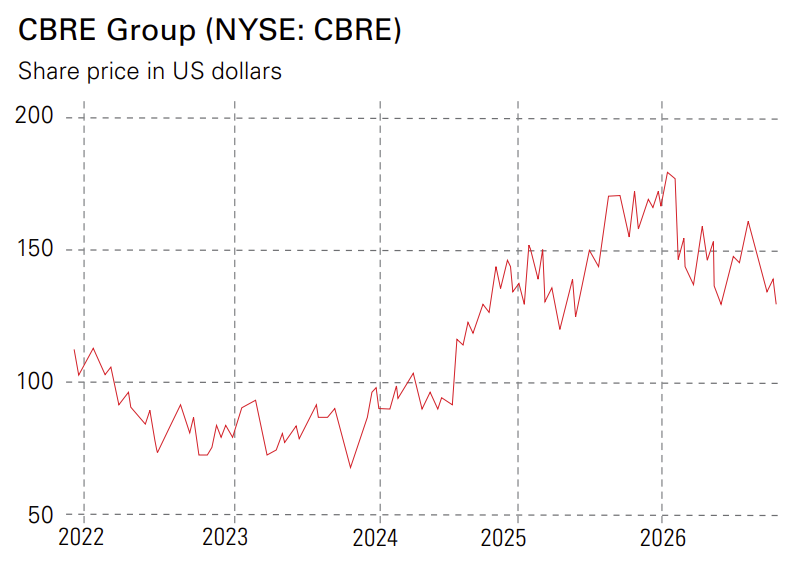
But despite the business's robust fundamentals and the underlying market, CBRE has been left behind by the market rally. Investors' insatiable appetite for AI and related stocks has left old-world, physical-asset plays behind. CBRE has been a victim of this. Despite the fact that the business is a key player in the world of servicing and managing data centres, and looking after the buildings keeping the workers of the AI boom warm and dry, investors are overlooking the company.
The shares are now trading at what appears to be a discount valuation. In 2023, they were on a price-to-earnings (P/E) ratio of 19.9. They're now down to a forward p/e of 15.7, according to UBS, and are expected to fall to 13.9 in 2027. That's nearly one standard deviation below their 20-year average. With net earnings set to rise 20.1% this year, 11.5% in 2027 and nearly 10% a year by 2030, this valuation does not reflect the growth potential. There is no dividend, but the firm is buying back shares. In 2024, it added $5 billion to an existing $4 billion programme, taking the total to $9 billion by the end of the decade.
This article was first published in MoneyWeek's magazine. Enjoy exclusive early access to news, opinion and analysis from our team of financial experts with a MoneyWeek subscription.