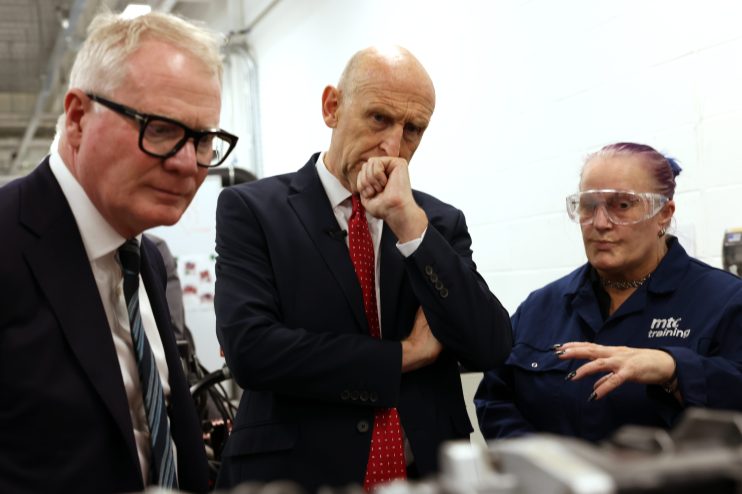
The Chancellor John Healey says growth will provide the “pathway out of indebtedness and into prosperity”. But the path is a difficult one to tread, write Mauricio Alencar.
When it was announced that John Healey would be delivering a speech in Coventry, it was assumed that he would be visiting Jaguar Land Rovers’s headquarters with cars and machines providing an apt backdrop for the cameras. Previous chancellors such as George Osborne and Rachel Reeves have chosen JLR sites to deliver flagship speeches in the past.
But Healey was down the road at the Manufacturing Technology Centre. At the same time, JLR chiefs were preparing to tell some 4,000 workers they were at risk of being made redundant.
The car manufacturing giant has had a brutal 12 months dealing with the fallout of a cyber attack. But, from the perspective of both the public and the government, the problems are symbolic. Treasury and Department for Business staff will be more worried about what job cuts mean for “good growth” and Andy Burnham’s stated ambition to “partner” with the private sector.
The formal announcement spoiled Healey’s desire to seize the narrative on the UK “turning a corner”. In fact, JLR’s announcement may have reminded investors and prospective workers that the economy has not yet taken the right turn.
Can Healey avoid negativity?
Burnham and Healey have signalled their wish to “do things differently” to their predecessors Sir Keir Starmer and Rachel Reeves. Shortly after taking to government, ministers complained about their fiscal inheritance, the so-called £22bn black hole, as a ploy to justify some benefit cuts and higher taxes.
At its surface, Healey’s speech on Monday showed his willingness to be more optimistic. He said the UK had “latent potential” and “huge resilience”. He said there were “relative strengths in dealing with the fiscal challenges”.
But then sprinkled between optimistic statements were rather more negative reflections on the state of the UK economy.
He is “deeply concerned” about the cost of living and business. Economic growth is “fragile” and the country is “scarred” by youth unemployment. The government had plans to lift spirits but it could “not deliver all this tomorrow”.
Opposition party figures have already attacked Healey for not providing any news of substance. Reform UK’s Robert Jenrick called the speech “dreary” while the Conservatives’ Andrew Griffith said “warm words” would not make growth “a reality”.
Both of the parties have said they would cut welfare spending to fund tax cuts. Healey and Burnham have spoken about their ambition to get the welfare bill down without delivering “crude cuts”. Neither have linked the size of spending on disability or pensions to potential tax cuts, however.
Healey may feel he cannot afford to make such promises. After a heavy Labour backbench rebellion, an embarrassing U-turn by Starmer and Reeves on £5bn welfare cuts led to the launch of government reviews lasting more than a year.
Proposals laid out by the minister Sir Stephen Timms on personal independence payments (Pips) as well as the completion of a separate review by Alan Milburn on youth unemployment could give the government some cover to introduce cuts although neither report is due until after the Budget. It stops Healey from being able to target the £322bn welfare budget – most of which is made up of pensioner spending – for cuts. Healey would then have to roll back public spending boosts previously announced by Reeves if he really wanted to cut taxes by substantial amounts to offer people real “breathing space” on the cost of living.
But even then, business chiefs, government officials and voters understand the prospect of tax cuts are highly unlikely this year. Thomas Pugh, the economist at the accountancy RSM, said on Monday that the Chancellor himself has far less breathing room than Reeves had when the Spring Statement was delivered in early March this year.
He calculated the fiscal buffer available – based on borrowing targets that are wholly dependent on judgements made by the Office for Budget Responsibility – at £11.5bn, down from £23.6bn. The erosion has come as gilt yields have spiked due to global bond market turmoil, pushing up government borrowing costs. The government is projected to spend more than £116bn in debt interest this year, rising to about £137bn in 2030. This is higher than the education budget, the second largest government department.
The timing of a rout in bond markets is particularly damning for Healey, he said, as the snapshot time period the OBR uses to make its fiscal forecasts is likely to come around mid-September. It could add to significantly higher cost projections in its fiscal forecasts than if the OBR had taken data from June when yields were slightly lower.
Lower migration and higher inflation projections could also further cost Healey this year, according to Pugh. The City economist added that this level of headroom would be above what Reeves twice had, meaning the Treasury can “probably live” with a buffer above £10bn.
But a rise in bond yields and poorer forecasts “does leave the Chancellor in a precarious position”, Pugh added.
“The reason Reeves decided to more than double the headroom was because such a narrow buffer created endless speculation about what taxes would have to go up every time there was a change in gilt yields. That speculation was bad for growth.”
Like their predecessors, the best Healey and Burnham could hope for is for President Trump to find a way to open up the Strait of Hormuz for the foreseeable future. Oil and gas prices would likely fall as firms expect trade flows to resume, triggering a sequence of events that favours the UK. Inflation expectations would likely fall back, interest rate hike expectations would ease, bond yields would drop and the government would see more room for manoeuvre in public finances.
But there is an alternative for the Chancellor. He said in his speech that growth was the “sustainable pathway out of indebtedness and into prosperity”. Beyond greater devolution and some planning reforms, it is not clear what Healey’s growth vision is or how quickly he plans to deliver it. Andy Haldane, the former Bank of England chief economist who advised Burnham, and Rishi Sunak are among those saying that the Chancellor should rule out tax hikes to allow businesses to proceed with planned investments and for households to spend more without fearing a drop in income.
Tax reform, improving trade and an overhaul of public sector performance may be within the scope of measures that Healey could take to lift growth, however politically unpalatable some changes may be. But in his speech on Monday, there was no mention of the word “radical”. In a recent interview, he suggested he would provide “continuity” from the last government. Researchers at Capital Economics have also remarked that new administrations can only do so much to boost growth and productivity, with just two of nine governments since 1955 presiding over a period of faster GDP growth than the government before.
Remarks on Monday morning underpin the Chancellor’s intention to cut through the noisy gloom hitting UK plc. But bosses are unlikely to be getting any instant remedy to their woes in the next few months. Healey wants to get the UK economy on track but the corner he is driving it towards looks difficult to get around.