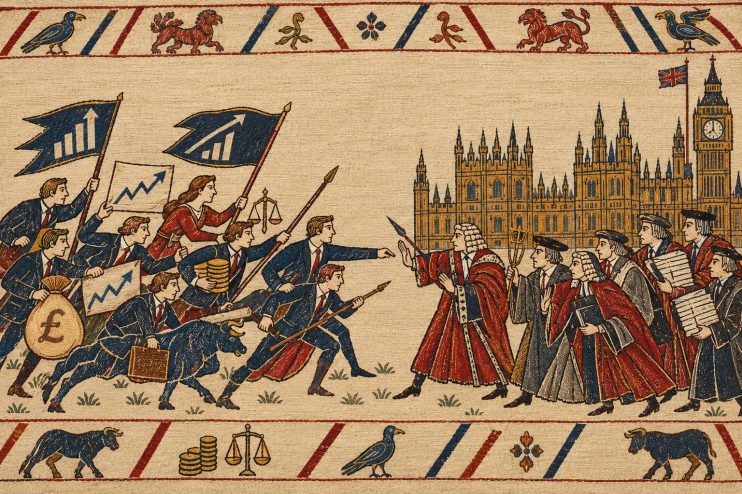
Politics is about to get more stark and much more consequential. Business leaders need to be pragmatic, dealing with the government of the day. But it strikes me that in this battle of ideas, they need to stand up for what works – especially when the country we all love is going in the wrong direction, says Liam Halligan
Earlier this week, I was delighted to address a Confederation of British Industry reception at the British Museum – with a chance to see the magnificent Bayeux Tapestry depicting, of course, the Battle of Hastings.
While 1066 was a long time ago, there’s another battle going on now, across our politics and the economy – a Battle of Ideas.
Britain remains a great place to live and work – boasting enormous scientific and artistic acumen.
And – crucially – we’re home to some great businesses, small and large, run by talented, driven entrepreneurs.
Stay in the know
Three daily briefings with the key market moves and top business and political stories.
SUBSCRIBE HEREBut for quite a few years now, commercial success achieved in Britain has been despite rather than because of government policies.
For decades, under the Tories and now Labour, the state has been getting bigger – and is now far too intrusive and chronically unaffordable, to the extent it’s threatening financial stability.
After the big government of the 1970s, the tax burden fell steadily to 30 per cent of GDP by the early 1990s, the end of the Thatcher era.
It rose again under New Labour and pretty steadily during 14 years of Tory-led government.
Over the last two years, though, since Labour regained office, Britain’s tax burden has spiralled. From 38 per cent now – the highest since 1948 – we’re heading for 41 per cent by the end of this decade. And that’s before next week’s budget.
Increasingly, the centre-left wants yet higher taxes, more state borrowing and spending – bigger government. The centre-right is meanwhile pushing for lower taxes, government that does less, a smaller state.
Business leaders need to be pragmatic
This is the battle of ideas now looming over the British economy. That’s why politics is about to get more stark and much more consequential.
Business leaders need to be pragmatic, dealing with the government of the day. But it strikes me that in this battle of ideas, they need to stand up for what works – especially when the country we all love is going in the wrong direction.
When you look at our high inflation, spiralling energy costs, rising unemployment and, particularly, our increasingly precarious public finances, Britain clearly (italics) going in the wrong direction.
For years, we’ve lived beyond our means – with governments of all stripes racking up huge borrowing and debts.
The government borrowed £24.5bn last month – almost £11bn of which was spent on debt interest payments, £400 per household on debt service costs, in September alone.
Debt interest payments since April amount to £61bn – that’s our annual defence budget, enough to build 40 brand new hospitals, or employ 100 thousand extra nurses for ten years.
This isn’t how you’d run a business and it’s now how we should be running our country.
Unlike Hastings, this isn’t a battle with France. But ministers often tell me our friends across the channel have a higher national debt than we do. Yes, but Britain’s debt has been growing so far, and we’ve become so inflation prone, we pay far more to borrow – with annual debt service costs now 3.6pc of GDP, compared to 2.5pc in France.
The UK’s public finances are dangerously fragile and could easily implode. Former senior officials at the Bank of England and Office of Budget Responsibility are now speaking out. Business leaders need to speak out too.
A battle of ideas is looming, with Britain at a fork in the economic policy road. Not quite as consequential as the Norman Invasion, it will nonetheless significantly impact the lives and livelihoods of millions of British households.
As the ultimate creators of our national wealth, when it comes to that battle, Britain’s business leaders, of firms big and small, have a vital role to play.
Liam Halligan is director of the Centre for Policy Studies