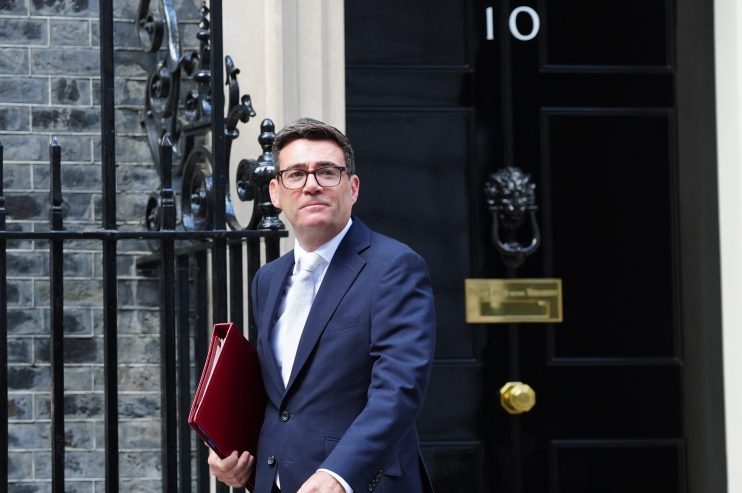
Andy Burnham has said politicians are central to his “theory of growth” in his first statement in the House of Commons as Prime Minister.
Addressing MPs from all parties, Burnham said his ideas for the UK economy centres on a “triple helix approach to economic development” in which universities, businesses and the government foster economic growth. The ‘triple helix’ model was first drawn up in the 1990s by economic theorists Henry Etzkowitz and Loet Leydesdorff.
He told MPs that devolution provides a “clear answer to the question with which this country has long wrestled” on who drives growth.
“My theory of growth requires it to be driven with the full authority of the very centre of government, in close partnership with His Majesty’s Treasury,” Burnham said.
“Number 10 North has been set up with that full focus.”
He said the “triple helix approach” would “build a pro-business culture and an innovation-led economy in all parts of the UK”.
Burnham deflects tax questions
However, Burnham deflected a question on whether he would rule out tax rises from the opposition leader Kemi Badenoch. Bosses at retailers including Tesco and M&S are the latest of a number of industry leaders calling for Burnham and Chancellor John Healey to not target businesses with more tax hikes.
The Prime Minister said he had already cut two taxes so far, referring to reducing business rates by 20 per cent for pubs and music venues, and a decision to strip VAT from household energy bills.
In their first parliamentary sparring session, Badenoch accused Burnham of being fixated on Margaret Thatcher, “a woman who became Prime Minister before I was born”.
“He is living in the past and wants to take us back to the 1970s,” Badenoch said. “On this side of the house, we are for the future. We are for the future, Mr Speaker, not the past.”
But Burnham used his first address to provide a sweeping view of his “diagnosis” for Britain’s economic ills, saying that some places had been “drifting” for 40 years. Some of the blame went towards a “failed economic model which does not trickle down”.
Public control and devolution
The former Manchester mayor said his personal experience of leadership over the city offered him further credibility to push for “public control” over services such as transport and water. He said privatisation of the latter sector “stands as a leaking monument to that approach – a country run in the private rather than public interest”.
“Our job here is to make it real by taking a place-first rather than party-first approach. It starts with reasserting basic standards for Britain, that this is a country where no one sleeps rough, and no community is blighted by an illegal waste tip, and from there, working together to build a new sense of optimism around the country.
“We can make this next decade better than the last.”
Much of the first session on Tuesday was also spent on Ukraine, with Burnham paying tribute to his Tory predecessors for standing by the country in the face of aggression from Russia.
He also paid tribute to Sir Keir Starmer, who announced his resignation earlier on Tuesday, as having “given this country a lifetime of public service”.