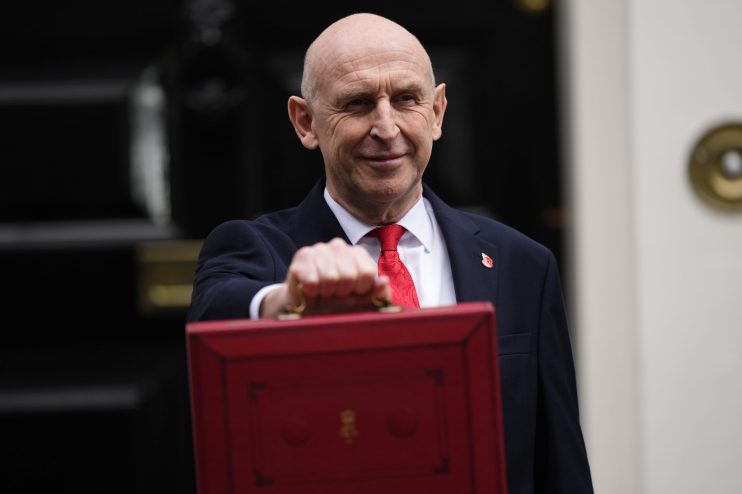
John Healey has announced a string of tax hikes to fund short-term measures worth billions of pounds to help households and businesses cope with rising prices, in a maiden Budget that omitted major spending plans on defence and welfare.
In his speech, the Chancellor said the government would look to raise defence spending to three per cent of GDP to three per cent by 2030 as a “target date”. He said the government would “look hard” at departmental budgets and “use more innovative financing”, including through public bodies and agreements with allied nations.
The mix of policies targeting banks and online retailers now takes the Labour government’s cumulative tax hike to over £70bn since its election in 2024.
His fiscal buffer against the government’s main borrowing rule now stands at £15bn, compared to £23.6bn in March. He said he used the headroom to “absorb” the impact of the latest energy price shock. The deficit is projected to amount to 3.4 per cent of GDP next year, a figure closely watched by traders.
Stay in the know
Three daily briefings with the key market moves and top business and political stories.
SUBSCRIBE HERECity analysts have widely warned that an omission in plans for raising defence investment and departmental cuts mean the Budget has not accounted for heavy pressures on public finances.
The Budget focused on a range of cost of living measures, including an extension on a freeze on fuel duty and VAT cut on energy bills, as well as a new £2.6bn scheme to provide payments to support 20m homes with bills.
Fiscal devolution
The Chancellor’s statement also laid out Andy Burnham’s plans to transfer financial powers out of Whitehall as part of devolution reforms and upgrading investment by public bodies through borrowing against future income. Tech firms will also have to sign up to government rules relating to local priorities in order to build data centres.
Healey told MPs that he would fully fund the existing defence investment plan, covering a near-£5bn hole in expenditure.
He added that “choices” around departmental spending would come at next year’s Spending Review. Healey said this review would deliver on a “fundamental rewiring of the state” as the government aims to boost public sector productivity, which could create savings.
Reviews on welfare around youth unemployment and disability payments will be completed by the end of the year. The Chancellor said he would reject “crude cuts” and “rebuild our welfare so that it supports people from youth into old age”.
“This is a Labour Budget for the worker, the sole trader, the parent at the school gate, the young person desperate to start their first job or start their first business,” Healey said. “These are my choices: Raising revenue from those who can afford to pay.
“Just as the British people helped support our banks 20 years ago, it is our banks that will help give families breathing space today.
“The decisions I have taken today will help steer Britain through.”
Tax rises on banks and online retailers
The most significant near-term tax rise came around banks as he raised the profit levy by another three per cent for a limited 15-month period.
Extra gambling taxes and a requirement for online marketplaces such as Amazon to pay VAT will boost revenue, Healey said.
HMRC will also be handed powers to collect overdue tax from people who are “can clearly afford to pay” while people conducting self-assessment on taxes will have to make “smaller, more regular payments”.
Healey also added that investors would face a number of changes on tax rules.
This includes tighter rules on corporation tax expensing, reducing the business asset disposal relief threshold from £1m to £500,000, and an increase on rates of tax on income from property and savings by another two percentage points from April.
A levy on income from dividends and taxes on income from employment will remain unchanged.
He said measures would help him maintain “fiscal discipline”.
Healey’s limited tax raid partly funded support for households and businesses. He said on Wednesday that business rates for pubs, clubs and music revenues would be cut by 20 per cent while more small businesses would enjoy a relief on taxes.
He also announced an alcohol duty relief for brewers and some extra relief for new investment. This involves a new capital gains tax relief for founders, a 10 per cent rate on lifetime gains of up to £10m for the founders of businesses.
A further £20.4bn will also be handed to the National Wealth Fund and the British Business Bank over the coming years, the Chancellor confirmed.
Healey’s economic issues
The speech referred to “economic storms” caused by conflicts in the Middle East as a prolonged war between Iranian-backed militias and US allies has kept trading flows across the Strait of Hormuz and other critical routes in the region partially blocked.
He referred to gas prices nearly tripling since the Iran war started and oil prices surpassing $100 per barrel.
The Office for Budget Responsibility, the independent forecasters whose calculations determine whether Healey has maintained control over public finances, said growth would be lower than previously expected at one per cent next year and then 1.6 per cent in 2028.
The forecast for next year’s figures was a major downgrade on a previous forecast in the spring when the fiscal watchdog said the UK economy would expand by 1.6 per cent in each of the next two years.
Forecasts on growth were upgraded for years further into the horizon. This year’s growth is expected to be 1.2 per cent, slightly higher than previously forecast.
Healey said: “Britain has beaten the forecasts this year, and with the action I’m taking today, I believe Britain can beat them again”
The OBR also opted to raise its inflation forecasts in a sign that the country’s cost of living pressures are set to deepen.
Devolution plans laid out
In a major break from his predecessors, Healey said he would preside over the transfer of financial power out of Whitehall, stopping local leaders from going “cap in hand” to the government with requests for more cash. He said his plans would be the “most radical” devolution programme in a generation.
The new economic system will see mayors get a slice of extra income tax receipts generated locally, plus 20 per cent of business rates revenue.
Extra cash retained will be used to invest in infrastructure, the Chancellor said.
Prior to the speech, the Conservatives opposition called on the government to raise defence spending to three per cent and take radical measures to cut spending.
Reform UK published an alternative Budget on Monday that featured 63 policy proposals, including cutting regulation around net zero and workers’ rights, as well as cutting taxes for employers hiring British workers.