Bond yields and geopolitics are ever present for investors. But that brings its own challenges, as it can often be difficult for us to recognise things that surround us and shape our thinking to the point where they go unremarked.
There is an old parable repeated by David Foster Wallace in , which, in his version, goes something like the following: two young fish are swimming along and run into an older fish. “Morning, boys. How's the water?” asks the older fish. The younger fish nod, swim on, then one turns to the other: “What the hell is water?”
Bond yields are rapidly rising
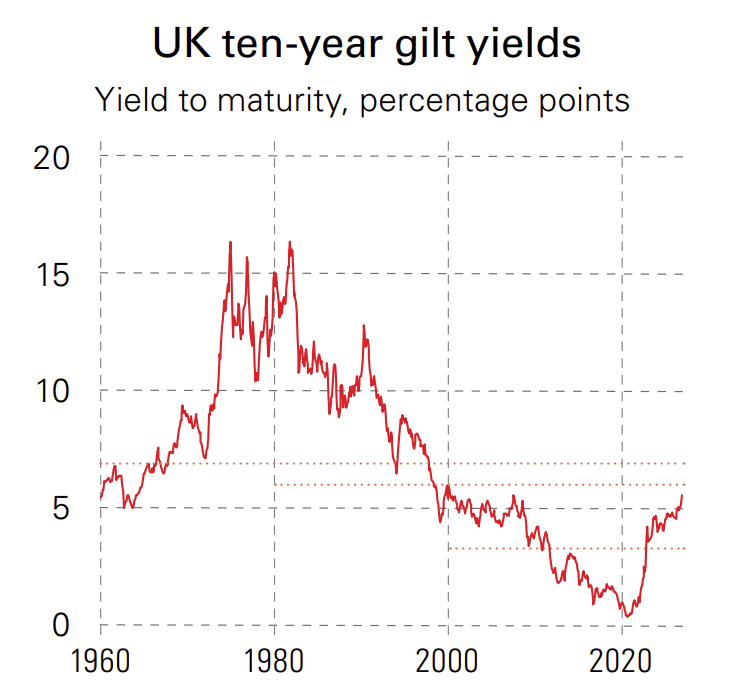
Bond yields are rising fast. Ten-year gilts are at 5.4%, ten-year Treasuries at 5.2%. German and Japanese bond yields are also at two-decade highs. Many investors now view these bonds as attractive – although the fact that yields are still trading there tells us that money is not yet flowing back into them in a big way.
Start your trial of MoneyWeek today
Get unparalleled financial insight, analysis and expert opinion you can profit from.
Start your trial
Sign up for MoneyWeek’s free twice-daily newsletter.
Join more than 165,000 subscribers and keep yourself informed with latest financial news, insights and expert analysis to help you understand what really matters when it comes to your finances.
Join more than 165,000 subscribers and keep yourself informed with latest financial news, insights and expert analysis to help you understand what really matters when it comes to your finances.
To decide whether they are good value, we need to consider what has pushed bond yields up. Is it fears of higher inflation, worries about government finances, growing supply of long-term corporate debt, or expectations of robust growth driving higher short-term rates? However, we must also consider whether our sense of what's normal could also be misleading us.
Ten-year gilt yields are well above their average of 3.3% since 2000. Yet for much of that time, they were held down by central-bank intervention. Many analysts and managers working today will have spent most of their formative years in a low-yield environment, and will instinctively feel that 5% is exceptionally and unsustainably high. Yet if we look back further, the picture changes. The average since 1980 would be 6%, while the average since 1960 – including the inflationary 1970s – would be 6.9%. So whether yields are exceptional depends on what you think is normal.
When does geopolitics matter?
My second example comes from a recent seminar, where an experienced institutional investor argued that geopolitics doesn't matter. Yes, markets react to events in the short term, but these rarely had lasting consequences, he noted.
Yet such individual events were mostly fluctuations within a steady environment. Always remember that every investor working today has spent most, or all, of their career in the post-Cold War era, with the expectations for trade, security and capital markets that peace created. We are clearly in a different geopolitical regime today – and that will have consequences.
We will be discussing the implications of this at our on Friday, 6 November in London. But to stretch the parable a bit: the fish often learns what water very abruptly, when it gets hooked by the fisherman. Investors want to avoid the same outcome.
This article was first published in MoneyWeek's magazine. Enjoy exclusive early access to news, opinion and analysis from our team of financial experts with a MoneyWeek subscription.