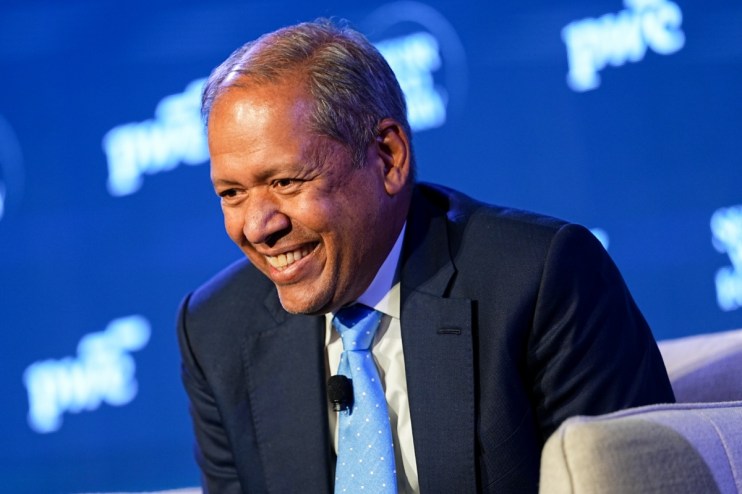
‘ investment bank could be in line for another major boost. But Samuel Norman takes a look at the progress investors will be wanting to hear on its latest strategy plans.
When CS Venkatakrishnan laid out his sweeping restructuring of Barclays he promised a “simpler, better and more balanced” bank.
Key to this was reducing reliance on investment banking operations, which had proven to be a volatile source of revenue due to its unpredictability across dealmaking and trading.
Speaking at the beginning of 2024, Venkat said the investment bank has to be “higher returning” but also become a “smaller part of Barclays”.
Unfortunately for Venkatakrishnan, known in the industry as Venkat, market tensions have kept the investment bank centre stage across the group – and come Thursday it will be under the spotlight during the group’s third-quarter update.
Stay in the know
Three daily briefings with the key market moves and top business and political stories.
SUBSCRIBE HERELast year, the investment bank made up 44 per cent of the group’s revenue, thanks largely to the market chaos triggered by President Donald Trump’s tariff trade offensive. Even while traditional deal advisory lagged, trading desks made hay, with equities income rising 12 per cent to £3.2bn.
In the first half of 2026, there were new geopolitical tensions, same outcome. Barclays investment banking division saw its income climb 11 per cent year-on-year to £8bn for the first half of the year.
Equities income soared 45 per cent to £1.3bn in the second quarter alone as traders capitalised on the market swings and volatility drawn out by the Middle East conflict. Investment bank income grew as a share for the group to 48.4 per cent.
The geopolitical crises may have derailed Venkat’s hopes to make investment banking operations a smaller share of the bank, but his strategy to tighten the balance sheet has worked behind the scenes.
The bank chief made no specific target around revenue share but instead pledged to bring return on tangible equity (RoTE) for the investment bank in line with the wider group. RoTE is a key profitability ratio, measuring a company’s net income relative to the average value of a company’s common equity.
By the end of the year, Venkat has hoped to bring it in line with a broader group target of 12 per cent from around seven per cent in 2023.
In 2025, RoTE reached 10.6 per cent and for the first half of 2026 surpassed 15.5 per cent. This follows the bank bearing the axe on costs in the division with its cost-to-income ratio improving significantly to 54 per cent in the first half, compared to 62 per cent in 2025.
No investors will be assessing Venkat’s larger ambition where he looks to extend RoTE above 14 per cent by 2028.
Another big target for scrutiny on Thursday will be progress on risk-weighted assets (RWA), a key measure of the overall size and financial risk of its loans and investments. Analysts expect Barclays investment bank will hold around 55 per cent of the group’s RWA following the third quarter.
Venkat pledged to bring this down to “around” 50 per cent by the end of 2026 in a bid to boost the firm’s stock price and free up capital for returns. Analysts expect the investment bank’s share will remain around 55.14 per cent for the year-end.
In an update earlier this year, Venkat was bolder in his promises. The bank chief said the share would be reduced to 50 per cent by 2028 – something internal analysts believe is achievable, pencilling in 50.73 per cent
Barclays fights to pump up stock price
The original strategy has been centred on boosting Barclays’ share price, which has lagged its counterparts in recent years. Just weeks before the bank unveiled its overhaul years ago, Qatar’s sovereign wealth fund cut its stake in the firm, amplifying fears around returns.
But investors have rewarded the manoeuvres with Barclays share price up 150 per cent since the February 2024 overhaul – notwithstanding some steep losses on account of the geopolitical turmoil.
To drum up further excitement, Barclays laid out plans in February to return more than £15bn to shareholders through dividends and buybacks by 2028.
The quarter due to report on Thursday is forecast to be another win for Barclays with analysts expecting pre-tax profit to rise to £2.4bn from £2bn the year prior.
But the investment bank threatens to steal the spotlight once more – if Wall Street’s reporting season is anything to go by.
The US’ big six – that’s JP Morgan, Goldman Sachs, Morgan Stanley, Bank of America, Citigroup and Wells Fargo – reaped a $22bn trading revenue haul in the third quarter.
Richards added as a whole Barclays revenue momentum was expected to “remain robust” in the third-quarter keeping Venkat’s 14 per cent RoTE target “within reach”.
Global instability may have stopped Venkat from reining in the investment bank’s dominance but the bank chief will need to show his grip on long-term targets isn’t loosening to keep investors on side.