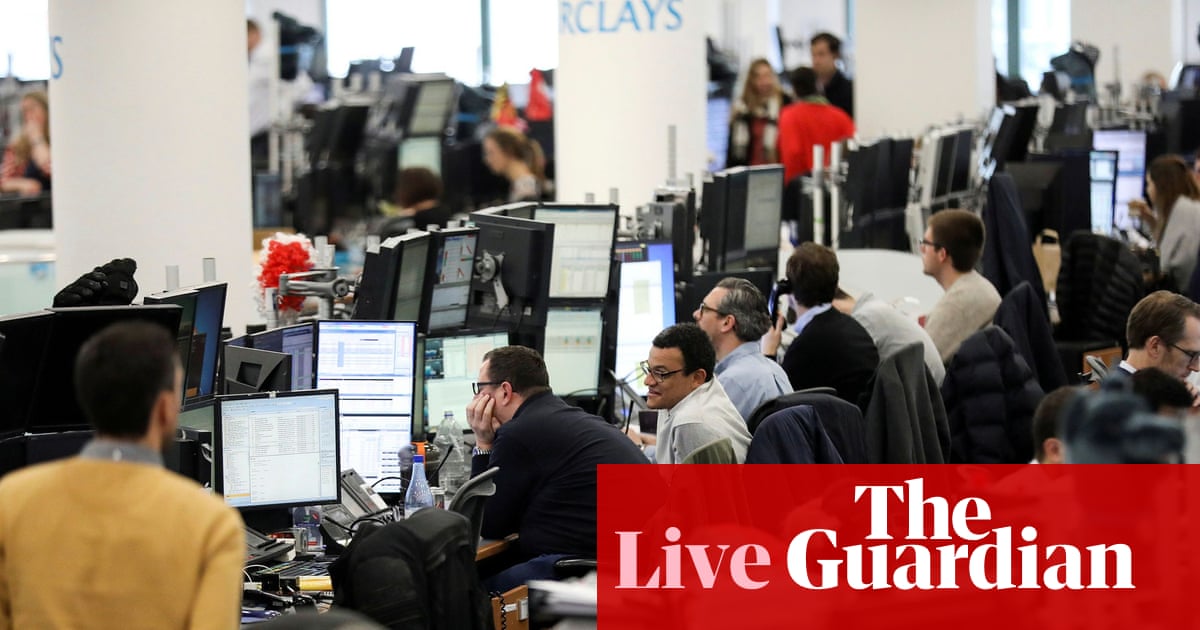
Its chief financial officer, , told journalists on a call that 1,000 of the job cuts have already been implemented, with another 4,000 to go before the end of the year.
The news was buried in this morning's presentation, where the UK bank revealed higher profits of £2.3bn for the July to September period, up 12% on last year. It is handing a further £500m back to shareholders.
C. S. Venkatakrishnan, the chief executive, said that the bank's cost to income ratio has improved from 63% to 62% in the last three months.
The Barclays share price is up slightly this morning, but has lost about a quarter of its value in the past three months.
The Barclays results come after reports on Monday that the Bank of England was examining whether Barclays traders had misrepresented illiquid private credit loans by using derivatives.
Barclays shares have fallen by 20% over the last three months, also pressured by the prospect of higher bank taxes in the upcoming budget.
at interactive investor said:
Indeed, the UK banks have an additional hurdle to overcome in the form of the imminent budget. The sector has underperformed so far this year on a number of concerns, one of which is the bank surcharge. One market estimate suggests that the bank surcharge will be returned to 8% from the current 3% which in turn would reduce earnings by a possible 6%, although whatever the outcome some of the uncertainty which has been overhanging the banks would be removed.
On balance, these concerns have blemished the investor confidence which was clearly in evidence at the interim results, even though the longer-term picture remains solid and where Barclays has maintained its guidance for this year and next. Prospects for its three largest units, the Investment Bank, Barclays UK and Barclays US Consumer Bank are the main drivers and it may yet emerge that this quarter's slightly uninspiring update is a blip rather than establishing a weaker trend.
Despite the quarterly share price weakness and the heightened expectations which have resulted in a weaker opening price today, the direction of travel remains intact, with the shares having posted a gain of 15% over the last year, as compared to a hike of 13% for the wider FTSE100. Over the last two years, the price is ahead by 74% and there seems little doubt that the group's financial strength, alongside its geographical and business diversity are factors which keeps the stock in demand among investors, such that the market consensus of the shares as a buy should remain untroubled.
Richard Hunter, head of markets at the trading platform interactive investor, said the Barclays results are a bit "a mixed bag which is unlikely to blow away the clouds which have been hovering over the sector".
In the investment bank, which accounts for 42% of group revenues, the recent US experience of the large names was echoed, he noted. Equity income rose by 47%, but Fixed Income, Currencies and Commodities (FICC) was 19% lower, leading to an overall 4% gain. Investment banking fees and advisory rose by 13%, with other highlights coming from Barclays UK Corporate.
Hunter added:
A cautious impairment provision of £500m was 20% lower than the previous year, with defaults remaining stable and far from ringing any alarm bells.
More broadly, the group reiterated its financial muscle with a further £500m share buyback, in addition to the £1bn announced at the interim results. This is part of the group's ambitious aim of £10bn of returns between 2024 and 2026, and then £15bn of returns between 2026 and 2028.
At a more granular level, there are pockets which may raise the eyebrows of some investors. The US Consumer Bank saw income decline by 1%… although the numbers were muddied by the inclusion of Best Egg numbers, which Barclays acquired in May for £600m. Barclays UK saw income growth of 4% largely due to the impact of the structural hedge, but numbers were contained by ongoing investment into its wealth proposition, where income nonetheless managed a 10% gain.
Here's our full story on :
Barclays is giving a further £500m to shareholders after reporting a jump in quarterly profits, as the lender steels itself for an increase in UK bank taxes at next week's budget.
It comes only days before the chancellor, , is due to announce a hike on banks in the 28 October budget, as the prime minister 's government looks for ways to raise revenue to help fund cost of living support programmes.
Barclays' strong performance included a 6% rise in net interest income at its UK retail banking operations, to £2bn. The figure has become a flashpoint for campaigners pushing for a bank tax. It accounts for how much money banks make from loan charges, minus what they pay on deposits, and is linked to interest rates, which have been rising as the Iran war has driven up inflation expectations.
Barclays third-quarter profits of £2.3bn – bring its profits so far this year to £8.4bn, up 15% on the year.
The TUC called the government for higher bank taxes, to fund a social energy tariff.
At the moment, the bank surcharge is an additional 3% corporation tax on the profits of banking companies above £100m. The Conservatives slashed the surcharge from 8% to 3% in 2023, just as interest rates were reaching their peak – a move that has cost the Treasury £6bn, the union body argued.
The TUC is calling for the government to increase the surcharge to raise up to £60bn over the next four years. Even just reversing the Tory cuts and setting it at 8% would raise £9bn over four years.
TUC general secretary said:
Barclays' bumper profits aren't an anomaly. All the big banks are doing exceptionally well at the same time – but their windfall profits have been underpinned by mortgage misery for millions. That's why it's time for banks to pay a fairer share.
At a time when the chancellor needs to raise more revenue to support households and businesses through a looming energy bill crunch, Britain's big four banks have made £200bn in profit since 2021. They can - and should - pay more tax.
Good morning, and welcome to our rolling coverage of business, the financial markets and the world economy.
' profits jumped in the last quarter and it handed more cash to shareholders as further bank taxes loom in 's budget next Wednesday.
The UK lender reported a 12% rise in pre-tax profits to £2.3bn for the three months to 30 September. Income rose 3% to £7.4bn, ahead of expectations. In the UK, loans grew 7% year on year with particular strength in its corporate business, up 14%.
It announced a new £500m share buyback, bringing the amount handed back to shareholders so far this year to £2.8bn, up 46% year on year.
C. S. Venkatakrishnan, the Barclays chief executive, said:
I am pleased with the ongoing momentum of Barclays' operational and financial performance.
With one quarter to go before the end of our original three-year plan, we have either achieved or are on track to achieve all of our 2026 group targets. We are confident in and committed to the 2028 targets that we laid out earlier in the year.
The investment bank delivered strong equities performance, offsetting a challenging environment for FICC [Fixed Income, Currencies and Commodities].
Barclays' investment bank reported income of £3.1bn, lower than analysts had forecast. Income from fixed income trading slid 19%, worse than a 5% drop among US banks.
The TUC urged the chancellor to increase taxes on banks at next week's budget.
The union body wants the government to use the money to pay for a social energy tariff that brings down energy bills by up to £559 a year for those on low and middle incomes.
A UK bank tax risk is now a base case. If it is confirmed on 28 October, it'll be the size and timing that will be key. If Healey does go ahead, shares of and , which are almost entirely exposed to the UK, would likely be impacted most, and you are seeing this already in the share price reaction today. is partly exposed. is least exposed in the mix.
In financial markets, the cost of French government borrowing has increased further, hitting multi-decade highs, and piling pressure on ministers after weeks of increasingly violent street protests.
The yield, or interest rate, on France's 10-year bonds rose 4 basis points to 5.039%, the highest since July 2002, after breaking through the 5% mark on Wednesday.
The risk premium over German Bunds has widened to 163bps, the widest since November 2011, reflecting investor concerns over France's fiscal outlook. The government has yet to pass its budget.
Oil prices have climbed above $111 a barrel this morning, after more Houthi attacks in Saudi Arabia fuelled fears over an escalation of the Middle East conflict and further disruptions to supplies.
Brent crude, the global oil benchmark, is up 2.5% at $111.58 a barrel, raising fears of higher inflation, which puts pressure on bonds.
Asian stock markets slid, with Japan's Nikkei down 2.65%, China's CSI 300 losing 1.5% and South Korea's Kospi tumbling 3.7%.
-
10am BST: UK index-linked gilt 2031 action
-
11am BST: UK CBI Industrial tends survey
-
11.50am BST: Bank of England governor Andrew Bailey speech
-
1.30pm BST: US Initial jobless claims for week of 17 October
-
3pm BST: Eurozone consumer confidence flash for October
-
3pm BST: US Conference Board leading index for September