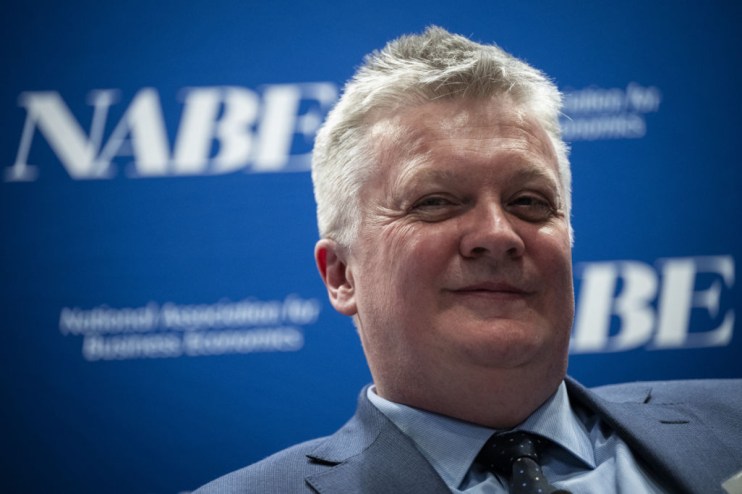
The Bank of England is unlikely to vote for the four interest-rate hikes forecast by financial markets, according to its chief economist, who added the central bank should have raised rates in the early stages of the Iran war.
Huw Pill, who has the most hawkish track record on the Monetary Policy Committee, played down the chances of the Bank raising rates by a full percentage point in the next year – the current path implied by financial markets.
He told an International Monetary Fund meeting in Bangkok he was “sceptical” about the need for such a sharp monetary tightening even as the Iran war threatens to carry inflation above four per cent at the start of next year.
“To get 100 basis points [of rate rises], we need a concrete manifestation of these risks [to wages and prices],” Pill told reporters. “We will get more evidence in the next six to nine months on second-round effects.”
Traders can effectively bet on the Bank of England’s interest rate path via what are known as swap rates. Since the onset of the Middle East conflict, the swaps market has consistently overestimated the number of UK central bank rate hikes, and currently suggests the MPC will vote for four interest rate rises in the next 12 months.
Bank of England can’t rely on ‘hall of mirrors’ from natural tightening
But throughout the war, officials have so far left Bank Rate unchanged and are instead on high alert for signs of so-called ‘second round effects’. The pattern, where the price pressure from an initial shock becomes embedded in an economy via wage and price setting, has so far failed to materialise. Price rises have so far been largely restricted to energy and fuel.
Pill said that despite the absence of second-round effects to date, the spectre of a 20 per cent jump in energy bills next year meant the Bank should have voted for an interest rate hike at the start of the war to prove it was “active”.
“It would have been good to move early and influence market expectations, and send a clearer signal we were active and agile,” he said. “I don’t think we have been in a good place.”
Other rate-setters have pointed to the monetary tightening that has occurred organically from the Bank of England’s decision to leave interest rates unchanged rather than cut them. The change in tack brought about by the war has led banks and mortgage providers to increase the rates they charge on new borrowing. The average rate of a five-year mortgage has jumped above six per cent from an average rate of below five per cent before March.
But Pill, who has voted to raise rates at every meeting since the Iran war, warned the Bank could not continue to rely on the natural tightening, branding it a “hall of mirrors” that could become a “house of cards”. “Acting and being agile feels more comfortable to me,” he said, adding: “You are doing something you are controlling.”