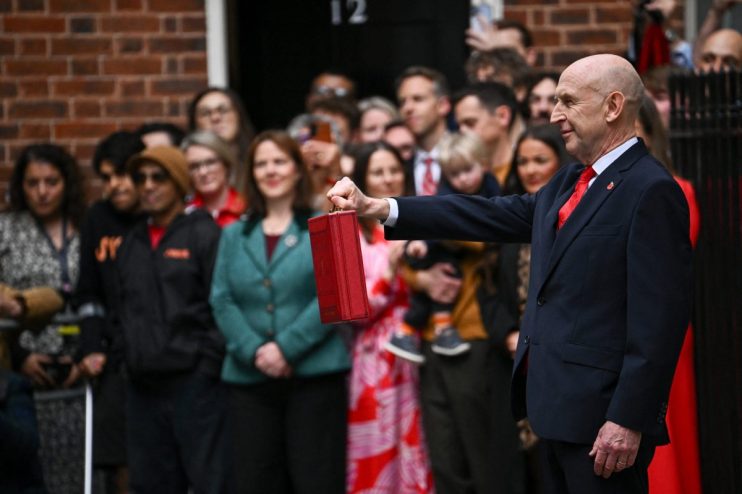
Healey has tried to avoid breaking anything – including Labour’s poll lead – in his Ming Vase Budget, writes Julian Jessop
As expected, John Healey delivered a low-key ‘first do no harm’ Budget, with a few treats for households and businesses and no nasty surprises for investors. What was needed, though, was a ‘do some real good’ Budget.
The only ‘rabbit’ was a £100 ‘household energy payment’ for 20m households in council tax bands A–D, costing £2.6bn. But even this merely replaced a widely trailed expansion of the Warm Home Discount.
The Chancellor had already ruled out many of the dafter ideas favoured by his colleagues, including equalising capital gains and income tax, or a new wealth tax. Despite their simplistic appeal, the Treasury and Office for Budget Responsibility (OBR) will have told him that neither idea would raise much money.
Two brave decisions
Two decisions were still ‘brave’. The first was to cut fiscal headroom from about £24bn to £15bn in 2029-30, rebuilding it only partially to £22bn in 2030-31.
Stay in the know
Three daily briefings with the key market moves and top business and political stories.
SUBSCRIBE HEREHealey gambled that markets would accept this as a sensible way to avoid further growth-damaging tax rises in response to what may only be temporary energy shock. What is the point of an emergency buffer if you do not use it?
So far, this gamble seems to have paid off: bond yields barely moved, though UK government borrowing costs remain the highest in the G7.
Tax rises of around £6bn in 2029-30 were also much smaller than feared, and about a tenth of those announced by Healey’s predecessor.
The second brave decision risked angering Labour activists by slowing the increases in the national minimum wage for younger workers. However, there is ample evidence that large minimum wage hikes have reduced job opportunities, especially in retail and hospitality.
For the City, the main news was the increase in the bank surcharge on corporation tax. But at three percentage points for just 15 months, it was smaller than feared, and major banks’ shares rallied slightly.
Healey also confirmed £15.4bn in additional funding for the National Wealth Fund and £5bn for the British Business Bank, two Public Financial Institutions, or ‘PuFIns’.
Some call this ‘off balance sheet’ funding, or even ‘fiddling the books’, because borrowing offset by acquiring a financial asset is neutral for the targeted debt measure, PSNFL.
That criticism seems unfair: these activities remain transparently on the balance sheet.
But there is a broader concern that more borrowing is still more borrowing, whatever its purpose, and the state’s record of investing your money wisely is dismal.
A Ming Vase Budget
Overall, this was a ‘Ming Vase Budget’. Healey has tried to avoid breaking anything – including Labour’s poll lead – in what may be the last major fiscal event before Burnham calls an early election.
Crucially, most of Burnham’s big ideas will require a new mandate. Some carry a hefty price tag, including a much larger role for the state in providing social care, infrastructure, utilities and housing, while others would cross existing manifesto red lines, notably by seeking a much closer relationship with the EU.
In contrast, a ‘do some real good’ Budget would have rolled back the increases in taxes and regulations that have raised UK business costs, starting with employers’ NI and the Employment Rights Act.
It would also abolish the most damaging taxes, notably stamp duty on property and shares, or at least simplify and improve the tax system in revenue-neutral ways.
We also need a credible medium- to long-term plan to control public spending, requiring tough decisions on the state’s size and role.
Unfortunately, these decisions will probably have to wait until the next parliament, and possibly for a different government.
Julian Jessop is an independent economist