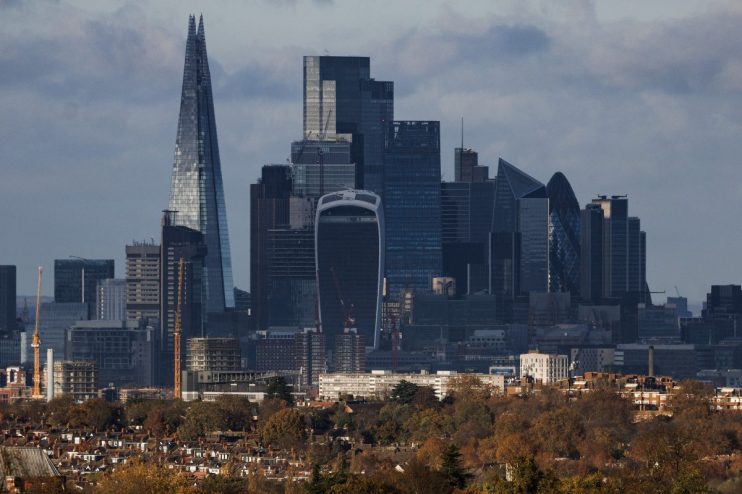
It is 40 years since the Big Bang unleashed London to become the global financial centre that it is, but by hammering the sector with windfall taxes, John Healey risks putting that success at risk, says Chris Hayward
Nigel Lawson’s Big Bang took London from a globally competitive financial and professional services sector to what we measure today as the pre-eminent financial centre of the world. Tomorrow, we mark 40 years since that defining moment that delivered prosperity across the UK in the decades following.
On Wednesday, the Chancellor will deliver his first Budget, which if speculation is to be believed would put at risk the success we as a country have achieved since 1986, by levying higher taxes on banks. In an era increasingly defined by an absolute necessity to deliver growth, this would be the complete and utter wrong move.
Proponents of the measure argue that higher sector taxes have merits on grounds of fairness. Banks have done well due to macroeconomic factors and they must pay their share when people are struggling.
But financial and professional services already contribute 12 per cent of the UK’s taxes, enough to fund our entire defence Budget, with change to spare. That revenue has helped the Labour government deliver their priorities including removing the two-child benefit cap, cutting VAT on energy bills, and capping bus fares at £2.
Stay in the know
Three daily briefings with the key market moves and top business and political stories.
SUBSCRIBE HEREAnd it cannot be fair that banks, which already face higher taxes than their competitors in Amsterdam and Frankfurt – and nearly 20 per cent more than our closest competitor as a financial centre, New York – are expected to shoulder an even greater burden.
Should the Chancellor announce this damaging step, the effects will not only be felt in the City of London, but in every town and city in the UK. Our own analysis shows that the financial and professional services sector employs 2.5m people, two thirds of which are outside of London – and in every Parliamentary constituency.
Such is the importance of London’s success to the rest of the country that firms in the sector with headquarters in the capital directly support 370,000 jobs outside of it. Greater Manchester, which the Prime Minister wants to form into the UK’s second political and economic centre, hosts 59,000 of these jobs.
For international banks, capital is mobile, and in an increasingly competitive world we cannot simply assume that businesses will tolerate an ever-rising tax burden. For domestic banks higher taxes mean less lending to SME’s who form a bedrock of our growth. According to a survey of industry executives by the trade association UK Finance, the “accumulation of individually manageable pressures has, over time, weakened the case for locating additional activity in the UK.”
Financial services are not a cash cow
The City of London Corporation has consistently argued that growth must be at the heart of economic policy. Financial and professional services are not simply another source of tax revenue; they are an engine of investment, productivity and opportunity. When firms thrive, they finance businesses, support innovation and help channel capital into the infrastructure and industries on which the UK’s future prosperity depends. Government should be looking to expand this contribution, instead it risks diminishing it.
The Chancellor must equip the Office for Investment: Financial Services, with the resource necessary to convert investor interest into jobs and investment. Attracting international capital is the key that will make the country thrive.
We must also abolish stamp duty on shares. If we want more firms to list in the UK, we need to make our capital markets more attractive to investors. Removing this tax would help strengthen the case for UK listings, supporting a wider ecosystem of high-paying jobs in legal, advisory and accounting services, while giving British businesses better access to the capital they need to grow.
And instead of piling on additional taxes, we must simplify our regulatory regime. Overlapping reporting requirements create unnecessary burdens for businesses. A more streamlined approach would reduce these costs and improve the UK’s competitiveness by allowing firms to focus on what they do best: creating jobs, backing British businesses and driving economic growth.
It was welcome to see the International Monetary Fund upgrade its UK growth forecast for 2026 to 1.3 per cent last week, while praising the government’s decisive action to reduce the deficit and urging it to stay the course. This is progress we must build on, not put at risk. Forty years after the Big Bang helped transform London’s financial markets, the Chancellor has an opportunity to strengthen the conditions for investment and growth for decades to come. We should not risk harming the goose that lays the golden egg.
Chris Hayward is policy chairman at the City of London Corporation