Typing relentless.com into a browser redirects you to Amazon's homepage. In the summer of 1994, Amazon's founder Jeff Bezos nearly chose Relentless as the permanent name for his fledgling online business, before friends persuaded him that it sounded rather too sinister. He registered the domain anyway. Amazon was eventually chosen because Bezos wanted a name that conveyed vast scale. He planned to build the world's largest bookstore, and ultimately something much bigger – an “everything store”. Relentless, however, captured the philosophy behind the business rather better: to be relentless in its pursuit of efficiency and customer service.
From the beginning, Bezos believed that lower costs should be passed on to customers rather than taken as profit. An online retailer did not need thousands of shops and sales assistants. It could use technology to handle a growing volume of transactions without adding costs at the same rate. The greater the scale, the more efficiently Amazon could spread its fixed costs and reinvest the savings in the customer proposition.
Bezos later gave this self-reinforcing process a name: the Amazon flywheel. The story goes that, in 2001, he sketched the idea on a napkin after an internal retreat with business writer Jim Collins. It set out how lower prices could attract more customers, increasing sales and scale, which in turn would allow Amazon to lower prices further. The sketch was a simple way of capturing a philosophy that had already been shaping Amazon for years, which was that Bezos was prepared to sacrifice profits today if doing so made the customer proposition stronger and the business larger tomorrow.
Start your trial of MoneyWeek today
Get unparalleled financial insight, analysis and expert opinion you can profit from.
Start your trial
Sign up for MoneyWeek’s free twice-daily newsletter.
Join more than 165,000 subscribers and keep yourself informed with latest financial news, insights and expert analysis to help you understand what really matters when it comes to your finances.
Join more than 165,000 subscribers and keep yourself informed with latest financial news, insights and expert analysis to help you understand what really matters when it comes to your finances.
That philosophy was already visible in Bezos's first big decision – what to sell. He arrived at books through logic rather than any particular attachment to literature. He made a list of products that might sell well on the internet and ranked them. Books came out on top because there were millions of different titles in print, far more than even the biggest physical bookstores could stock. There were also only two distributors, making sourcing simple. Finally, books are similar in size and shape, making packaging easier. The internet offered something a conventional shop never could: nearly limitless range. Amazon could be a bookstore that sold more than three million titles rather than merely tens of thousands.
Bezos was leaving a successful career at investment firm D.E. Shaw to build a business selling books using a technology most people had barely heard of. When his parents invested a large part of their savings, he warned them that he thought there was a 70% chance they would lose the money. So he was giving himself a 30% chance of success, which may seem low, but is roughly three times the odds he believed a typical start-up had.
That combination of ambition and clear-eyed acceptance of the possibility of failure is central to the Amazon story. Bezos could envisage a business that would eventually sell almost anything, yet he was prepared to start with one narrow category in which the internet offered an overwhelming structural advantage. But turning the ambition into a reality required money. Bezos spent months pitching the idea to investors and held more than 50 meetings before raising $1 million. The most common question for Bezos was “What's the internet?”, showing just how much of a challenge it was to raise money. His parents made up about $250,000 of that initial funding. Their investment is now worth several tens of billions of dollars.
How Amazon operated from Bezos's home to the stock exchange
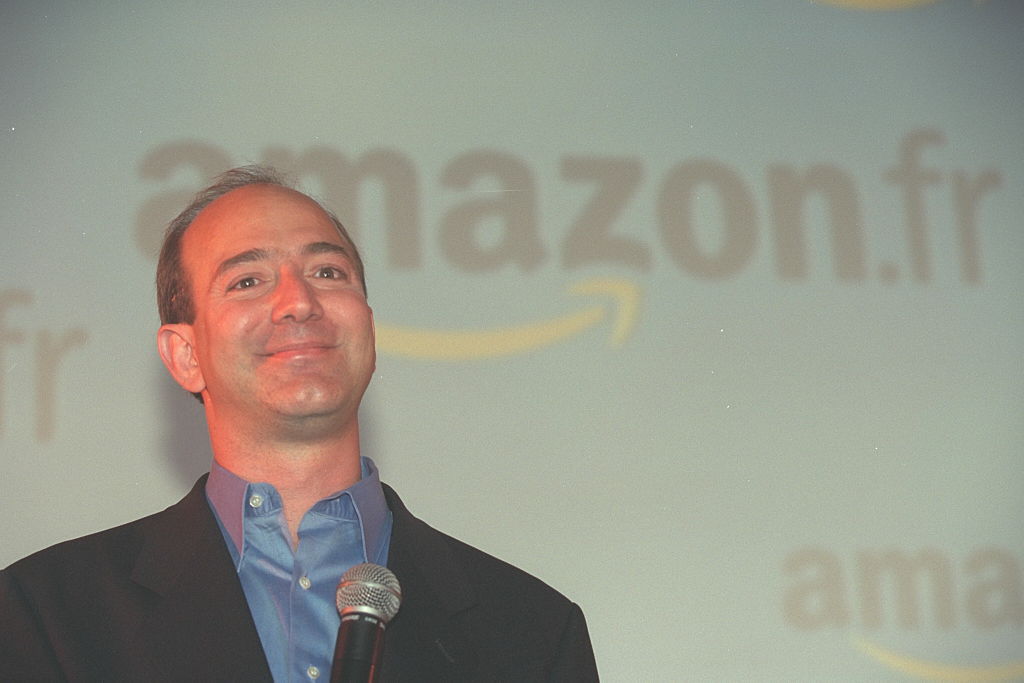
Amazon opened for business in July 1995 from Bezos's home in Bellevue, Washington. The operation was famously frugal, with desks made from doors and a culture in which every dollar mattered. Books also gave Amazon an unusual financial advantage. Wholesalers already held vast catalogues, allowing Amazon to offer far more choice than it could possibly have stocked itself. When a customer placed an order, Amazon could buy the book from its supplier rather than keeping every title on its shelves. More importantly, customers paid Amazon before Amazon had to pay its suppliers, making the business cash-flow positive early on. As the business grew, that helped to finance further growth.
By the time Amazon floated in May 1997, Bezos had decided that shareholders needed to understand how he intended to build the company. His first letter to shareholders was unusually clear and is today considered one of the most important letters to investors ever written. It said Amazon would prioritise long-term growth over short-term profits, measure itself by customer growth and repeat purchases, and make bold investments even when the financial returns were uncertain. If he had to choose between profit today and building a more valuable business for the future, Bezos made clear that short-term profits would be sacrificed.
He also described Amazon as being in “Day 1” of the internet. The phrase captured his belief that the company should always behave like a young business even as it grew, continuing to experiment, invest and adapt rather than becoming defensive. That philosophy soon took Amazon beyond books. It added music and other categories, while the introduction of third-party sellers began to turn the website into a marketplace rather than simply a retailer selling its own inventory.
Although few knew what the internet was in 1994, by the late 1990s investors had become convinced that it would transform the economy. Money poured into young internet companies, many of which had little revenue and no profits. Share prices soared and businesses found it remarkably easy to raise capital simply by promising rapid growth. Amazon benefited from this enthusiasm, but it also got caught up in it, making investments and commercial agreements with other young internet businesses.
Pets.com became the most famous example of what followed. The online pet-supplies retailer floated in February 2000, having been backed by Amazon among others, but collapsed before the end of the year. It had spent heavily trying to acquire customers without first proving it could serve them profitably. Pets.com was not alone. As investors lost faith in dotcoms, funding dried up and hundreds failed. The bubble burst. Amazon survived, but its shares fell from more than $100 at their peak to less than $6.
The experience forced Bezos to confront the difference between growth for its own sake and investment that strengthened competitive advantage. The firm cut costs and became more disciplined, but it did not abandon the long-term approach outlined in the 1997 letter. Instead, it focused its resources on making the core business more useful to customers and more efficient at scale. The easy money had disappeared, but what remained was a growing customer base, a widening selection of products and a business that was starting to prove it could survive without it.
How Amazon expanded into a platform
Surviving the dotcom crash changed Amazon, but it did not alter Bezos's ambition. The company had learned how to process millions of orders, manage warehouses and move goods around the world. Bezos began to see that the technology and systems Amazon had built to run its retail business could have uses far beyond selling products. The idea was bigger than simply finding new things to sell. If Amazon could build common systems that could be used repeatedly, the same investment could support entirely different businesses. Technology developed for one purpose could become the foundation for another. Amazon was beginning to look less like a retailer and more like a platform on which other businesses could be built.
Amazon Web Services (AWS) was the most important example. The origins of AWS lay in a problem Amazon had created for itself. As the company grew rapidly, its engineers were spending too much time building basic technology for individual projects. Teams were repeatedly creating their own storage systems and computing capacity. Amazon needed a better way to provide these services internally. The answer was to build them once, make them reliable and allow developers to access them whenever they needed them. Essentially, they built a centralised pool of high-grade computer infrastructure.
The genius was to realise that Amazon did not have to keep this infrastructure to itself. If its own engineers needed storage and computing power on demand, other developers probably did too. Instead of buying expensive servers, installing them and maintaining them, a start-up business could rent what it needed from Amazon and pay only for what it used.
Amazon began testing this idea in the early 2000s. S3, its online storage service, launched in 2006, followed by EC2, which allowed customers to rent computing capacity. Cloud computing is commonplace today, but 20 years ago the proposition was revolutionary. A small firm could access the same kind of computing infrastructure that previously required a large company to build and maintain it. This was a classic Bezos move. Amazon had spent years investing in infrastructure because it needed it to serve its retail customers. Once that infrastructure existed, Bezos looked for other ways to make it useful. The firm could then spread the cost of its investment across millions of customers rather than simply millions of book orders.
The stock market initially struggled to understand what Amazon was doing. Here was a company best known for selling books, offering computing infrastructure to software developers. Developers understood the attraction more quickly. A couple of engineers working from a flat could rent storage and computing power from Amazon without buying a room full of servers or signing a large technology contract. AWS helped remove one of the biggest barriers to starting and scaling a software company.
The financial potential took longer to become obvious. Amazon did not initially report AWS as a separate business, making it difficult for investors to see how profitable it was. Instead, for a decade the revenue it generated was lumped together in a segment with the vague title of “Other Revenue”. When the company first broke out the figures in 2015, AWS generated $7.9 billion of revenue and $1.9 billion of operating profit, a margin of almost 24%. AWS has since become vastly larger. In the most recent full year, it generated $128.7 billion of revenue and $45.6 billion of operating profit. To put that into perspective, a service created partly because Amazon's own engineers were struggling with their IT infrastructure now produces more operating profit than HSBC, the most profitable company in the UK.
AWS is more than a successful diversification. It provides a clear example of how Bezos thought about Amazon. Build infrastructure to solve your own problem. Make it simple enough that thousands of other people can use it. Then keep investing so the platform becomes more useful as it grows.
Amazon's loyal customer base
The same philosophy drove Amazon Prime, launched in 2005. Until then, online shoppers could choose slow delivery for free, or pay more to get their order quickly. Bezos wanted to remove that choice. Delivery should be both fast and free, with customers paying an annual subscription rather than a fee every time they ordered. There were concerns about the economics of the model, particularly the cost of serving customers who made heavy use of the unlimited two-day delivery.
Bezos went ahead anyway and it changed how customers used Amazon. Once they had paid for Prime, there was less reason to shop elsewhere or think about delivery costs on individual orders. Members tended to buy more frequently and spend more with Amazon. A membership fee could create a more loyal customer base that bought more from the business.
Prime then expanded beyond delivery. Amazon began adding services that made the subscription more valuable, increasing the reasons for customers to remain members. The acquisition of LoveFilm in 2011 helped provide the foundations for its streaming service, while Amazon went on to spend billions producing original television programmes and films and securing live sports rights. These investments made little sense if viewed as a traditional retailer moving into entertainment. They made more sense as a way of increasing the value of Prime. The more useful the subscription became, the harder it was for customers to cancel and the more of their spending Amazon could capture. As Bezos once explained, “When we win a Golden Globe, it helps us sell more shoes”.
The same willingness to disrupt existing businesses appeared elsewhere. When the iPod showed how quickly digital music could replace physical media, Bezos did not simply try to protect Amazon's position as the world's largest bookseller. Instead, he backed the Kindle, allowing Amazon to move into digital books before the threat became impossible to ignore. When third-party sellers began bringing millions of products onto Amazon's marketplace, the firm found another way to benefit from the activity by building an advertising business around the search traffic generated by those products. Advertising has since become a business generating tens of billions of dollars in annual revenue.
AI is the latest opportunity. Amazon is investing heavily, but much of its strategy follows a familiar pattern. AWS provides the computing power, chips and software tools that businesses need to develop and run AI applications, while Amazon is using the technology across its own operations to improve everything from warehouse automation to product recommendations.
Once again, Amazon is building infrastructure that can be used both within its existing businesses and sold to millions of outside customers.
That continuity has become more important since Bezos stepped down as CEO in 2021. His successor, Andy Jassy, had been at Amazon since 1997 and had worked closely with Bezos before building AWS from an internal project into one of the world's most important technology businesses. His job was not to preserve Amazon as it was, but to keep the company at “Day 1”, willing to invest, experiment and change while maintaining the discipline that had made those investments work. The post-pandemic cost-cutting programme showed that this could also mean doing less when Amazon had become too large and inefficient.
Is there an investment case for Amazon today?
That brings the story back to the investment case. Amazon has rarely looked cheap on conventional measures of profits or cash flow. Investors have often had to look beyond the earnings of the current year to understand what the company was building. That remains true today. The company is now so large that the extraordinary percentage returns of its early years are unlikely to be repeated, but it still operates businesses with enormous scale and attractive economics across cloud computing, online retail and advertising. The question for investors is whether Amazon can continue to turn that scale into new sources of growth.
Its history suggests that the answer depends less on predicting the next great technology than on maintaining the system Bezos built. Amazon invests heavily in infrastructure, uses it to improve its existing businesses and then looks for other ways to make those assets useful. AWS is the clearest example, while Prime, advertising and the logistics network show the same willingness to invest today for benefits that may take years to emerge. Jassy's task is to implement that approach at a vastly larger scale.
Relentless may have sounded like an unsuitable name for a fledgling online bookseller in 1994, yet it remains a good description of the philosophy that has driven Amazon ever since. The company has spent three decades lowering costs, improving the customer's experience, reinvesting the savings and finding new ways to use what it has built. For investors, the attraction is not simply the size of Amazon today. It is the possibility that the same process can continue to create valuable businesses that are difficult to envisage in advance.
This article was first published in MoneyWeek's magazine. Enjoy exclusive early access to news, opinion and analysis from our team of financial experts with a MoneyWeek subscription.