Our ETF portfolio has become a little over-exposed to tech, so it's time to introduce a new fund.
“Unprecedented” is a word that gets thrown around too easily, but make no mistake: the AI infrastructure boom that many investors are betting on would be unprecedented in scale – if it materialises.
Total spending based on the announced data-centre pipeline could amount to $10 trillion in the US between 2025 and 2032, according to a paper by Stijn Van Nieuwerburgh of Columbia Business School, which would be 3.6% of GDP. The previous record was the 2.2% of GDP spent on railways between 1870-1890.
Start your trial of MoneyWeek today
Get unparalleled financial insight, analysis and expert opinion you can profit from.
Start your trial
Sign up for MoneyWeek’s free twice-daily newsletter.
Join more than 165,000 subscribers and keep yourself informed with latest financial news, insights and expert analysis to help you understand what really matters when it comes to your finances.
Join more than 165,000 subscribers and keep yourself informed with latest financial news, insights and expert analysis to help you understand what really matters when it comes to your finances.
This doesn't mean that it's impossible, but if expectations are not met, makers of chips and other hardware – who are earning huge profits from an incredibly tight market – may not enjoy as many years of limitless demand as forecasts currently suggest. And the recent jitters in data-centre and memory stocks are a sign that the cost of disappointment could be severe.
The most unexpected downside could be in emerging markets; almost 45% of the MSCI Emerging Markets is now in tech, mostly in hardware suppliers. At present, we have 10% of our MoneyWeek ETF portfolio in the . We also have 5% in WisdomTree True Emerging Markets ETF to tilt to traditional emerging markets (there's no China, Korea or Taiwan in that fund).
I have often said that if we start to worry more about the sustainability of the AI cycle, we need to keep an eye on our ETF portfolio's tech exposure via EMIM. Increasingly, we feel the urge to act on that, so we are going to cut the 10% in EMIM to 5%. This brings our headline emerging-markets exposure to 10%, but the real effect is to bring down the total tech exposure that is hidden in our overall emerging-markets position.
We can still have higher tech exposure if we want, but do so in a way that becomes explicit – eg, hold something like . Or we can dial it down altogether. Either are valid – the key is that we can see more clearly what we have chosen to do.
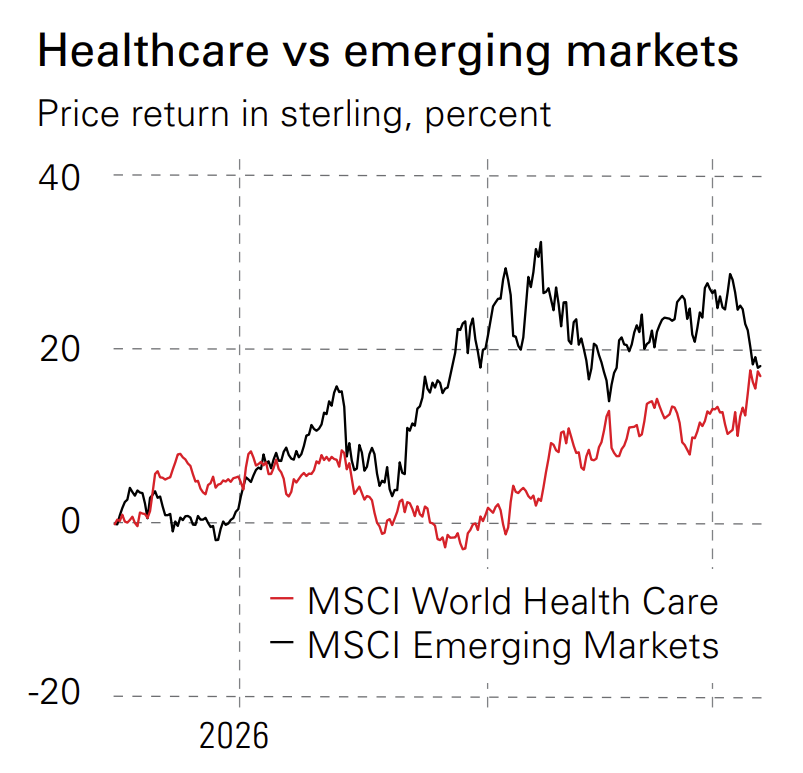
When we look at how different sectors are performing, it is clear the market's top anti-AI or risk-off trade is healthcare. You can see in the chart how it has moved broadly inversely to the tech-influenced markets indemerging-ex over the past year.
A change to the MoneyWeek ETF portfolio
This makes sense. Other defensives such as consumer staples are battling a number of problems, including changing tastes and weaker pricing power. Of course, healthcare is not risk-free either. Medical costs are a political issue. The patent cliff never goes away. Concentration is not low: Eli Lilly is 11% of the sector index. It is not cheap: on a forecast price/earnings ratio of 17.5, the MSCI World Health Care is at the same valuation as the overall MSCI World. However, demographics bode well for demand and earnings should be steady. It is attractive in its own way, as well as diversifying us from AI. So we will add 5% in Xtrackers MSCI World Health Care ETF ) to our portfolio.
This article was first published in MoneyWeek's magazine. Enjoy exclusive early access to news, opinion and analysis from our team of financial experts with a MoneyWeek subscription.