Over 250 films, 33 world premieres, and 88 participating countries… City AM’s culture desk have rounded up the movies we saw at this year’s London Film Festival, which has wrapped for another year.
From legal dramas to terrifyingly prescient films about AI, alternative histories and horrors, here are our thoughts on the releases this year, and when you can see them too, as well as links to the full reviews.
London Film Festival: the movies to book
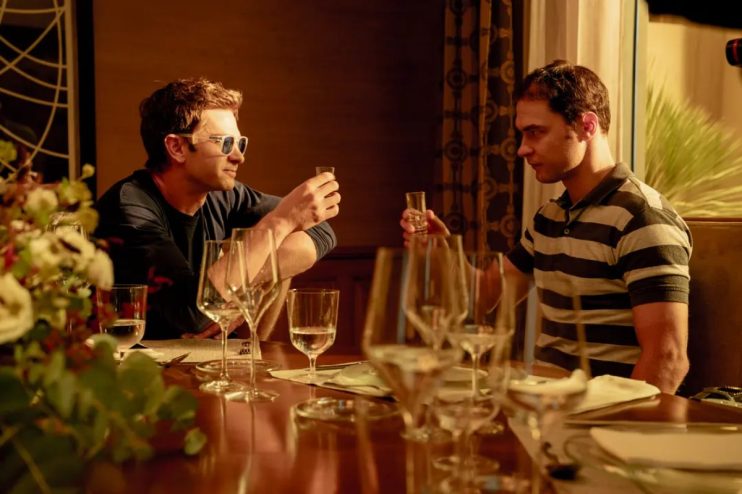
‘Two bumbling hitmen contemplate life and death on an ill-fated holiday’ could be the synopsis of Martin McDonagh’s near-perfect 2008 debut In Bruges, but in this instance it is in fact a synopsis of his new film Wild Horse Nine.
John Malkovich and Sam Rockwell replace Brendan Gleeson and Colin Farrell, each of them demonstrating large enough feet to fill those sizeable shoes. Opening in the American embassy in Chile in 1973, Wild Horse Nine is a kind of alternative history, following two boorish CIA agents, Chris Carlisle (Malkovich) and Lee Chesterfield (Rockwell) as they embark on a mission to Easter Island. Carlisle hints to anyone who will listen that he was involved in some historic event; Chesterfield wishes he’d keep his mouth shut, at least when they’re in public.
McDonagh is a master at combining high and low culture, with jokes about dwarfs playing basketball nested beside a broad Shakespearean sweep about the terrible passage of time and the futility of Western imperialism. I’m not sure it hits quite the same highs as In Bruges or Banshees, but Wild Horse Nine is another sad, funny, moving film by an astute chronicler of the human condition.
Read the full Wild Horse Nine review, in cinemas 6 November
Stay in the know
Three daily briefings with the key market moves and top business and political stories.
SUBSCRIBE HEREIt isn’t typically a film’s duty to push a political agenda, but with Artificial, the biopic of OpenAI co-founder Sam Altman, there is a clear call to action. It is inevitable that people will ask: ‘What can this film do?’
Luca Guadagnino’s film is a disturbing portrait of AI, following the tech entrepreneur Sam Altman, who launched AI chatbot ChatGPT in 2022. Some leading scientists have claimed that the power and potential of these programmes means they could destroy humanity by the end of the 2020s.
A decade ago that would have been the stuff of science fiction movies, but in autumn 2026, Artificial feels terrifyingly prescient.
It is also very good. Andrew Garfield is superb as a psychopathically cocksure Altman. The Spider-Man actor nails how the business leader is impossible to decipher, always full of nervous energy, forever gyrating his hips, casting strange Cheshire cat grins, and glancing his eyes toward the sky. Neither emotionally or physically can you ever quite catch up.
“Rogue” AI agents from OpenAI are already threatening online security with the latest example being a flood of requests from their AI robots causing Wikipedia to temporarily go down. Artificial will surely be the talking point film of 2027, and is the closest look we’ve had at the charismatic, terrifying men at the heart of the AI revolution.
Read the full Artificial review, in cinemas 22 January
The NT at London Film Festival
Despite the rise of stories depicting the epidemic, the horrors of AIDS are still underrepresented in film and TV. Russell T Davies’ It’s A Sin brought freshness by focusing on fleeting moments of joy, and Simon Stone’s Elsinore borrows from that playbook with this magnificent story that follows one victim’s remarkable life.
Andrew Scott will now be celebrated not for his LGBTQ storytelling in All of Us Strangers, but for Elsinore, his focused, magnetic account of the true tale of Ian Charleson, the actor who played Hamlet at the National Theatre in 1989, seven weeks before he passed away from the disease.
Scott, who produces and stars, is devastatingly good as the man who would rather “die of Hamlet than of AIDS,” delivering agonisingly realistic blow-by-blow accounts of the pain Charleson was experiencing. Beresford’s script follows Charleson’s true, remarkable tale, as the actor prepares to take on the sword-bearing Prince of Denmark in spite of regular sicknesses that cause him to be bed bound in the weeks leading to opening night.
Almost 20,000 men died of AIDS in the UK alone before effective treatment came in in the mid-1990s. Andrew Scott is surely due an Oscar for the agonising detail examined in Elsinore, which sketches out a fresh rulebook for a new era of LGBTQ storytelling.
Read the full Elsinore review, in cinemas January 29
In London, only three per cent of reported rapes lead to a suspect being charged. It is a fact so shocking that even people with no interest in the courts recite it. It is the problem that formed the backdrop of Suzie Miller’s very good play of the same name as this film, starring Killing Eve actor Jodie Comer, who in 100 minutes of theatre astonishingly played every character from the court judge to the victim.
Prima Facie follows Tessa Ensler, a criminal defence barrister who has become rich protecting men who are probably guilty of crimes by finding legal loopholes. But an incident in her personal life forces her to rethink the morality of her work.
Wicked’s Cynthia Erivo takes over from Comer for Susanna White’s big screen adaptation, alongside a supporting cast. Erivo is totally arresting as Ensler, bringing the sort of muscular fortitude that demonstrates how this young working class woman would graduate to this kind of job that’s typically reserved for the private schooled elite. She is also brilliant at conveying Ensler’s vulnerability; as she experiences a personal breakdown, Erivo’s angular, cocksure barrister softens, her eyes becoming wide chasms of overwhelm.
A terrific depiction of the injustices so many women face, and the truly harrowing plot.
Read the full Prima Facie London Film Festival review, in cinemas 13 November
Miles Teller and Adam Driver play Jewish brothers Irwin and Gary Pearl as they navigate a sepia-tinged 1980s New York. Irwin is the archetypal blue-collar worker, still a little in thrall to his retired cop brother. So when Gary arrives bearing a too-good-to-be-true business opportunity, Irwin jumps at the chance. The opportunity: helping a bunch of fresh-off-the-boat Russians with their oil disposal business in the dilapidated Brooklyn docks. What could go wrong?
The rest of the movie follows the brothers as they attempt to escape from the snare of these terrifying gangsters, the noose tightening at every turn.
Paper Tiger is at its heart a family drama. The Pearl brothers are both rivals and co-dependents; both have it all, yet they are willing to risk everything for a chance to get rich quick. The American Dream, baby!
The leads are predictably brilliant and the pacing is propulsive. There’s a sense of inevitability as these characters rattle towards their fates to the sound of ticking clocks and thumping machinery. It’s strange, then, that Gray’s ending feels borrowed from made-for-TV cop dramas, the final scenes visually stunning but narratively flat.
Read the full review for Paper Tiger review, in cinemas 5 February
More from London Film Festival…
Our obsession with looking – and remaining – young is stretched to its horrifying logical conclusion in slick Thai horror film Inherit.
The Manasvanich family is in crisis over a chemical leak at their factory, which may or may not be causing birth defects in the local population: the last thing they need is an unexpected visit from a long-lost octogenarian relative. But when Grandma Woranart turns up, she is no little old lady – she’s a bombshell in eveningwear who makes everyone both horny and uncomfortable.
It doesn’t take long for everyone to realise that Grandma has sold her soul to an ageless centipede demon, and soon the chase is afoot: can the Manasvaniches exorcise this evil spirit before she claims another vessel – and will this secretive family survive intact?
It’s a smart and scary satire of our obsession with flawless skin, one that will feel as relevant in Birmingham or Bristol as it will in Bangkok.
Read the full Inherit review, in cinemas TBC
Duncan Jones returns with Rogue Trooper, a lovingly crafted if strangely earnest love letter to pulp science fiction adapted from the cult-classic British anthology comic 2000 AD.
It’s rendered in computer animation and the first thing you notice is just how much Rogue Trooper looks like a video game, with an animation style that will be familiar to anyone who’s picked up a controller in the last ten years or so.
The first half of the film is essentially one long action sequence: the soldiers take out a fortress-sized tank, abseiling away as the thing explodes. Or they have a firefight amid a field of hallucinogenic gas, performing stealth take-downs while silhouetted against a dramatic psychedelic backdrop.
Its real strength, however, lies in its voice acting. Aneurin Barnard is wonderfully likeable as the lead and he’s supported by talent including Matt Berry (brilliant as always), Reece Shearsmith, Diane Morgan (slightly wasted), Jemaine Clement and Sean Bean. It’s briskly entertaining from start to finish and infused with such breathless adoration for science fiction that it’s hard not to be won over.
Read the full Rogue Trooper review, in cinemas TBC
British-Finnish production Nightborn revels in all the terrible functions of the human body: the blood and the guts and the secretions that we pretend are not the very fabric of our being. Around this theme Nightborn crafts a darkly funny allegory exploring the tribulations of new motherhood, with a particular focus on postnatal depression and postpartum psychosis.
We follow young-ish couple Saga and Jon (Seidi Haarla and Rupert Grint) as they arrive in a new home, having relocated from England to a huge, dilapidated house in her native Finland. But after Saga conceives their child during a spirited woodland romp, things quickly go south.
Nightborn’s biggest achievement is how effectively it places you in the mind of this struggling mother – we share her visceral dislike of her repulsive baby, with its guttural, animal-like cries and its clawed little fingers. Everybody else, however, thinks the baby is fine. A little too hairy, maybe, but mostly fine. So why does it crave human blood, wonders Saga?
There are also glimpses of the film Nightborn could have been but Bergholm seems unwilling to fully commit, instead leaving us alone for minutes at a time with a screaming infant, which isn’t much fun at all.
Read the full Nightborn review, which is in cinemas 30 October
The London Film Festival returns in October 2027